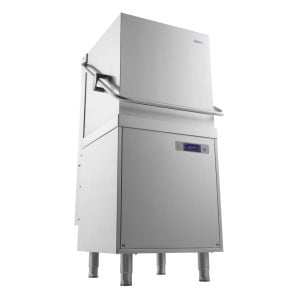
Pass-through dishwashers are larger commercial warewashing machines with a lift-up hood, designed for higher throughput than undercounter models, suiting busy hotels and high-volume pub, restaurant and commercial kitchens. Baskets-per-hour throughput and whether the site’s electrical supply can support the three-phase power larger models often require decide the choice.
Pass-through dishwashers typically process 40-70+ baskets per hour with cycle times around 60-120 seconds, considerably faster than undercounter machines, and commonly run on a three-phase electrical supply, with single-phase versions typically needing a dedicated 16-30A connection rather than a standard 13A plug. Water consumption is generally 2-3 litres per cycle, and most machines include a built-in break tank to comply with water regulations preventing backflow contamination. Warranties of 1-2 years are standard, extending further on tanks and boilers from leading manufacturers.
When does a kitchen need a pass-through dishwasher instead of an undercounter model?
Once daily covers regularly exceed what an undercounter machine can process in the available service window — typically above 100-150 racks a day — a pass-through model’s higher baskets-per-hour throughput becomes necessary to avoid a backlog of dirty ware.
Do pass-through dishwashers need a three-phase electricity supply?
Larger pass-through models usually do require three-phase power, though compact single-phase versions exist — these typically still need a dedicated 16-30A connection, so checking the electrical supply before ordering avoids installation delays.
Brands typical of this category include Winterhalter, Hobart and Classeq, all strongly represented, commonly specified for hotel and high-volume commercial kitchen warewashing.
If you have any questions about our products, then please get in touch.