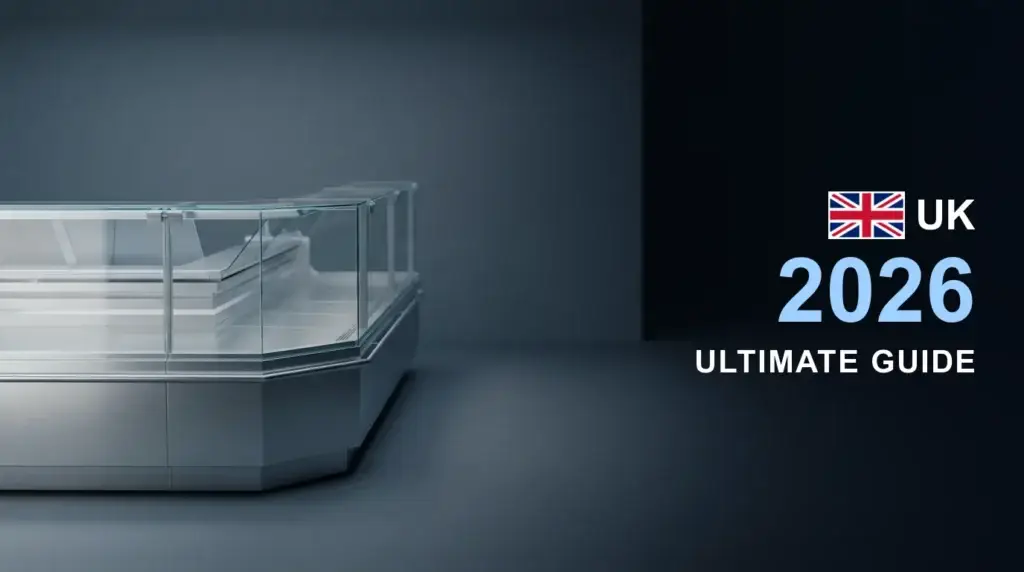
Choosing the Right Display Counter for Your Shop Layout: The Complete UK Guide (2026)
A display counter is the single hardest-working piece of equipment in a deli, café, farm shop, bakery or convenience store — it is simultaneously your refrigeration, your merchandising, your service point and your queue management system. This guide covers the four decisions that determine whether a counter earns its keep: serve-over versus multideck versus countertop format, how customer flow and sight lines dictate position, how to split refrigerated, ambient and heated zones along one run, and the footprint maths — plus the legal 8°C chilled display maximum that applies to every refrigerated counter in England and Wales.
- The 8°C rule: chilled food on open display must be held at 8°C or below in England and Wales (Food Safety and Hygiene (England) Regulations 2013, retained Reg 852/2004). Best practice target is 5°C. Hot display food must be held at 63°C minimum.
- Three counter formats: serve-over (staff-served, glass-fronted, deli/butchery/fishmonger), multideck (self-service, open-front or glass door, grab-and-go), countertop (impulse zone at the till, cakes and drinks). Most shops need two of the three.
- Sight-line height: product displayed between 750mm and 1,500mm from floor level sells fastest — the “buy zone”. Serve-over decks sit naturally in it.
- Aisle width: keep a minimum 1,200mm clear customer aisle in front of any counter — more where a queue forms alongside browsing customers.
- Footprint maths: a serve-over needs its display length plus ~900mm of staff corridor behind it — a 2,000mm serve-over consumes about 3.6m² of floor. Multidecks need no rear corridor.
- Glass doors cut energy: a glass-door multideck typically uses 30–40% less electricity than an equivalent open-front unit. The Zoin Cervinho 1000mm hinged-door multideck (£2,299.76 + VAT) is the door-fitted route in our range.
- Polar U-Series deli counters: flat-glass display fridges in three widths — 285Ltr (£1,849.31 + VAT), 385Ltr (£2,199.77 + VAT) and 485Ltr (£2,349.26 + VAT) — all integral plug-in units on a standard 13A supply.
- Year-one energy cost: an integral display counter drawing an average 0.5 kW around the clock uses ~4,380 kWh/year — about £1,183 at £0.27/kWh. Running cost matters as much as ticket price.
Display counters are bought backwards in most UK shops: the owner buys the counter they like, then tries to design the shop around it. The result is a queue that blocks the door, a serve-over nobody can see past, or a multideck fighting sunlight in the window. This guide runs the decision in the correct order — service style, then customer flow, then temperature zones, then footprint — covering the sight-line rules, the legal display temperatures, open-front versus glass-door energy economics, and the exact Polar and Zoin counters we stock.
This guide is for the trade buyer fitting out or refitting a retail food space — deli owner, farm shop manager, café operator, convenience retailer, butcher, bakery owner or multi-site procurement lead. Domestic display cabinets and one-off event hire are out of scope. Browse the full Craven Cooling commercial display range when ready.
Table of Contents
Decision 1: Serve-Over vs Multideck vs Countertop
The format question comes first because it is really a staffing question. A serve-over counter needs a member of staff behind it whenever the shop is open — that is a wage cost of £22,000+ per year full-time, dwarfing the hardware. A multideck sells unattended. A countertop unit works the till queue. Decide how your customers will be served before you decide what serves them.
| Format | How it sells | Best for | Watch-outs | Typical footprint |
|---|---|---|---|---|
| Serve-over counter | Staff-served across a glass-fronted refrigerated deck; customer points, staff portion and wrap | Delis, butchers, fishmongers, cheese counters, fresh patisserie — anywhere theatre and advice add margin | Needs staff whenever open; needs a 900mm rear working corridor; slowest format at peak | Counter length + 900mm behind |
| Multideck (open-front) | Self-service from tiered shelves; customer grabs and goes | Sandwiches, drinks, dairy, ready meals, grab-and-go lunch trade | Highest energy draw of any format; air curtain disturbed by draughts and doorways; needs night blind | Unit depth ~600–770mm, no rear corridor |
| Multideck (glass door) | Self-service behind hinged or sliding doors | Drinks, dairy, anywhere energy cost matters more than a half-second of shopping friction | Door swing needs aisle clearance; handles smear and need cleaning hourly at peak | Unit depth + door swing ~450mm |
| Countertop display | Impulse purchase at the till point — cakes, desserts, cold drinks at the moment of payment | Cafés, sandwich bars, farm shop till points | Small capacity; blocks till sight lines if over 500mm tall at counter level; check counter can take 60–90 kg | ~600–900mm of existing counter |
| Ambient counter / dry display | Unrefrigerated merchandising — bread, whole cakes, jars, gifting | Bakeries, farm shops — anything shelf-stable at room temperature | No temperature control, so no high-risk foods — cream cakes and cooked meats are illegal here | As built — no services needed |
Most successful small food shops run a hybrid: a serve-over as the margin-making focal point, a multideck for the grab-and-go trade that will not queue, and a countertop unit at the till for the impulse dessert.
Decision 2: Customer Flow and Counter Position
Where the counter sits matters more than which counter you buy — a counter positioned against the customer flow gets ignored no matter what is in it.
The first 1.5–2 metres inside the door is dead space — customers register almost nothing placed there. Keep the hero counter out of it and place the first display where the eye lands once the customer has slowed down.
The route from door to till is your money line. The serve-over’s glass face should run alongside it so customers browse its whole length without deciding to; a counter they must seek out loses the casual browse entirely.
If the queue crosses the main aisle, browsing stops shop-wide for the whole rush. Run it alongside a wall or the countertop impulse display — a queue standing next to cold drinks and traybakes is a queue that spends.
An open-front multideck holds temperature with a curtain of chilled air that draughts and direct sun destroy. Site open-front units at least 2 metres from external doors and out of sunlight, or specify glass doors — the Zoin Cervinho tolerates a difficult shopfront position far better.
The last 900mm before payment is the highest-conversion space in the shop. A compact flat-glass unit like the Polar U-Series 285Ltr here — desserts, cold drinks, cream cakes — converts queueing time into basket growth.
Decision 3: Sight Lines and Counter Height
Customers buy what they can see without effort: the band from roughly 750mm to 1,500mm above the floor is where product sells fastest, and counter selection flows from keeping margin lines inside it.
| Height band | Retail name | What sells here | Counter implication |
|---|---|---|---|
| Above 1,500mm | Stretch zone | Signage, lightweight dry goods, branding | Multideck top shelf — keep light and low-risk |
| 1,100–1,500mm | Eye level | Highest-margin lines, new products, hero items | Multideck shelves 2–3; top deck of a serve-over |
| 750–1,100mm | Touch level | Core sellers, everyday staples, meal deals | Serve-over main deck sits here — its natural advantage |
| Below 750mm | Stoop zone | Bulk, multipacks, heavy items, slow lines | Multideck bottom shelf and base wells |
Counter height controls the human interaction too. A serve-over glass edge at 1,200–1,300mm lets staff and customer talk naturally while keeping food in the touch-level band; much higher and children cannot see the deck at all — a real takings issue for ice cream and patisserie. Flat glass like the Polar U-Series gives an open, straight-down view and easy cleaning; curved glass gives a wraparound view of tall displays. And never let one counter hide another: keep tall multidecks (1,900–2,000mm) against walls and low counters in the middle ground — “tall at the edges, low in the middle” makes shops feel bigger, browse better and shrink less.
Decision 4: Refrigerated, Ambient or Heated Zones
A food-to-go shop rarely needs one temperature — it needs three, side by side, and the law treats each differently.
Refrigerated (≤8°C)
Legal max 8°C — target 5°C- Cooked meats, cheese, cream cakes, sandwiches, salads
- Serve-over, multideck or countertop fridge
- Daily temperature log — twice a day minimum
- Load only to the marked load line
Ambient
No temperature control- Bread, whole cakes without fresh cream, jars, dry goods
- Cheapest display — no energy, no services
- Never for high-risk chilled foods
- Ideal for the stretch zone and gifting displays
Heated (≥63°C)
Legal min 63°C hot-hold- Pies, sausage rolls, rotisserie, hot food-to-go
- Heated display merchandiser or hot cupboard top
- 2-hour rule applies once below 63°C
- Site away from refrigerated units’ air intake
Frozen display
−18°C storage standard- Ice cream, frozen ready meals, frozen bakery
- Display chest or upright glass-door freezer
- Highest energy per litre of any format
- See our chest vs upright freezer guide
The zoning rule that matters: every integral counter dumps condenser heat into the room, and a heated display parked against a multideck’s air intake forces the fridge to fight the pie warmer all day. Leave at least 300mm between heated and refrigerated cabinets, keep grilles unobstructed, and never box an integral unit into joinery without ventilation cut-outs.
Zone order matters too: chilled meal deal first, heated impulse second, till-point dessert last. Browse the heated display equipment range and ambient display counters to build the warm and dry zones of the run.
Decision 5: Footprint Maths and Services
Counters fail surveys more often than they fail spec sheets. Before ordering, run the numbers on floor space, door swings and electrics.
Then check the services. Every counter in this guide is an integral plug-in unit on a standard 13A socket — no pipework, no specialist installation — but integral units need breathing room: honour the manufacturer’s ventilation clearances (typically 100–150mm at the grilles) and give each counter its own switched socket, never a shared multi-way adaptor. Finally, measure the route in, not just the destination: check the unit’s packed dimensions against the narrowest door between kerb and final position before ordering.
UK Price Tiers — July 2026
Display Counters We Stock
Four stocked units covering the deli counter and grab-and-go roles. All are integral plug-in units on a standard 13A supply, covered by our 2-year parts warranty across the UK and Ireland. Prices July 2026, + VAT.
- 285Ltr flat-glass display fridge
- Integral unit — standard 13A plug-in
- Flat glass front for clean sight lines and easy cleaning
- Suits till-point and short-run deli display
- 2-year parts warranty UK & Ireland
The compact end of the U-Series — right-sized for a café or farm shop till zone. Flat glass keeps product visible from standing height and wipes down in seconds.
View UA060 →- 385Ltr flat-glass display fridge
- Integral unit — standard 13A plug-in
- Extra display width over the 285Ltr for a full deli face
- Suits sandwich bars and deli counters
- 2-year parts warranty UK & Ireland
The one most shops actually need — enough glass frontage for a proper lunchtime range without the footprint of a full serve-over. The 385Ltr carries a full sandwich, salad and dessert offer.
View UA061 →- 485Ltr flat-glass display fridge
- Integral unit — standard 13A plug-in
- Widest glass face in the U-Series range
- Suits busy delis and high-street food-to-go
- 2-year parts warranty UK & Ireland
The full-width option where the chilled counter is the main event — only £149.49 more than the 385Ltr for another 100 litres of display. Confirm your aisle still clears 1,200mm before committing.
View UA062 →- 1,000mm-wide multideck, black finish
- Hinged glass doors — typically 30–40% lower energy than open-front
- Self-service grab-and-go format
- Tolerates siting near doorways far better than open-front
- 2-year parts warranty UK & Ireland
The self-service workhorse: a metre of vertical grab-and-go display with hinged doors that hold the chilled air in — visible on the electricity bill every quarter. Allow for door swing in the aisle plan.
View UA055-100 →In this guide ↓
- Key facts and 2026 UK reference numbers
- The decisions that matter on purchase day
- UK price tiers and what each tier buys you
- Stocked products at Craven Cooling — verified specs and prices
- Year-one total cost of ownership worked example
- UK compliance checklist
- Layout planning checklist
- FAQ — eight buyer-objection questions answered
Energy Cost & Year-One Running Budget
Display refrigeration runs 24 hours a day, 365 days a year, which makes running cost a first-order buying criterion, not a footnote.
Two habits protect that number: night blinds on any open display, and a monthly brush-and-vacuum of the condenser grille — the cheapest energy-efficiency measure in retail. Our servicing team covers planned maintenance if you would rather contract it out.
UK Compliance Checklist for Display Counters
Retail display sits under the same food hygiene framework as the kitchen, plus a few counter-specific traps.
England and Wales law sets 8°C as the chilled maximum, with limited defined exemptions. Run at a 5°C target so a heatwave never puts you in breach, log temperatures twice daily and keep the records — see food.gov.uk business guidance.
Heated display merchandisers must hold food at 63°C minimum — below that the 2-hour rule starts running. Probe hot cabinets at the coldest shelf position, not the hottest.
Under retained Reg 852/2004, raw meat on display must be physically separated from cooked and ready-to-eat lines — separate counters or a solid divider, separate utensils, and a strict handwash-between protocol. Cross-contamination at the counter is a top-five EHO enforcement issue in mixed delis.
Loose foods at a serve-over need allergen information available and signposted; prepacked-for-direct-sale items need full ingredient labelling with allergens emphasised. Build ticket-edge labelling into the counter plan from day one.
Each counter on its own socket, no daisy-chained adaptors, visual checks for damaged plugs at open-up, and periodic PAT testing with certificates on file.
Glass and handles daily, shelves and decks weekly with food-safe sanitiser, gaskets checked monthly, condensate drains kept clear — a blocked drain puddles under the counter and grows exactly the biofilm an inspector looks for.
Shop Layout Planning Checklist
Work through this with a tape measure before any order is placed.
-
✓
Walk the customer route and mark the money line Walk to the till the natural way and chalk the route. The serve-over glass face belongs alongside it; the impulse unit at the end of it.
-
✓
Check 1,200mm clear aisle in front of every counter Measure with true depth including handles, and any glass-door swing at 90°. Under 1,200mm, browsing stops.
-
✓
Confirm 900mm staff corridor behind any serve-over Two staff must be able to pass each other at peak. Less than 900mm and your Saturday service speed halves.
-
✓
Map sunlight across the day Direct sun raises product temperature and fades packaging. Check the site at 9am, midday and 4pm — or specify glass doors for the exposed spot.
-
✓
One dedicated 13A socket per refrigerated unit Positioned so the plug is reachable without moving the counter. No multi-way adaptors on refrigeration, ever.
-
✓
Verify ventilation clearances against the manual Typically 100–150mm at intake and exhaust grilles. Boxing an integral counter into joinery without cut-outs cooks the compressor.
-
✓
Measure the delivery route, kerb to position Narrowest door width, corridor turns, any steps. Check against the unit’s packed dimensions, not its installed dimensions.
-
✓
Plan the queue path and put product beside it The queue should run along a wall or the impulse display, never across the browsing aisle. Queueing customers with product at touch level spend more.
All Display Counter Options We Stock or Source
| Model / Range | Format | Best role | Services | Trade price + VAT |
|---|---|---|---|---|
| Polar U-Series 285Ltr UA060 ★ | Flat-glass deli display fridge | Till-point & compact deli | 13A plug-in | £1,849.31 |
| Polar U-Series 385Ltr UA061 ★ | Flat-glass deli display fridge | Sandwich bar & deli counter | 13A plug-in | £2,199.77 |
| Polar U-Series 485Ltr UA062 ★ | Flat-glass deli display fridge | High-street food-to-go | 13A plug-in | £2,349.26 |
| Zoin Cervinho Multideck 1000mm UA055-100 ★ | Glass-door multideck | Grab-and-go self-service | 13A plug-in | £2,299.76 |
| Curved glass serve-over counters | Staff-served serve-over | Deli, patisserie theatre | 13A plug-in typical | Quoted to spec |
| Meat & fish display counters | Specialist serve-over | Butchery, fishmonger | Spec dependent | Quoted to spec |
| Ambient display counters | Unrefrigerated display | Bakery, dry goods, gifting | None | Quoted to spec |
★ = Stocked at Craven Cooling. Category ranges stocked or sourced to specification. Prices July 2026, + VAT.
For upright glass-door merchandising, see the glass door fridge retail chill guide. Weighing frozen display options? Read chest vs upright display freezers. For the hot side of the run, see the heated display cabinet grab-and-go guide, and for the glass shape decision, curved vs flat glass serve over counters.
Choose a display counter by working through service style, customer flow, temperature zones and footprint — in that order. Serve-over counters suit staffed theatre (deli, butchery, patisserie) but consume their length plus a 900mm staff corridor and a wage; multidecks sell unattended and fit small floors; countertop units convert the till queue. Position counters on the natural walking line, hold product in the 750–1,500mm buy zone, and never park an open-front multideck opposite the entrance or in direct sun — glass doors also cut energy use by 30–40%. Chilled display must legally hold 8°C or below in England and Wales (target 5°C); hot display must hold 63°C or above; raw and ready-to-eat lines must be separated at the counter. Keep 1,200mm of clear customer aisle in front of every unit and give each counter its own 13A socket with ventilation clearance. Craven Cooling stocks the Polar U-Series flat-glass deli display fridges — 285Ltr UA060 at £1,849.31 + VAT, 385Ltr UA061 at £2,199.77 + VAT, 485Ltr UA062 at £2,349.26 + VAT — and the Zoin Cervinho 1000mm glass-door multideck UA055-100 at £2,299.76 + VAT, with serve-over, meat, fish and ambient counters stocked or sourced to specification. Call 01792 732702 or email sales@cravencooling.co.uk with your floor plan; all units carry a 2-year parts warranty, and the Swansea showroom runs side-by-side comparisons.