
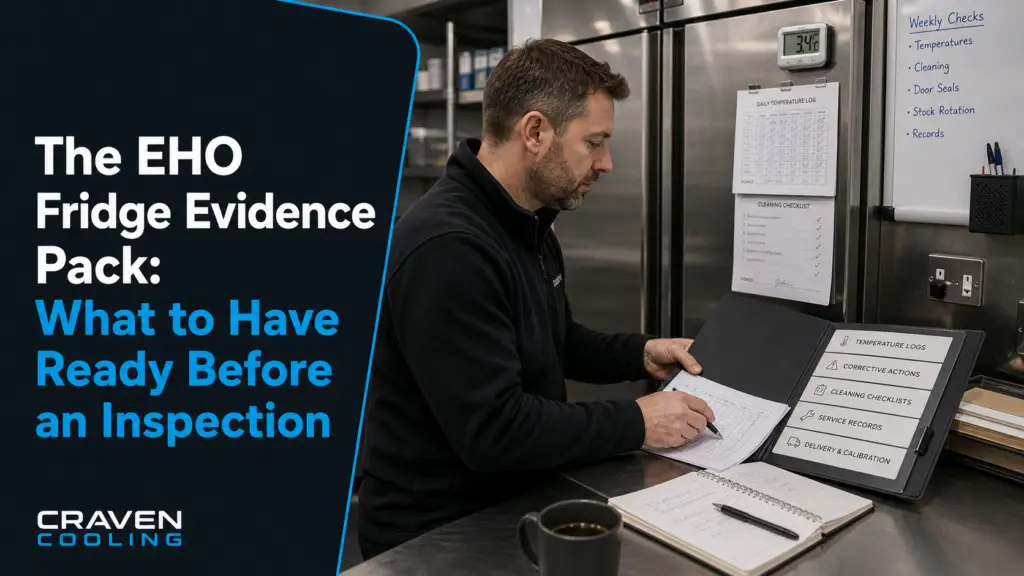
The EHO Fridge Evidence Pack: What to Have Ready Before an Inspection
An Environmental Health Officer does not only look at the fridge display. They look for a food safety system that is being used. For refrigeration, that means temperature records, corrective actions, stock labels, cleaning evidence and proof that faults were handled properly.
- Logs need action: a bad reading without a note is an unanswered question
- Labels matter: date coding supports stock rotation and traceability
- Cleaning is evidence: coil, seal and internal cleaning should not be invisible
- Fault notes help: service history explains recurring problems
- SFBB supports routine: documented checks are part of a practical food safety system
Craven already has HACCP temperature and date-coding guides. This article turns those pieces into one inspection-ready evidence pack for busy operators.
Table of Contents
Keep Temperature Logs With Corrective Actions
A daily log proves very little if nobody records what happened when a reading was wrong. Add a short action field: moved stock, called engineer, checked door seal, cleaned condenser, discarded food or rechecked after service.
Link Date Labels to Stock Rotation
Date coding helps staff prove that chilled food is not only cold but controlled. Labels should match the site’s food safety procedure and be legible to the person actually using the fridge at speed.
- ✓Use consistent labels. Changing wording between teams creates confusion.
- ✓Train the opening check. First person in should spot old stock before prep starts.
- ✓Keep the system simple. A perfect label scheme that staff ignore is not evidence.
Add Cleaning and Maintenance Notes
Door seals, handles, shelves, drains and condensers all affect safe refrigeration. A cleaning schedule shows routine; a service note shows escalation. Keep both with the temperature records rather than scattered in email.
Make the Folder Easy to Hand Over
Whether digital or printed, the pack should be obvious: current week, previous records, corrective actions, service visits, cleaning rota and staff training notes. If only one manager understands it, the system is too fragile.
| Evidence item | What it proves |
|---|---|
| Temperature log | Routine monitoring |
| Corrective action | Staff respond to problems |
| Cleaning record | Hygiene is scheduled |
| Service note | Faults are escalated |
The Manager Check Before You Spend Money
Before committing to a repair, replacement or new piece of equipment, step back and write a short operational brief. What happens in the busiest hour? Which member of staff notices the problem first? Which product, service point or customer experience is affected? Which records prove the pattern? That brief is often more useful to Craven Cooling than a vague request for “a bigger fridge” or “a better machine”.
For The EHO Fridge Evidence Pack: What to Have Ready Before an Inspection, the strongest buying decision comes from matching equipment to the way the site actually trades. A pub, café, restaurant, care home and convenience store can all own the same category of kit and need different answers because their peak periods, staffing, stock movement and inspection pressure are different.
| Manager question | Why it improves the brief |
|---|---|
| When does the issue appear? | Separates peak-load problems from all-day faults. |
| Who works around it? | Shows the labour cost and training risk. |
| What record proves it? | Turns opinion into evidence: logs, wastage, service notes or sales gaps. |
| What would success look like? | Defines whether the answer is safer food, faster service, lower waste or more sales. |
Build the pack
Tools and templatesOfficial context
Food safety managementCraven Cooling view: The strongest evidence pack is not thick; it is current, readable and connected to real actions. EHOs want to see a system that staff actually use.
An EHO fridge evidence pack should include temperature logs, corrective actions, date labels, cleaning records, service notes and staff routine evidence. Keep it simple enough for the whole team to use.


