
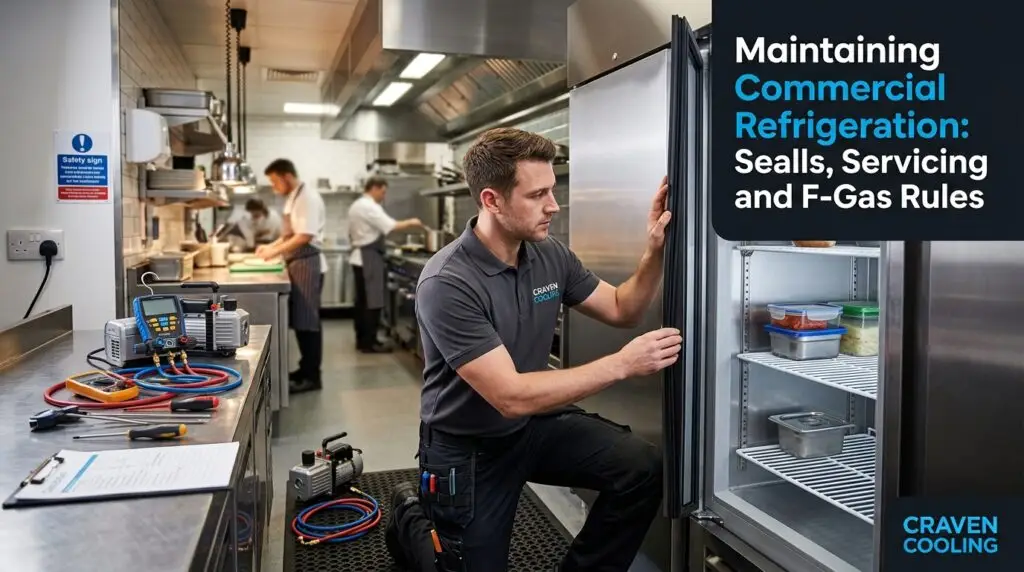
Maintaining Commercial Refrigeration — Seals, Servicing and F-Gas Rules
A commercial fridge or freezer that is cleaned, sealed and serviced holds temperature on a third less energy and lasts twice as long as one that is run to failure. The maintenance that keeps it there comes down to four routines and one legal duty: keep the door seals soft and sealing, keep the condenser coil clear of dust, keep the evaporator and drain free of ice and blockage, log temperatures so drift is caught early — and, because every unit contains fluorinated refrigerant, meet the F-Gas Regulation duties for leak checks, records and certified engineers. This guide sets out each routine with the frequencies, the failure signs, and the numbers that decide whether a dirty coil is costing you £50 a year or £400.
- Dirty condenser penalty: a coil choked with dust and grease makes the compressor work harder — a badly fouled condenser can lift running cost by 20–30% and is the single most common cause of a unit “not getting cold enough” that is not actually broken.
- Door seals are consumables: a perished, torn or magnet-weak gasket lets warm moist air in continuously — the compressor never stops, ice builds, and the interior sits warm. Seals typically need replacing every 2–4 years depending on duty and door traffic.
- F-Gas leak checks by charge: under the retained F-Gas Regulation (EU 517/2014), equipment containing 5 tonnes CO2-equivalent or more of refrigerant must be leak-checked at least every 12 months (more often above higher thresholds). Most single reach-in cabinets sit below that; larger systems and cold rooms often do not.
- Certified engineers only: anyone installing, servicing, repairing or decommissioning equipment containing F-Gas must hold the relevant F-Gas certification, and the business must use a certified company for that work. This is a legal requirement, not best practice.
- Records are a duty: for equipment above the leak-check threshold, you must keep records of refrigerant type and quantity, checks, top-ups and recovery — retained for at least five years and available to the regulator.
- Temperature logging catches drift early: a fridge creeping from 3°C to 6°C over a fortnight is a maintenance signal — a blocked coil, a tired seal, a failing fan. Logged, you act before it hits the 8°C legal ceiling; unlogged, you find out when stock spoils.
- Planned beats breakdown: a planned maintenance visit (coil clean, seal check, gas and electrical check, drain flush) typically costs a fraction of an emergency call-out plus a van of spoiled stock — and it is scheduled at a quiet time, not mid-service.
- Ventilation kills compressors: a cabinet crammed against a wall or boxed into a hot corner cannot reject heat. Leave the manufacturer’s clearance (typically 50–100mm+) around the condenser or the compressor cooks itself over months.
Refrigeration is the equipment most kitchens notice only when it fails — and by then the choice is an emergency call-out, a skip of spoiled stock, and a scramble to borrow fridge space. Almost all of that is avoidable. The mechanisms that make a fridge run warm or fail early are few, visible and slow: a clogged coil, a tired seal, an iced evaporator, a slow refrigerant leak. Catch them on a routine and you convert a catastrophic failure into a five-minute job. This guide covers each in the order they matter, with the F-Gas legal duties that sit over the top of any UK commercial refrigeration system.
It is written for the people who own and run the kit — publicans, hoteliers, care-home caterers, shop owners, contract caterers and kitchen managers responsible for a fleet of cabinets, cold rooms and prep counters. It is an educational maintenance guide, not a product pitch: where a job needs a certified engineer, that is said plainly. When a unit is beyond economic maintenance, browse the storage fridge range at Craven Cooling or ask about a servicing contract.
Table of Contents
- Step 1: Door Seals — Care, Testing and Replacement
- Step 2: Condenser and Evaporator Cleaning
- Step 3: Temperature Logging and Early Drift Detection
- Step 4: F-Gas Regulation — Leak Checks, Records and Engineers
- Step 5: Planned Maintenance vs Breakdown
- Step 6: The Energy Cost of Poor Maintenance
- Frequently Asked Questions
- Related Buying Guides
Extra running cost a badly fouled condenser coil can add versus a clean one
CO₂-equivalent charge at or above which annual F-Gas leak checks become a legal duty
Typical door-seal replacement interval on a hard-worked commercial cabinet
When a fridge stops holding temperature, the instinct is to assume a failing compressor or lost gas. Far more often the condenser — the coil at the back or underneath that rejects heat — is packed with dust, flour and grease. Air cannot pass through it, heat cannot escape, the compressor runs continuously and still loses the battle. A ten-minute brush-and-vacuum every month restores it. Left for a year in a flour-heavy bakery or a fryer-side location, the same coil can push running cost up by a quarter and cook the compressor to an early death. Check the coil before you call it broken.
How often a condenser coil should be checked and cleared in a busy kitchen
Step 1: Door Seals — Care, Testing and Replacement
The door gasket is the cheapest component on a commercial fridge and the one that quietly costs the most when it fails. A sound magnetic seal holds a continuous airtight line around the door; a perished one lets a thin stream of warm, humid kitchen air leak in every second the fridge is closed. The compressor responds by running longer and harder, ice forms where the moist air meets cold metal, and the interior temperature creeps up — all from a strip of rubber costing a fraction of the call-out it triggers.
| Symptom | What it means | Action |
|---|---|---|
| Seal feels hard or cracked | Rubber has perished with age and heat — it no longer springs back to seal | Replace the gasket; hardened seals cannot be revived |
| Paper-slip test fails | A sheet of paper shut in the door pulls out with no resistance — the seal is not gripping there | Check for distortion; replace if it fails in several places |
| Ice forming near the door frame | Warm moist air is leaking in past the seal and freezing on contact | Inspect and replace seal; defrost and dry the frame |
| Tears, splits or missing corners | Physical damage from trolleys, GN pans or heavy door use | Replace — a torn gasket cannot be patched reliably |
| Sticky, mouldy or soiled seal | Spills and grease trapped in the folds; a hygiene issue and a wear accelerator | Clean weekly with warm soapy water; dry the folds |
Seal care is mostly cleaning and gentleness. Wipe the gasket weekly with warm soapy water and dry the folds — trapped food and grease degrade the rubber and breed mould. Do not slam doors or let trolleys catch the seal. When a gasket does fail, most are a clip-in or screw-in replacement that a competent maintenance person can fit, though a hinge alignment issue that is chewing seals needs an engineer. Keep a spare gasket for your busiest units on the shelf — a torn seal on a Friday night is a two-day wait for a part you could have had in stock.
Before you book an engineer for a fridge that “won’t get cold” or “ices up constantly”, check the seal and the coil first. A perished gasket and a clogged condenser between them explain the large majority of warm-running and over-icing complaints on units that are mechanically fine. A five-minute seal test and a coil clean can save an unnecessary call-out — and if the unit is still warm after both, you have ruled out the two cheapest causes and the engineer’s visit is better targeted.
Step 2: Condenser and Evaporator Cleaning
A refrigeration system moves heat from inside the cabinet to the kitchen air using two coils. The evaporator (inside, cold) absorbs heat from the food and air; the condenser (outside, at the back or underneath) dumps that heat into the room. Both must stay clean and clear to work. The condenser fouls with airborne dust, grease and flour; the evaporator ices up when drainage or airflow fails. Neglect either and the whole system labours.
It is the finned coil that rejects heat — usually behind a grille at the back, or underneath the cabinet on undercounter and prep units, often near a fan. On integral units it lives inside the housing; on remote systems it is outside or on the roof. Know where yours is before it fails.
Switch off and unplug (or isolate), then vacuum the coil fins with a soft brush attachment, working with the fins not across them so you do not bend them. A stiff paintbrush and a vacuum clears most build-up. In flour-heavy or fryer-side locations, do this fortnightly, not monthly.
A seized or dust-clogged fan means the coil gets no airflow even when clean. Confirm it turns freely and runs when the compressor is on. A fan that hums but barely moves is a cheap part failing — flag it for the engineer before the compressor pays for it.
A thick ice layer on the internal evaporator insulates it and blocks airflow. Auto-defrost units usually manage this; if ice keeps building, the defrost cycle, heater or drain has failed. Manually defrost, dry thoroughly, and if it returns quickly, get the defrost system checked.
Meltwater from the evaporator runs to a drain and evaporation tray. A blocked drain overflows inside the cabinet or freezes solid, and standing water is a hygiene and corrosion problem. Flush the drain line and clean the tray on the same schedule as the coil.
Coil cleaning, seal checks, drain flushing and defrosting are all owner-level maintenance. The sealed refrigerant circuit — the pipework, compressor, expansion valve and the gas itself — is not. Opening it, topping up refrigerant, or brazing a joint is F-Gas-certified work by law, and doing it without certification is both illegal and dangerous. If a job involves the refrigerant, it stops being maintenance and becomes an engineer’s job. Clean the coil; leave the gas to the ticket-holder.
Step 3: Temperature Logging and Early Drift Detection
Maintenance is reactive when you fix what has already broken and preventive when you catch what is about to. Temperature logging is the tool that shifts you from the first to the second. A cabinet does not usually fail overnight — it drifts. A seal tires, a coil fouls, a fan slows, and the holding temperature creeps up over days or weeks. Logged, that creep is a warning you act on at 5°C; unlogged, you meet it at 9°C with a fridge full of spoiled stock.
| What the log shows | Likely cause | Maintenance action |
|---|---|---|
| Slow creep up over 1–2 weeks | Fouling condenser or tiring seal reducing efficiency gradually | Clean coil, test seal — the two cheapest fixes first |
| Sudden jump, stays high | Fan failure, defrost fault, or refrigerant loss | Isolate stock, book a certified engineer |
| Wide swings through the day | Overloading, door left open, hot food loaded, or thermostat fault | Check loading and doors first; then controls |
| Fine overnight, warm at peak | Undersized for the load, or blocked airflow when full | Review loading and clearance; consider capacity |
| Freezer climbing above -18°C | Iced evaporator, seal failure, or defrost drain blockage | Defrost, dry, clear drain; check seal |
Record the display air temperature of every cold unit at least twice a day — opening and close is the usual rhythm — and note anything that reads high. The display shows air temperature; when a reading looks wrong, spot-probe the core of actual food to confirm whether it is a genuine problem or a brief door-opening spike. A short air spike self-corrects; a rising trend is the unit asking for attention. Keeping the log also does double duty for HACCP: retained Regulation (EC) 852/2004 expects temperature control to be monitored and recorded, and an EHO treats an unrecorded check as one that never happened.
A cabinet’s built-in thermometer can drift just like any other. A unit reading 4°C on the door while the middle shelf sits at 8°C is a food-safety failure hiding behind a reassuring display. A service visit confirms the display matches reality and the unit holds temperature under load. Craven Cooling provides fridge and freezer servicing and calibration across the UK & Ireland — the check that turns a trusted number into a verified one.
Step 4: F-Gas Regulation — Leak Checks, Records and Engineers
Every commercial fridge, freezer and cold room contains a fluorinated refrigerant (an F-Gas) circulating in a sealed circuit. Because these gases are potent greenhouse gases, their handling is controlled by the retained F-Gas Regulation (EU 517/2014), which sits over any UK refrigeration system. It creates three duties an operator must understand: use certified engineers, leak-check equipment above a size threshold, and keep records. None of it is optional, and the responsibility rests with the business that owns and operates the kit.
| Charge (CO₂-equivalent) | Typical equipment | Minimum leak-check frequency |
|---|---|---|
| Below 5 tonnes | Most single reach-in fridges and undercounter cabinets | No mandatory periodic leak check |
| 5 tonnes and above | Larger systems, some cold rooms, multi-cabinet packs | At least every 12 months |
| 50 tonnes and above | Sizeable cold rooms, central packs, big remote systems | At least every 6 months |
| 500 tonnes and above | Industrial-scale refrigeration | At least every 3 months, plus leak-detection system |
Thresholds and frequencies per the retained F-Gas Regulation. Fitting a fixed leak-detection system where required can halve some check intervals. Your refrigeration engineer confirms which band a given system falls into from its refrigerant type and charge.
Any work on the sealed refrigerant circuit — installation, servicing, leak checking, repair, refrigerant recovery, decommissioning — must be done by an F-Gas certified engineer, and the business must engage a certified company. Ask to see certification; a legitimate refrigeration firm produces it without hesitation.
If a system holds 5 tonnes CO₂-equivalent or more, it must be leak-checked at the frequency for its band. The engineer calculates the CO₂-equivalent from the refrigerant type and kilograms of charge — you do not have to work it out, but you do have to make sure the check happens.
For units requiring leak checks, keep records of refrigerant type and quantity, quantities added or recovered, dates and results of checks, and the certified engineer’s details. Retain them for at least five years and have them available if the regulator asks.
If a leak is found, it must be repaired without undue delay and the system re-checked (typically within a month) to confirm the repair held. A leaking system loses refrigerant, runs poorly, and breaches the duty to prevent emissions — three reasons to act on it fast.
When a unit is scrapped, its refrigerant must be recovered by a certified engineer, not vented. Do not send a live-charged fridge to a general skip — arrange proper decommissioning and recovery as part of replacement.
F-Gas responsibilities fall on the operator of the equipment, meaning the business running it day to day, not just whoever installed it. If you inherited a cold room with a plant room full of pipework when you took over the lease, its leak-check and record duties are now yours. The practical answer is a servicing contract with a certified firm that schedules the checks, keeps the records to the legal standard, and hands you a compliant paper trail — so the duty is met without you tracking refrigerant charges yourself.
Step 5: Planned Maintenance vs Breakdown
There are two ways to run refrigeration: fix it when it breaks, or maintain it so it does not. Breakdown maintenance feels cheaper because you only pay when something goes wrong — until you add up the emergency call-out premium, the out-of-hours rate, the spoiled stock, the lost service, and the shortened equipment life from running units into the ground. Planned maintenance costs a predictable, modest sum on a schedule and heads off most of that.
Owner Daily / Weekly
In-house, no engineer
- Log temperatures twice daily
- Wipe and check door seals
- Clear spills and standing water
- Watch for ice build-up
- Note anything reading warm
Owner Monthly
In-house, no engineer
- Vacuum the condenser coil
- Check the condenser fan spins
- Flush the condensate drain
- Paper-slip test every seal
- Confirm clearance around units
Engineer Scheduled
Certified, planned visit
- Deep coil and system clean
- Electrical and control checks
- Refrigerant / F-Gas leak check
- Defrost system and drain check
- Records to the legal standard
Breakdown Only
The costly default
- Emergency / out-of-hours rates
- Spoiled stock write-off
- Lost service and covers
- Shortened equipment life
- Fails at the worst moment
The sensible model layers all three: owner-level daily and monthly routines that cost nothing but time, a scheduled engineer visit once or twice a year (more for cold rooms and heavy fleets) that covers the F-Gas duties and the jobs that need certification, and breakdown cover as the safety net rather than the strategy. A planned visit is booked for a quiet Tuesday morning; a breakdown chooses the busiest Friday night. That timing difference alone justifies the schedule.
Craven Cooling offers planned refrigeration servicing for single cabinets, prep counters, cold rooms and full fleets — coil cleans, seal and control checks, F-Gas leak checks and record-keeping to the legal standard, and calibration so your displays tell the truth. Call 01792 732702 or email [email protected] with your equipment list for a maintenance schedule and quote.
Step 6: The Energy Cost of Poor Maintenance
Maintenance pays for itself twice — once in avoided breakdowns and once in the electricity bill. Refrigeration runs 24 hours a day, 365 days a year, so a small percentage penalty from a dirty coil or tired seal compounds into real money. Here is what a neglected condenser costs on a typical double-door upright fridge.
Multiply that across a fleet and the number gets serious: a mid-size kitchen with six cold units all running dirty coils can be burning £700–£900 a year in avoidable electricity, plus the accelerated wear that brings replacement forward by years. Tired door seals add their own slice — a fridge whose compressor never rests because warm air leaks in continuously is running the same penalty by a different route. The maintenance that fixes both costs a brush, a vacuum, and a spare gasket.
A cabinet needs to reject heat, and it can only do that if air can move around the condenser. Pushed hard against a wall, boxed into a cupboard, or sited next to a fryer or oven, a fridge recirculates its own hot exhaust and works permanently against itself — higher bills, higher interior temperatures, and a compressor cooking itself over months. Leave the manufacturer’s clearance (commonly 50–100mm or more) around the condenser, keep units out of hot corners, and never store boxes on top of an integral unit’s vents. Free cold air in equals cheaper, longer-lived refrigeration.
The Refrigeration Maintenance Checklist
Run the daily and weekly items in-house; schedule the engineer items with a certified firm. Every line prevents a bigger bill later.
-
✓
Temperatures logged twice daily
Fridges ≤8°C (running 1–4°C), freezers ≤-18°C — recorded at open and close, anything warm flagged and acted on. -
✓
Door seals wiped and tested
Cleaned weekly, dried in the folds; paper-slip tested monthly; torn or hardened gaskets replaced, spares held for key units. -
✓
Condenser coil vacuumed monthly
Isolated and brushed clear of dust, grease and flour — fortnightly in flour-heavy or fryer-side locations. -
✓
Condenser fan and drain checked
Fan spins freely and runs with the compressor; condensate drain flushed and evaporation tray cleaned. -
✓
Ice build-up defrosted
Evaporator kept clear of insulating ice; recurring ice investigated as a defrost, seal or drain fault. -
✓
Clearance and ventilation maintained
Manufacturer’s air gap around condensers kept clear; units out of hot corners; vents never boxed in or stacked over. -
✓
F-Gas leak checks and records current
Systems above 5 tonnes CO₂-equivalent leak-checked to schedule by a certified engineer; records kept five years. -
✓
Certified engineer visit scheduled
Planned service once or twice a year covering system clean, electrical and control checks, and F-Gas duties.
family-run, with a Swansea showroom and a 2-year parts warranty across the UK & Ireland. We service and calibrate commercial refrigeration, handle F-Gas leak checks and records with certified engineers, and supply replacement cabinets when a unit is beyond economic repair — one contract, one point of contact.
Book Refrigeration Servicing
Call Sales — 01792 732702
Related Buying Guides
Choosing the right cabinet in the first place makes maintenance easier — start with our how to choose commercial refrigeration for your kitchen guide. Planning a cold room? See the modular cold room installation and sizing guide, which covers the same F-Gas circuit at larger scale. Match the box to the job with how to choose a commercial fridge, and keep the whole cold chain in check with our HACCP temperature checks and monitoring guide.
Maintaining commercial refrigeration comes down to four owner-level routines and one legal duty. Keep door seals soft, clean and sealing — they are consumables replaced every two to four years, and a perished gasket masquerades as a failing fridge. Vacuum the condenser coil monthly (fortnightly in flour or fryer environments): a fouled coil can add 20–30% to running cost and cook the compressor. Defrost the evaporator and clear the condensate drain so ice and blockage do not build. Log temperatures twice daily so drift is caught at 5°C, not discovered at 9°C with spoiled stock. Over all of it sits the retained F-Gas Regulation (EU 517/2014): all work on the sealed refrigerant circuit must be done by an F-Gas certified engineer, systems holding 5 tonnes CO₂-equivalent or more must be leak-checked at least annually (6-monthly above 50 tonnes), and records of refrigerant, checks and top-ups must be kept for five years — with the duty resting on the operator. Never open the refrigerant circuit yourself. Planned maintenance layered over daily routines beats breakdown call-outs on cost, timing and equipment life, and a dirty coil alone can waste around £149 a year per cabinet at £0.27/kWh. Craven Cooling (Swansea showroom) services and calibrates refrigeration, handles F-Gas leak checks and records with certified engineers, and supplies replacements: 01792 732702 or [email protected].
Frequently Asked Questions
▼
▼
▼
▼
▼
▼
▼
▼


