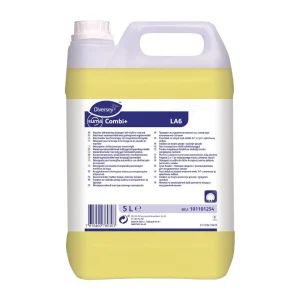
Why this rinse aid earns its place
This rinse aid is the finishing step in the wash cycle, not the wash itself — it's dosed into the final rinse of a dishwasher or glasswasher to speed up drying and leave every glass, plate and piece of cutlery sparkling rather than spotted. It's built for kitchens and bars running through-put fast enough that streaky, slow-drying glassware is a real service problem.
Fed through built-in or external auto-dosing equipment (it's designed to work alongside Cleenol Washaid dosing kit), the concentrated formula ensures crockery and glassware dry rapidly to a streak-free, sparkling finish rather than sitting damp in the rack. An anti-scaling agent is built into the formula specifically to stop scale building up in the rinse section over time, which matters for keeping dosing lines and jets clear and the machine running efficiently.
It's formulated for soft-to-medium water conditions, so it suits most UK mains supplies without needing a harder-water specialist product, and it's biodegradable to EU standards. The blue colour makes it easy for staff to identify at a glance among other chemicals in the wash-up area, and the 2×5 litre pack gives a sealed backup container ready to swap in the moment the first runs dry.
COSHH: six habits of safe chemical use
Control of Substances Hazardous to Health — the routine every commercial kitchen and cleaning cupboard is expected to run.


SDS
Read the label and the manufacturer’s safety data sheet — the pictograms tell you what you are holding.

Who could be harmed, and how badly? Judge likelihood against severity before anyone opens the cap.

Eliminate or substitute first, engineer and organise next — PPE is the last line, never the first.

Keep the controls working: check ventilation, dosing equipment and storage stay as they should be.


Everyone who uses it knows the hazards, the correct dilution and the PPE — before the first shift, not after.

Products and processes change. Reassess when they do, and keep the record that proves it.