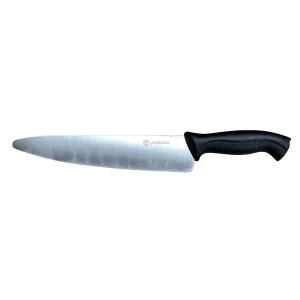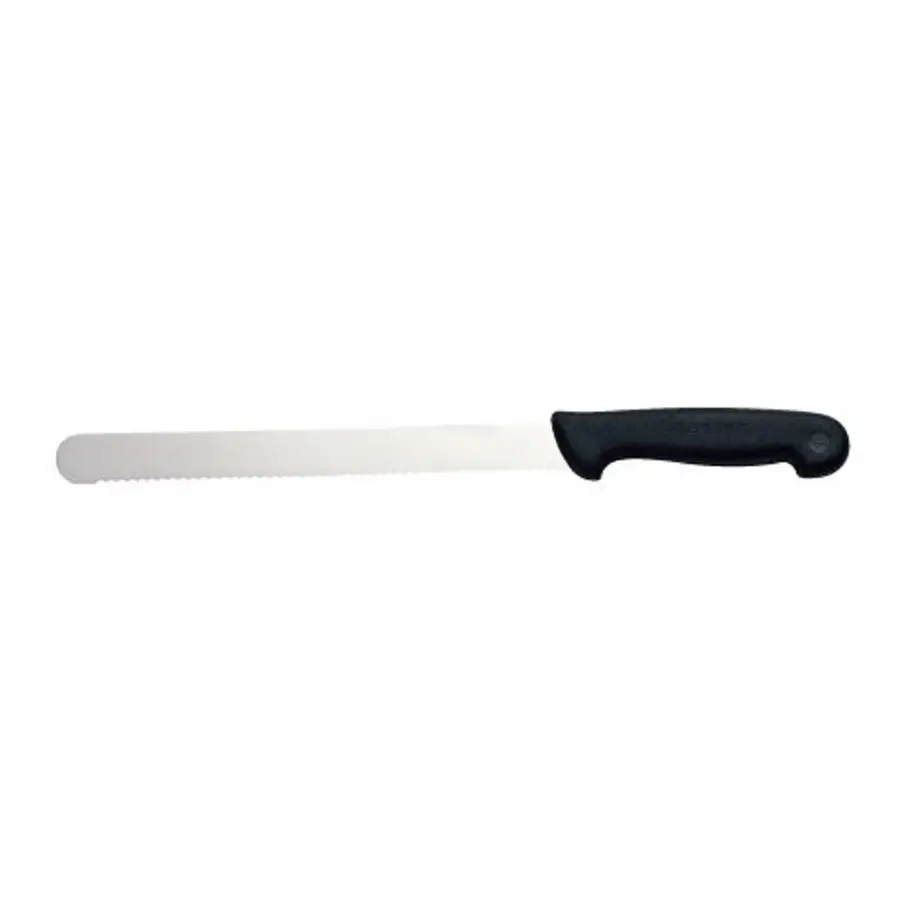
Why this knive earns its place
A bread knife cuts by sawing rather than pressing, and that is why blade length matters more here than on almost anything else on the rack. A 10in blade goes through a bloomer or a filled baguette in one clean draw. Anything shorter and you are working back and forth over the same cut, which tears the crumb, drags the filling sideways out of the sandwich and leaves a ragged face on every slice. The same logic applies to anything with a hard shell over a soft middle — a crusty roll, a pavlova, a fridge-cold tomato — where a pressing cut collapses the inside before the outside gives way.
Stainless is the standard blade steel on a commercial bench because it survives the environment rather than because it is glamorous: constant washing, acid from tomato and citrus, and being put down wet on a stainless surface, which will happen whatever the policy says. Handle colour is the other half of the story. In the kitchen colour system, the food-group colours are allocated to raw and high-risk work, and black sits outside them — which is why a black-handled knife tends to be the general-purpose one on the rack rather than tied to a single station. Keep it in a rack or a guard rather than loose in a drawer, where the edge gets knocked against everything else in there.