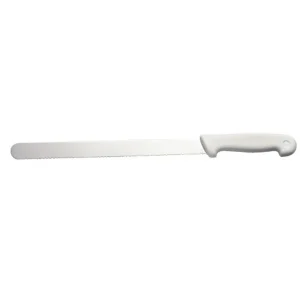

Why this knive earns its place
A paring knife is the one that never touches a board. At 3in the blade is worked in the hand, drawn towards the thumb, with the other fingers steering whatever is being turned against it: peeling a shallot, taking the eyes out of potatoes, trimming sinew and fat off a trim, hulling soft fruit, tidying the edge of something that has already been portioned. It is the shortest working blade in a kitchen and it does more hours than most, because everything that comes back off the board and needs finishing goes through it. Length is the point — a longer blade cannot be controlled that close to the fingers.
The rounded tip is a deliberate trade and worth understanding before you order. A pointed paring knife does its coring and piercing with the last few millimetres, so that work moves to another blade; what is left is everything the edge does, which is the bulk of paring. In return you get the small knife that can be issued across a brigade, put in a student's hand, or carried out to an off-site job without being the thing that punctures a hand, a glove or a bag when it is used at speed in close quarters. Stainless steel is the right build for work this wet and acidic — fruit, alliums and raw trim all day, washed off between jobs without pitting or staining. Black is outside the HACCP colour codes of red, blue, yellow, green, brown and white, so it reads as general-purpose rather than being tied to a station.