
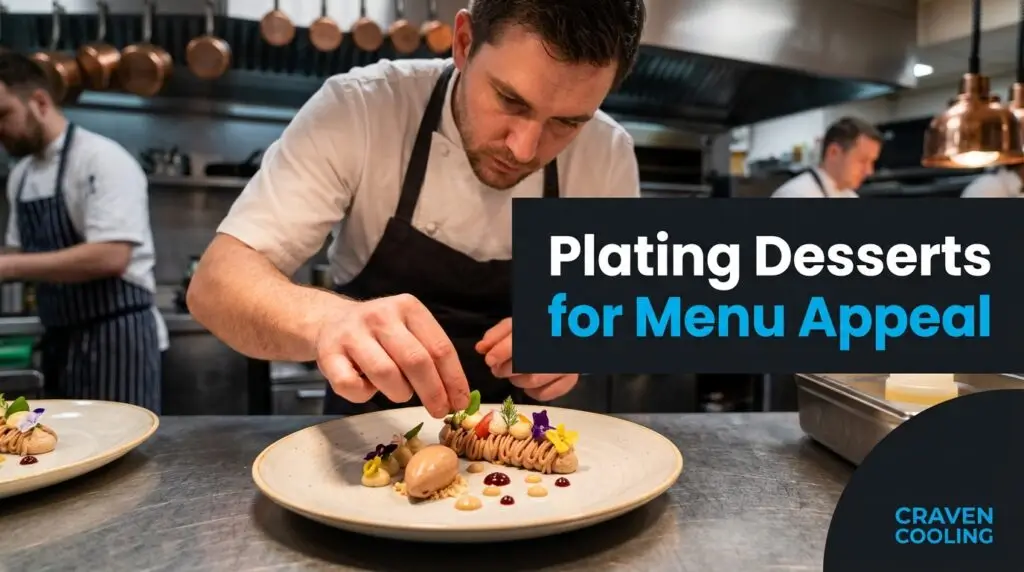
Plating Desserts for Menu Appeal
A well-plated dessert is your highest-margin plate and the last thing a guest photographs before they pay, so how it looks decides whether the whole table orders one. Six repeatable principles do the work: leave negative space, plate to the geometry you chose, build height with an odd number of components, use slate for drama where the food suits it, drag sauce with intent, and pair hot with cold. Get them right on crockery that carries them, and dessert becomes a 75–80% gross-profit course servers actually sell. This guide covers the plating decisions, the vessels, and the GP and service-speed maths that turns appeal into money.
- Dessert is your best-margin course: food cost runs 20–25% of menu price, giving 75–80% gross profit — far ahead of a main. Appeal moves the attach rate.
- Negative space is not wasted space: filling roughly 60% and leaving 40% clear reads premium; covering the whole plate reads cheap. The rim is the frame.
- Coupe vs rim geometry changes the composition: a coupe suits loose, saucy plating; a wide rim frames a tight composition. Choose the geometry first.
- Odd numbers and height sell: three quenelles beat two or four, and a component 60–80mm tall photographs far better than a flat plate. Guests calibrate value on height.
- Slate and stone create instant drama for petit fours, cheese and rustic plating — dark surfaces make pale desserts pop. Not for hot, saucy plates that pool.
- Temperature contrast is the cheapest wow: a warm sponge with cold ice cream doubles perceived craft at almost no food cost — if the cold element is plated last.
- Speed protects the appeal: a sub-90-second build holds the pass at peak. Pre-portion and pre-freeze quenelles so a commis can execute in under a minute.
- Craven Cooling stocks Churchill, Steelite and Rene Ozorio dessert tableware — coupe plates, rim plates, slate bowls and slate trays. Browse the dessert & starter plates range or compare at the Swansea showroom. Call 01792 732702.
Dessert is the course most kitchens under-invest in and most guests judge hardest. By the time the menu arrives, the guest is deciding whether to extend the meal — and the plate on the next table is doing your selling. Composition drives attach rate, attach rate drives the highest-GP revenue on the card, and the crockery decides whether it reads across a dim room.
It is written for the trade buyer and section chef: pastry sections standardising a spec, operators lifting attach rates, hotel F&B teams running banqueting at volume, and caterers plating off-site where speed matters as much as looks. When you are ready to spec the vessels, browse the Craven Cooling dessert and starter plates range.
Table of Contents
- Decision 1: Plate Shape & Geometry — Coupe vs Rim
- Decision 2: Negative Space & Composition
- Decision 3: Height, Odd Numbers & the Focal Point
- Decision 4: Slate, Stone & Material Drama
- Decision 5: Sauce Technique & Temperature Contrast
- Decision 6: GP Economics, Upsell & Service Speed
- UK Price Tiers — July 2026
- Dessert Tableware We Stock
- The Dessert GP Calculation
- Best-Practice Plating Workflow
- Pre-Service Plating Checklist
- Frequently Asked Questions
- Related Buying Guides
Gross profit on a typical plated dessert — the highest-margin course on most menus
Food-to-space ratio that reads premium — fill 60%, leave 40% clear
Target build time per dessert to protect the pass at peak
Nothing on your menu spreads by sight like a well-plated dessert. When a plate lands looking crafted and photogenic, the neighbouring table’s attach rate jumps. Appeal is a margin decision, not vanity: the highest-GP course is also the one most sensitive to how it looks. Spend the effort where the return is biggest.
The attach-rate uplift a photogenic dessert drives versus a flat, over-filled plate
Decision 1: Plate Shape & Geometry — Coupe vs Rim
Every composition is built inside the geometry of a plate, so the plate is the first decision. The two dominant shapes — coupe and wide-rim — pull the design in opposite directions, and the wrong one fights the dessert all night.
| Geometry | Stocked example | Best for | Watch-outs |
|---|---|---|---|
| Coupe plate — no rim, gentle well, food to the edge | Churchill Alchemy Balance Coupe 165mm — £54.85 + VAT /6 | Contemporary, loose, sauced plating; the full surface is the canvas | No rim to catch a running sauce — a loose sauce reaches the edge and drips on the carry |
| Wide-rim plate — defined flat rim, central well | Churchill Alchemy Jardin 202mm — £114.66 + VAT /12 | Framed, tight central compositions; the rim is a built-in border that makes a precise dessert look gallery-like | The rim shrinks the usable area — plate to the well and keep it spotless |
| Slate / stone bowl or tray — dark, textured, edgeless | Steelite Pompeii Slate Bowls 140mm — £43.21 + VAT /6 | Rustic, sharing and petit-four plating; dark ground for contrast (see Decision 4) | Not for hot, saucy desserts that pool; wrong for a precise fine-dining plate |
Diameter matters as much as shape. Too large and a portion drowns; too small and it looks cramped. For à la carte desserts, 200–230mm is the sweet spot — room for negative space without empty china. The Churchill Alchemy Jardin at 202mm sits in that band. Smaller 140–170mm bowls and coupes suit pre-desserts, mousses and tasting-flight elements.
Decision 2: Negative Space & Composition
The most common dessert-plating mistake is filling the plate. A crowded plate reads cheap and anxious; deliberate empty space reads confident and expensive — and it costs nothing.
The 60/40 Rule
Fill 60%, leave 40% clear
- 60% food, 40% clean reads premium
- Empty space frames the food and directs the eye
- Over-filling signals value-menu, not fine dining
- Works on coupe and rim alike
Keep the Rim Clean
The frame stays empty
- The rim is the frame — never plate into it
- Wipe every fingerprint and sauce fleck
- A smeared rim undoes a perfect plate
- Carry plates by the rim, not the well
Off-Centre Placement
Break the bullseye
- Off-centre placement creates movement
- Dead-centre plating looks canteen-like
- Use the thirds — hero on an intersection
- Let the space fall on one side
One Clear Hero
Everything supports the star
- Every plate needs one dominant component
- Sauces, crumbs and garnish are supporting cast
- Competing heroes confuse the value read
- Scale the hero to justify the price
Composition is also about flow. Plate along a diagonal or gentle arc: the hero anchors one end, a drag of sauce sweeps toward it, garnishes step down the line. That movement makes a still photograph feel dynamic.
A lonely mint sprig, a dusting of icing sugar, or a random berry does not rescue a weak plate — it dates it. Every element must earn its place with flavour, texture or colour. If a garnish only fills space, remove it.
Decision 3: Height, Odd Numbers & the Focal Point
Flat plates photograph flat. The two cheapest ways to add perceived craft are to build vertically and work in odd numbers — pure technique, no ingredient cost, and the difference between a home-cook plate and a professional one.
| Principle | What to do | Why it works | Watch-out |
|---|---|---|---|
| Build height | Aim for a hero 60–80mm tall — stacked, leaned or propped | Height casts shadow and depth; the plate reads sculpted, not spread | Structure must survive the carry — anchor tall elements in a base of cream, crumb or sauce |
| Odd numbers | Plate in 1, 3 or 5 — three quenelles, not two or four | Odd groupings feel dynamic; even numbers look static | Beyond five, count stops reading — switch to a scatter |
| Vary the levels | Lean a tuile, prop a wafer, tilt the hero against a base | Diagonal lines read as movement and skill | Everything at 45° looks contrived — one bold angle |
| Repetition with rhythm | Three sauce dots descending in size; three berries stepped | Rhythmic repetition guides the eye and looks composed | Identical spacing looks mechanical — vary it |
The focal point is where height and odd numbers combine. A classic execution: a warm fondant stood proud, an ice cream quenelle against it (cold-against-warm), a drag of sauce leading the eye in, three garnishes descending. That is one hero, height, odd-number rhythm and negative space — every rule at once, none adding cost.
A cleanly pulled quenelle of ice cream, cream or mousse reads as instant skill and adds 40–50mm of height with zero extra ingredient. Pre-freeze them on a lined tray during prep so service is place-and-go. Two warmed spoons and a firm base ice cream give the cleanest three-sided quenelle.
Decision 4: Slate, Stone & Material Drama
Colour and material are half the drama, and nothing delivers instant contrast like a dark slate or stone surface. A pale panna cotta, a scoop of vanilla or a row of macarons leaps off dark slate in a way it never does off white china — transforming the photograph that sells the next order.
Slate Bowls
Dark ground, contained
- Pre-desserts, mousses, sharing sweets
- Dark interior makes pale desserts pop
- Contains a loose or scooped dessert with drama
- Steelite Pompeii 140mm — £43.21 + VAT /6
Slate Trays & Boards
The sharing stage
- Petit fours, mignardises, sharing boards
- Square or round to suit the concept
- Rene Ozorio Wabi Sabi 285mm — £369.73 + VAT /6
- Reads premium and photographs beautifully
When Slate Works
Play to its strengths
- Pale, set, dry or scoopable desserts
- Rustic, artisan and sharing concepts
- Afternoon tea, petit fours, cheese course
- Anywhere contrast sells the plate
When Slate Fails
Know the limits
- Hot, thin, saucy desserts that pool and run
- Precise plates needing a clean frame
- Anything cut with pressure on the plate
- High-volume washing if the finish is porous
Material drama is not limited to slate. A stone-effect bowl like the Steelite Pompeii gives the same dark ground with vitrified-ceramic practicality — dishwasher-safe and chip-resistant. Genuine slate can be porous, heavy and slow to wash, so for a busy section the ceramic is usually smarter; keep true slate trays for display and sharing where the texture is part of the theatre.
Decision 5: Sauce Technique & Temperature Contrast
Sauce is where amateur and professional plates diverge most, and temperature contrast is the cheapest way to double perceived craft. Both are technique, not ingredient.
Each technique suits a different plate. The drag (swiped with the back of a spoon) creates movement and a base for the hero — it needs the open surface of a coupe. The dot-and-drag (dots pulled through with a skewer) reads precise and modern. The quenelle base (a shallow pool that stops the ice cream sliding) is function as design. The squeeze-bottle dot gives control at speed. The rule is intent: a sauce should look placed, never spilled.
| Hot element | Cold element | Effect | Plating note |
|---|---|---|---|
| Warm fondant / molten centre | Quenelle of ice cream | The signature contrast — the UK’s most-ordered pairing | Plate the cold last; a warm plate slumps the quenelle before the table |
| Hot chocolate / caramel poured tableside | Set cream, parfait or semifreddo | Theatre plus contrast — the pour is the show | Sauce at pouring temperature, dessert from the chiller |
| Warm tart / crumble | Cold crème anglaise or clotted cream | Comfort contrast; classic British format | Anglaise cold and thin enough to pool, not drown |
| Warm poached fruit | Iced sorbet | Bright, fresh, lighter contrast | Sorbet from the coldest holding to survive the plate |
The whole effect collapses if the cold element arrives soft. Ice cream and sorbet must be held at serving temperature and plated last, and the plate must not shock them. A blast chiller or conservator is the equipment behind every temperature-contrast dessert. If quenelles slump on the pass, fix the freezer and the sequence.
Colour discipline finishes the plate. Two or three colours read as designed; five or six read as chaotic. A dark chocolate dessert wants one bright accent — a raspberry gel, an orange tuile — not a rainbow. On dark slate the brightest sauces sing; on white china a restrained palette looks more expensive.
Decision 6: GP Economics, Upsell & Service Speed
Now the commercial core. Dessert is the highest-gross-profit course on almost every UK menu, and plating appeal is the biggest lever on sales.
Start with the margin. A dessert with a food cost of £1.20–£1.80 selling at £7.00–£8.00 runs 20–25% food cost, giving 75–80% gross profit — materially better than a main, where protein drags GP to 65–70%. Every incremental dessert is near-pure contribution, and what moves that sale is the plate the neighbouring table can see.
Take a restaurant serving 45 covers a night, six nights a week — about 14,000 covers a year. Lift dessert attach rate from 30% to 40% and that is roughly 1,400 extra desserts annually. At £7.50 each on 78% GP, that is around £8,190 of extra gross profit a year — and the tableware costs a fraction of that and lasts for years.
Annual GP from a 10-point attach-rate lift on 14,000 covers
Speed protects all of this. A dessert that takes three minutes to build holds the pass at the worst moment, meaning cold mains. The answer is plating that looks elaborate but executes fast: pre-portion sponges and tarts, pre-freeze quenelles, pre-fill squeeze bottles, and lay the plate out so a commis hits the photo in under 90 seconds. Fine-dining appeal at brasserie speed.
Finally, the upsell. Appeal drives spontaneous attach, but the plate also enables the deliberate one: a photogenic dessert justifies a wine or coffee pairing, a sharing slate justifies a higher price, and a striking petit-four board turns two courses into three. Train the floor to sell what the kitchen plated to sell.
UK Price Tiers — July 2026
Stocked dessert tableware. Prices + VAT.
£43.21 + VAT
Steelite Pompeii Slate Bowls 140mm — 6 (£7.20/bowl)
£54.85 + VAT
Churchill Alchemy Balance Coupe 165mm — 6 (£9.14/plate)
£114.66 + VAT
Churchill Alchemy Jardin 202mm — 12 (£9.56/plate)
£369.73 + VAT
Rene Ozorio Wabi Sabi Slate Trays 285mm — 6 (£61.62/tray)
Dessert Tableware We Stock
Stocked July 2026. Prices + VAT.
+ VAT per 12 pack — £9.56 per plate
Frames a tight central composition
- 202mm — the à la carte dessert/starter sweet spot
- Defined rim acts as a built-in frame
- Churchill Alchemy vitrified — durable at turnover
- Long-run range for like-for-like reorders
- Doubles as a starter plate — two courses, one line
The framing plate for precise, sculptural desserts. Plate to the well, keep the rim clean, and a small composition reads deliberate.
+ VAT per 6 pack — £9.14 per plate
Loose, sauced, modern plating
- 165mm coupe — no rim, full-surface canvas
- Ideal for pre-desserts and tasting elements
- Drags and scatters read edge to edge
- Gentle well holds a shallow sauce pool
- Churchill vitrified — dishwasher-proof
The open canvas for contemporary plating — pre-desserts, mousses and smaller tasting-menu courses where a full plate would overwhelm.
+ VAT per 6 pack — £7.20 per bowl
Makes pale desserts pop
- 140mm slate-effect bowl — ceramic, not raw stone
- Dark ground for maximum tonal contrast
- Pre-desserts, mousses, sharing sweets
- Vitrified — takes the dishwasher at volume
- Slate drama with none of the wash drag
Slate drama with crockery practicality. A pale panna cotta or scoop of vanilla leaps off the dark interior, even in low light.
+ VAT per 6 pack — £61.62 per tray
Petit fours & sharing boards
- 285mm square slate tray — premium sharing stage
- Petit fours, mignardises, sharing boards
- Square geometry for gridded presentation
- Rene Ozorio Wabi Sabi — artisan textured finish
- Reads high-end; a natural upsell platform
The centrepiece for petit fours and dessert sharing. Square geometry suits a gridded layout that justifies a higher price.
+ VAT per 6 pack — £61.62 per tray
Softer sharing presentation
- 285mm round slate tray — organic sharing shape
- Afternoon tea, cheese course, petit fours
- Round geometry for a softer, flowing layout
- Rene Ozorio Wabi Sabi — artisan textured finish
- Pairs with the square tray for variety
The round counterpart for flowing sharing layouts — ideal for afternoon tea, the cheese course, and scattered petit fours.
We supply complete tableware packages — dessert plates, coupes, slate bowls and sharing trays — matched to your menu and covers, comparable side-by-side at the Swansea showroom. Call 01792 732702 or email [email protected], or browse the dessert & starter plates range and whiteware range.
The Dessert GP Calculation
Run the numbers on a single signature dessert to see why the plate is worth the effort. Energy is costed at £0.27/kWh for any blast-chill or warming step.
The point is not the exact figure — your costs will differ — but the shape: ingredient cost is small, gross profit is large, the marginal dessert nearly all profit. That makes plating appeal a rational investment.
Best-Practice Plating Workflow
Consistency turns a good plate into a sellable one. These steps make every dessert leave the pass looking like the photo.
Choose coupe, rim or slate before you design the dessert. Photograph the signed-off plate and pin it at the section.
Pre-portion sponges and tarts, pre-freeze quenelles, pre-fill squeeze bottles, pre-cut garnishes. Complexity moves into prep so the build is place-and-go in under 90 seconds.
Lay the base, anchor the hero off-centre, add supporting elements along the line, and place any ice cream or sorbet last so it holds its shape.
Hold the 60/40 fill, keep it off-centre, and stop before it feels crowded. If a garnish is only filling space, leave it off.
A single sauce fleck or thumbprint on the rim undoes the composition. Keep a clean cloth on the pass and wipe before it goes — the frame must be spotless.
Confirm the freezer or conservator is at temperature so quenelles hold, and pull any chipped plate — a chipped rim is both a hygiene issue and a broken frame.
Pre-Service Plating Checklist
Run through this before every service so appeal and speed hold all night.
-
✓
Signed-off plate photo pinned at the section
Every cover matches the reference — composition, height, count and space consistent all night. -
✓
Quenelles pre-frozen and squeeze bottles filled
Complexity in prep, not service — place-and-go keeps the build under 90 seconds at peak. -
✓
Cold chain confirmed at temperature
Blast chiller or conservator holding, so ice cream and sorbet keep their shape to the table. -
✓
Correct crockery pulled and clean-rimmed
The right plate for each dessert — coupe, rim or slate — stacked ready, rims spotless, none chipped. -
✓
Colour palette held to two or three
Sauces and garnishes checked against the plate — restrained reads expensive. -
✓
Odd-number and height rules applied
One clear hero, odd groupings, deliberate height — it photographs with dimension. -
✓
Floor briefed on the dessert upsell
Servers know the pairing, the sharing option and the story — the kitchen plated it to sell. -
✓
Clean cloth and wipe discipline on the pass
Every plate leaves with a spotless rim. The frame is checked last, every time.
Bring your dessert menu to the Swansea showroom and compare coupe plates, rim plates and slate side by side. 2-year parts warranty on equipment across the UK & Ireland.
Browse Catering Equipment
Call Sales — 01792 732702
Related Buying Guides
For the grounding on composition, sauce work and garnish, read a chef’s guide to professional plating techniques. For platter and vessel choice, see choosing tableware for Italian and sharing-style menus. On the cold chain behind temperature contrast, read why plate temperature matters in food service, and for the hot-side counterpart, see tableware for hot food service.
Plating desserts is a margin discipline, not decoration: dessert runs 75–80% gross profit, and how the plate looks decides the attach rate on your best line. Choose the geometry first — a coupe (Churchill Alchemy Balance 165mm, £54.85 + VAT per 6) for loose, sauce-forward plating; a wide rim (Churchill Alchemy Jardin 202mm, £114.66 + VAT per 12) to frame a tight composition; slate for drama. Leave negative space, plate off-centre around one hero, build 60–80mm of height, work in odd numbers, and use dark slate — the Steelite Pompeii Slate Bowls 140mm (£43.21 + VAT per 6) or Rene Ozorio Wabi Sabi slate trays 285mm, square (VV842) or round (VV846), at £369.73 + VAT per 6 — to make pale desserts pop. Drag sauce with intent, plate cold last, and keep the build under 90 seconds. A 10-point attach-rate lift is roughly £8,000 of gross profit a year. Craven Cooling stocks all five — call 01792 732702 or visit the Swansea showroom.
Frequently Asked Questions
▼
▼
▼
▼
▼
▼
▼
▼


