
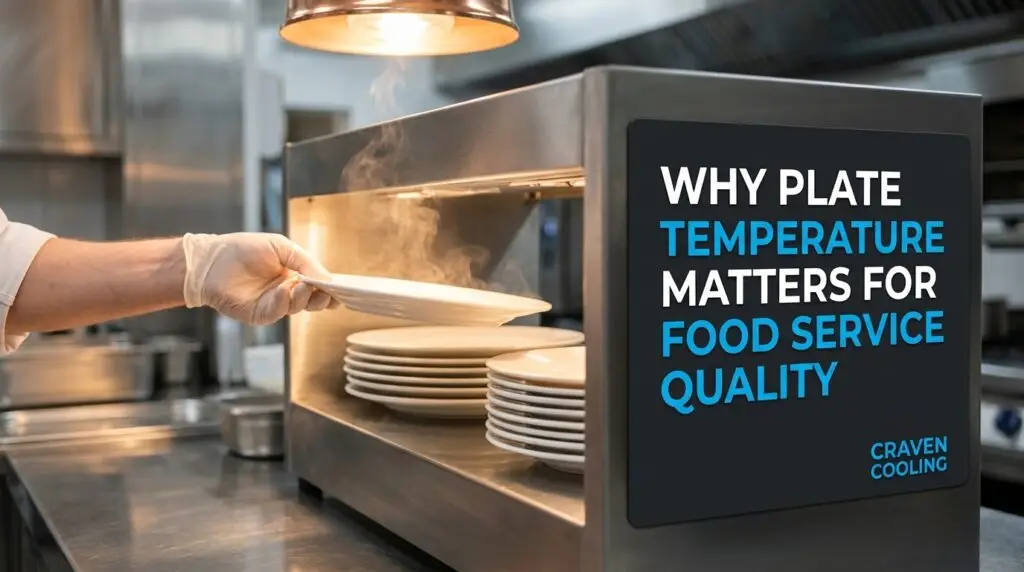
Why Plate Temperature Matters for Food Service Quality
A cold plate is the single most overlooked reason hot food arrives lukewarm at a UK table — and it happens in the last thirty seconds of a dish’s life, after the kitchen has done everything right. The physics are unforgiving: a plate straight off a cold shelf can sit at 18–20°C, and the moment a chef spoons 70°C food onto it, the crockery drinks the heat straight out of the meal. A thick porcelain plate at room temperature can pull the surface of a portion down by 10–15°C in the walk from pass to table, and on a busy night that can drop food that left the kitchen above the 63°C hot-hold line into the tepid zone a guest complains about. The fix is cheap and physical: pre-warm your crockery to 60–65°C so the plate gives heat back to the food instead of stealing it. This guide covers why it happens, the plate-warming methods that fix it, the thermal mass of the crockery you buy, the pass workflow that makes it routine, guest perception, hand-safety, energy cost at 27p/kWh, and how plate temperature ties into the 63°C rule that governs every hot service in the country.
- A cold plate is a heat sink. Crockery at room temperature (18–20°C) pulls heat out of hot food the instant it is plated — a cold, thick plate can drop the food surface by 10–15°C before it reaches the table.
- Pre-warm to 60–65°C. The target for serving crockery is a plate hot enough to give heat back to the food but still safe to carry — roughly 60–65°C plate surface, warm to a gloved hand, never scalding to a bare one.
- Thermal mass matters. Thick vitrified porcelain holds heat and keeps food hot longer; thin bone china and melamine hold almost none — melamine can’t be warmed safely and always serves food onto a cold surface.
- The 63°C link. Under the Food Safety (Temperature Control) Regulations 1995, hot food must be held at or above 63°C. A cold plate can push already-borderline food below that line at the very last step — plate-warming protects both quality and compliance.
- Plate-warming methods: heated cabinet or hot cupboard (bulk, even, back-of-house), plate stack / mobile dispenser (self-levelling, front-of-house), heat lamp over the pass (surface top-up), and warming drawer (compact, under-counter) — each suits a different service.
- The pass workflow: plate warm → plate up → serve fast. A warm plate only helps if the food goes on quickly and reaches the table before the advantage is lost.
- Guests notice. Lukewarm food is one of the most common restaurant complaints in the UK, and a cold plate is a frequent hidden cause even when the kitchen cooked and held everything correctly.
- Energy is modest but real: at 27p/kWh a 1kW plate warmer running 10 hours a day costs about £2.70 a day, near £985 a year — a small price against the covers a cold-plate complaint costs you.
Plate temperature is the quiet variable that undoes good kitchens. A brigade can source the right ingredients, cook to temperature, hold above 63°C on a well-specified line, and still send out food that reads lukewarm to the guest — because the last surface the food touches, the plate, was cold. It is a physics problem disguised as a service problem, and because it happens in the final seconds it rarely gets diagnosed. Chefs blame the kitchen, front-of-house blame the pass, and the real culprit is a stack of 19°C crockery quietly acting as a radiator in reverse.
This guide is written for the trade operator who cares about the plate that lands in front of the guest — restaurateurs, hotel and banqueting managers, gastropub and carvery operators, care home and contract catering managers, event caterers, and anyone specifying crockery, plate warmers and a pass workflow for repeated commercial service. It assumes you already hold hot food correctly; the job here is the last thirty seconds, and the equipment and habits that stop a cold plate ruining a good dish. Browse the plate warmer range or the full Craven Cooling catalogue when ready.
Table of Contents
- Decision 1: The Physics — Why a Cold Plate Steals Heat
- Decision 2: Plate-Warming Methods Compared
- Decision 3: Crockery Thermal Mass — What You Buy Matters
- Decision 4: The Pass Workflow — Warm, Plate, Serve
- Decision 5: Guests, Hand-Safety & the 63°C Rule
- Heat Lamps We Stock
- Worked Energy Cost Example
- Pre-Service Plate-Warming Checklist
- Frequently Asked Questions
- Related Buying Guides
Target plate surface temperature — hot enough to help, safe enough to carry
Typical heat a cold plate strips from the food surface before it reaches the table
The legal hot-hold floor a cold plate can push borderline food below at the last step
A kitchen can do everything right — cook to temperature, hold above 63°C, plate with care — and still lose the dish in the final thirty seconds because the plate was cold. Crockery at 18–20°C is a heat sink: the moment 70°C food lands on it, the plate drinks the heat out of the meal, and a thick, cold plate can pull the food surface down by 10–15°C on the walk to the table. Warm the plate to 60–65°C first and the physics flips — the plate gives heat back to the food and holds it hot for the guest. It is the cheapest quality upgrade in food service, and the most overlooked.
The window between pass and table where a cold plate does its damage
Decision 1: The Physics — Why a Cold Plate Steals Heat
Start with what is actually happening on the plate, because once you understand it the rest of the decisions follow. When hot food touches a cold plate, heat flows from the food into the crockery until the two reach a shared temperature — that is conduction, and it is fast and one-directional at the moment of plating. The food is hotter, the plate is colder, so the food loses. How much it loses depends on three things: how cold the plate is, how much crockery there is to heat (the thermal mass), and how long the food sits on it before the guest eats.
Take a realistic case. A portion of steak and chips leaves the pass at 70°C on a heavy porcelain plate that has been sitting on a room-temperature shelf at 19°C. Conduction pulls heat out of the underside of the food into the plate instantly; the plate warms, the food surface cools. By the time a server has carried it thirty to sixty seconds across a busy dining room, the food touching the plate has given up a large share of its heat to the crockery and the air, and the guest’s first forkful — the bit against the plate — can be markedly cooler than what the chef sent. On a cold plate the drop is worst; on a warm plate the plate has no appetite for the food’s heat and the meal stays hot.
| Plate starting temp | What happens on contact | Effect on the dish at the table |
|---|---|---|
| Fridge / cold store (~5°C) | Massive heat draw — worst case, sometimes seen with plates stored near a chiller | Food noticeably cold underneath within seconds; guest complaint near-certain |
| Room temperature (~19°C) | Strong heat draw — the everyday default in most kitchens | Food surface drops 10–15°C on the walk to table; the hidden cause of “lukewarm” |
| Hand-warm (~40°C) | Moderate draw — plate still takes some heat | Better, but not enough for a long dining room walk or slow eater |
| Warmed (60–65°C) | Minimal draw — plate near food temperature, gives heat back | Food stays hot to the table and through the meal; the target |
| Overheated (75°C+) | Plate too hot to hold — a hand-safety and service risk | Food can keep cooking; servers can’t carry it; over-warming is its own problem |
Two variables amplify the effect. The first is the size and weight of the plate — a big, heavy charger has far more mass to heat than a small side plate, so it draws more heat and drops the food further (covered in Decision 3). The second is dwell time — the longer the food sits between pass and mouth, the more heat conduction and evaporation strip away. A quick pass-to-table service loses less than a slow one, which is why warm plates and a fast pass work together (Decision 4). Get all three right — warm plate, appropriate crockery, quick service — and the food a guest eats is close to the food the chef sent.
Decision 2: Plate-Warming Methods Compared
There are four common ways to warm crockery in a commercial kitchen, and they suit different services, volumes and layouts. The right choice is about how many plates you turn over, where the warming needs to happen, and how consistent you need the temperature to be. Get the family right first, then the model.
Heated Cabinet / Hot Cupboard
Bulk, even, back-of-house
- Enclosed, thermostatically controlled
- Warms plates in volume, evenly, gently
- Best for restaurants, banqueting, carveries
- The consistent-temperature workhorse
Plate Stack / Dispenser
Self-levelling, front-of-house
- Heated tube holds a column of plates
- Spring dispenses one warm plate at a time
- Best for carvery, buffet, high-turnover service
- Mobile versions travel to the servery
Heat Lamp Over the Pass
Surface top-up at plate-up
- Radiant top-heat over the plating area
- Keeps plated food and plate hot at the pass
- Best for the pass, à la carte plate-up
- A top-up, not a bulk warmer on its own
Warming Drawer
Compact, under-counter
- Slides under the pass or counter
- Holds a modest stack of plates warm
- Best for small kitchens, gastropubs, cafés
- Space-efficient where a cabinet won’t fit
The heat lamp is the most misunderstood of the four, and worth being precise about. A quartz or halogen lamp delivers radiant heat down onto a surface — it keeps the top of a plated dish, and the plate it sits on, hot at the pass for the minutes between plating and service. It is superb for the à la carte pass and the carvery carve point: plate the food, hold it under the lamp while the rest of the table’s plates are finished, and everything goes out hot together. What a lamp does not do is warm a tall stack of cold plates from cold on its own — for bulk warming you want a cabinet, a dispenser or a drawer, and then a lamp over the pass to hold the warmed, plated dish. The two work as a layer, not as substitutes.
| Method | Bulk warming? | Best service | Where it sits | Relative energy |
|---|---|---|---|---|
| Heated cabinet | Yes — high volume, even | Restaurant, banqueting, carvery | Back-of-house, feeds the pass | Medium |
| Plate stack / dispenser | Yes — column of plates | Carvery, buffet, servery | Front-of-house or mobile | Low–medium |
| Heat lamp | No — surface top-up only | À la carte pass, carve point | Over the pass / plating area | Low |
| Warming drawer | Modest — small stacks | Gastropub, café, small kitchen | Under-counter, at the pass | Low |
Busy operations rarely rely on one method. The common, effective pattern is: warm the bulk of your crockery in a plate warmer or heated cabinet back-of-house, bring warm plates forward to a stack or dispenser at the pass, and hold plated food and its plate hot under a heat lamp while a table’s plates are finished. For self-service and carveries, a heated countertop display keeps warmed plates and hot food together at the servery. Match each layer to the volume it actually handles.
Decision 3: Crockery Thermal Mass — What You Buy Matters
The plate itself is half the equation, and the crockery you buy determines how well plate-warming works. Thermal mass is the amount of heat a material can store — and for serving crockery you want it high enough that a warmed plate holds its heat all the way to the table, but not so high that warming takes forever or the plate becomes a burn risk. Different materials behave very differently, and some cannot be warmed at all.
Thick, dense vitrified porcelain — the standard heavy-duty commercial plate — has good thermal mass. It takes a little longer to warm, but once warm it holds heat well and keeps giving it back to the food across a long dining room walk or a slow eater. Bone china is lighter and thinner: it feels premium and warms quickly, but it stores less heat, so it cools faster once plated. Melamine, common in cafés, care settings and outdoor service, is a plastic — it is durable and unbreakable, but it is a poor heat store and, critically, it cannot be safely heated in a plate warmer or cabinet, so melamine service always puts food onto a cold surface.
| Material | Can it be warmed? | Holds heat once warm? | Best for |
|---|---|---|---|
| Vitrified porcelain (thick) | Yes — takes warming well | Excellent — high thermal mass | Restaurants, hotels, carveries — the workhorse |
| Bone china (thin) | Yes — warms quickly | Moderate — cools faster, low mass | Fine dining where presentation leads |
| Stoneware / earthenware | Yes — warms slowly | Good — solid, dense body | Rustic and gastropub plating, sharing dishes |
| Melamine (plastic) | No — do not heat | Poor — negligible mass | Cafés, care, outdoor, kids — unbreakable, but always cold |
| Cast iron / metal (skillet) | Yes — very high retention | Excellent — keeps cooking | Sizzler and skillet dishes served on the heat source |
Melamine crockery must not go in a heated cabinet, plate warmer or under a hot lamp. Sustained heat can damage the surface, cause it to craze or blister, and in some cases release material into food — most melamine is rated for cold and ambient service only, not for warming. If your service demands hot food on a warm plate, melamine is the wrong choice; use warmable vitrified porcelain or stoneware and keep melamine for cold, outdoor, care or children’s settings where its unbreakability is the priority. Always follow the crockery manufacturer’s stated temperature limits.
The practical upshot for buyers: if you run hot food service and care about the plate the guest eats from, specify heavy vitrified porcelain or dense stoneware that takes warming well, and size your plate warmer to the crockery you actually use — a warmer that can bring a stack of thick chargers to 60–65°C is a different beast from one warming thin side plates. Match the crockery, the warmer and the service, and the whole chain holds heat from pass to table.
Decision 4: The Pass Workflow — Warm, Plate, Serve
A warm plate only earns its keep if the workflow around it is disciplined. The whole point of pre-warming is to hand the guest hot food, and that means three things happening in tight sequence: the plate is warm before food touches it, the food goes on quickly, and the dish reaches the table fast. Break any link and the warm plate is wasted effort. This is a workflow decision as much as an equipment one.
Load the plate warmer or cabinet well before the rush and bring crockery to 60–65°C. A warmer switched on at the start of service is still catching up when the first orders land; pre-heat it like you pre-heat an oven, and keep it topped up so a warm plate is always to hand at the pass.
Plate straight from hot food held above 63°C onto the warmed plate. Don’t let warm plates sit out cooling in the pass, and don’t let hot food wait on the side while the plate is fetched. The plate and the food should meet hot, both near serving temperature, with no gap where either cools.
If a table’s plates are finishing at different times, hold the completed ones under a heat lamp so surface and plate stay hot — but treat it as seconds and minutes, not a parking spot. The lamp holds a warm, plated dish; it does not rescue a dish left too long. Send the whole table together.
The warm plate buys you time, but not unlimited time. Runners should clear a finished dish from the pass promptly and walk it straight to the guest. Every extra minute in the pass or on a tray is heat lost — the warm plate slows the loss, it doesn’t stop it.
As clean crockery comes back from the wash, rotate it into the warmer so there is always a warm stack ready for the next wave. A cold plate grabbed in a rush because the warm stack ran dry undoes the whole workflow — keep the warmer fed all service.
The discipline that makes this stick is treating the warm plate as a perishable resource. A plate warmed to 60–65°C and then left sitting in the pass for five minutes has cooled towards room temperature and is no better than a cold plate — the benefit is in the plate being warm at the moment food touches it and the dish moving quickly after. Kitchens that get plate temperature right build the warm-plate habit into the pass rhythm: plate warm to hand, food on fast, table served fast, crockery rotated back. It costs nothing but attention, and it is the difference between hot food and lukewarm food on identical menus.
Warm the plate to 60–65°C, plate up straight from hot food, and get the dish to the guest in under a minute where you can. Feed the warmer continuously so a warm plate is always ready, and use the heat lamp to hold a plated dish for seconds — not as a place to park food. Tell us your covers, service style and crockery and we’ll spec the plate-warming layers to fit the pass you actually run.
Decision 5: Guests, Hand-Safety & the 63°C Rule
Plate temperature sits at the join of three things operators care about: what the guest experiences, whether staff can safely handle the crockery, and whether the food stays legally compliant. Get the plate temperature right and all three line up; get it wrong in either direction — too cold or too hot — and one of them suffers.
Guest perception. Lukewarm food is one of the most common causes of restaurant complaints in the UK, and a cold plate is a frequent hidden reason for it. A guest doesn’t know or care that the kitchen cooked to temperature and held above 63°C — they know the food in front of them isn’t hot. Worse, the complaint often comes when the kitchen has done everything right, because the failure is invisible: a warm plate would have carried the same food to the table hot. Warm plates are, in effect, a cheap insurance policy against a complaint category that damages reputation and drives comps and re-fires.
“Food arrived lukewarm” is one of the most damaging lines a guest can leave in a review, because it reads as carelessness even when the kitchen cooked and held everything correctly. A cold plate is often the real cause — and warming crockery to 60–65°C removes it. Against the cost of a comped main, a re-fire, or a one-star review, a plate warmer is one of the cheapest quality investments in the building. It protects the food the guest actually eats, not just the food the chef sent.
What a lukewarm-food review can cost — often from a cold plate
Hand-safety. There is a ceiling on how hot a plate can be, and it isn’t set by the food — it’s set by the hands that carry it. A plate warmed above roughly 70°C becomes uncomfortable to hold with a bare hand and, higher still, a genuine burn risk to both kitchen and front-of-house staff who move dozens of them a service. This is a real workplace safety consideration under general duties to protect staff; the Health and Safety Executive publishes guidance on burns and hot-surface risks in commercial kitchens at hse.gov.uk. The 60–65°C target exists precisely because it is the band that is hot enough to keep food warm but still handleable — ideally with a cloth — without scalding. Over-warming isn’t a shortcut to hotter food; it’s a way to burn staff and cook the underside of the dish.
Warming plates far above 65°C does not make the food meaningfully hotter to the guest — it makes the crockery dangerous to handle and can keep cooking delicate food from underneath. Staff carrying plates too hot to hold will either drop them, rush them, or reach for cloths that slow service and still risk burns. Set plate warmers to hold around 60–65°C, brief staff to use a service cloth, and treat a plate that is painful to touch as a fault to fix, not a sign the warmer is working. Follow HSE catering guidance on hot surfaces and burns.
The 63°C link. Plate temperature and food safety are connected at the last step. Under the Food Safety (Temperature Control) Regulations 1995, hot food held for service must be kept at or above 63°C. Plate-warming does not change that rule — food must still leave hot-hold above 63°C — but a cold plate can undo compliance at the moment of plating by dragging borderline food down through the line just as it heads to the table. A dish that leaves the kitchen at 64°C and lands on a 19°C plate can be below 63°C by the time it is served; the same dish on a warm plate stays above it. Warming crockery is not a substitute for correct hot-holding, but it protects the temperature the kitchen worked to achieve right up to the guest.
Heat Lamps We Stock
The two quartz heat lamps below cover the pass and the carve point — the surface top-up that keeps a warmed, plated dish hot in the seconds between plating and service. Pair them with a bulk plate warmer or heated cabinet for warming crockery from cold, and use the lamp to hold the plated dish at the pass. For heated cabinets, plate stacks and warming drawers, tell us your covers and we’ll source to spec. Both stocked July 2026. Prices ex VAT, 2-year parts warranty.
+ VAT — Craven Cooling price
Pass & carve point
- Single radiant heat lamp, modern black finish
- 220V with UK plug — plug-and-go
- Surface top-heat for the pass or carved joint
- Holds a warmed, plated dish hot at plate-up
- Flexible placement — no fixed install
The single lamp for the à la carte pass and the carvery joint. Radiant top-heat keeps the surface of an already-hot dish — and the warm plate under it — hot for the seconds between plating and service. Pair with a plate warmer or heated cabinet for warming crockery from cold.
+ VAT — Craven Cooling price
Wider pass coverage
- Double radiant heat lamp, modern black finish
- 220V with UK plug — plug-and-go
- Covers a wider pass or a busier plating line
- Two heads for even surface coverage
- Same short-hold role, more span
The double lamp for a wider pass or a busy plate-up line where several dishes wait to go out together. Two radiant heads cover more surface evenly, so warmed plates and hot food hold temperature across the whole plating area without cold spots at the edges.
Craven Cooling stocks and sources the full plate-warming range — bulk plate warmers and heated cabinets for warming crockery from cold, heated countertop display for the servery, and heat lamps for the pass. Call 01792 732702 or email [email protected] with your covers, service style and crockery and we’ll spec the layers to warm plates to 60–65°C without over-spending on energy.
Worked Example: What Plate Warming Costs to Run
A restaurant runs a plate warmer plus a heat lamp over the pass across lunch and dinner service. Here is what the electricity actually costs at 27p per kWh — modest against the covers a cold-plate complaint costs.
Set that against what it prevents. A single comped main course, a re-fire, and the goodwill lost from one guest telling a table their food was lukewarm can wipe out a week of that energy bill in an evening — and a run of lukewarm-food reviews does far more damage than the meter ever will. A 1kW plate warmer running 10 hours a day is about £2.70 a day, near £985 a year on its own; add the lamp and you are still comfortably inside the cost of a handful of complaints. Plate warming is one of the few kitchen upgrades where the running cost is trivial next to the quality it protects.
Pre-Service Plate-Warming Checklist
Before every service, run through the plate-warming chain before the first order lands.
-
✓
Plate warmer pre-heated to 60–65°C before service
Switch it on early like an oven — a warmer still catching up when orders land sends out food on plates that aren’t yet warm. Confirm it is holding, not just switched on. -
✓
A warm stack of the right crockery to hand at the pass
Load the crockery you actually serve on — thick porcelain takes longer to warm than thin plates. Make sure a warm stack is within reach so no one grabs a cold plate in a rush. -
✓
No melamine in the warmer
Melamine must never be heated. Keep it separate and reserve it for cold, outdoor, care or children’s service where unbreakability is the priority, not hot plating. -
✓
Plates warm but handleable — not too hot to carry
Check a plate is warm to a gloved hand, not scalding to a bare one. A plate too hot to hold is a burn risk and cooks the food underneath — dial it back to 60–65°C. -
✓
Heat lamp on and covering the plating area
The pass lamp should be up to temperature and positioned to cover where dishes wait, so a plated dish and its warm plate hold heat while the rest of a table is finished. -
✓
Rotation plan so the warm stack never runs dry
Assign someone to feed clean, dry crockery back into the warmer through service. A warm-plate policy fails the moment the stack empties and cold plates come out to keep up.
Tell us your covers, service style and crockery — restaurant, hotel, carvery, gastropub, care home or function — and we’ll spec the plate warmers, heated cabinets and heat lamps that keep food hot from pass to table without wasting energy. See the range at the Swansea showroom. 2-year parts warranty across the range · [email protected] · 01792 732702.
Browse Catering Equipment
Call Sales — 01792 732702
For the crockery that goes on your warm plates, read the tableware for hot food service guide. For the equipment that holds the food hot before it reaches the plate, see how to choose heated food display equipment for food safety. For sizing lamps over a servery, read how many heat lamps for a carvery or servery counter. And for the front-of-house drinks side of service, see setting up a tea and coffee service.
Plate temperature is the last, most overlooked variable in food service quality. A cold plate is a heat sink: crockery at room temperature (18–20°C) pulls heat out of hot food the instant it is plated, and a thick cold plate can drop the food surface by 10–15°C on the walk from pass to table — the hidden cause of “lukewarm” food even when the kitchen cooked and held everything correctly. The fix is to pre-warm crockery to 60–65°C, hot enough to give heat back to the food but still safe to carry. Thermal mass matters: thick vitrified porcelain and dense stoneware warm well and hold heat, thin bone china cools faster, and melamine must never be heated and always serves food cold. Four methods warm plates — heated cabinets and hot cupboards for bulk, plate stacks and dispensers for the servery, warming drawers for small kitchens, and heat lamps for surface top-up at the pass — and busy kitchens layer them. The pass workflow makes it work: plate warm, plate up fast, serve fast, and rotate crockery back so the warm stack never runs dry. Plate temperature also protects the 63°C hot-hold rule under the Food Safety (Temperature Control) Regulations 1995 — a cold plate can push borderline food below 63°C at the last step, while a warm plate defends it. Over-warming above 65°C is a hand-safety hazard for staff, not a bonus. Energy is modest: a 1kW plate warmer at 27p/kWh costs about £2.70 a day, near £985 a year — trivial against the cost of a lukewarm-food complaint. Craven Cooling stocks the Steelite Creations Modern Single Heat Lamp (£382.25 + VAT) and Modern Double Heat Lamp (£580.17 + VAT), and sources plate warmers, heated cabinets and warming drawers to spec. Call 01792 732702 or visit the Swansea showroom; 2-year parts warranty.
Frequently Asked Questions
▼
▼
▼
▼
▼
▼
▼
▼


