
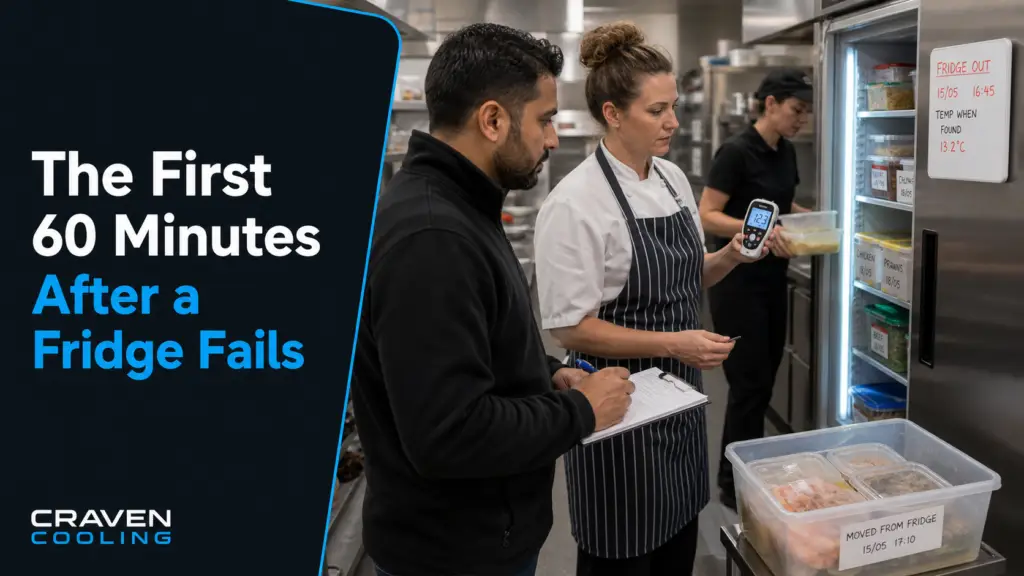
The First 60 Minutes After a Fridge Fails
When a commercial fridge fails, the first hour is not the time to debate brands or prices. It is the time to protect stock, stop unnecessary door openings, capture temperatures, move food only where safe and decide who owns the next action.
- Door discipline matters: every unnecessary opening loses useful cold
- Record the timeline: time and temperature guide later decisions
- Move stock carefully: another fridge must actually be safe and suitable
- Escalate clearly: staff need to know who calls the engineer
- Do not hide the event: records protect the business and customers
This article sits beside the breakdown cost blog: one explains the cost, this gives the incident response routine.
Table of Contents
Minutes 0-15: Confirm the Fault and Stop Heat Gain
Check the display, listen for obvious faults and stop repeated door opening. Put one person in charge of the cabinet so several staff do not keep checking the same problem.
Minutes 15-30: Record Temperature and Stock Risk
Write down the cabinet temperature, time discovered, product types and whether food is high-risk. If another unit is available, check that it is operating safely before moving stock.
- ✓Use a probe where appropriate. Do not rely only on the cabinet display if food safety is in question.
- ✓Separate high-risk food. Treat cooked meat, dairy and prepared foods differently from sealed drinks.
- ✓Keep labels visible. Date coding still matters during a move.
Minutes 30-60: Escalate and Make a Commercial Decision
Call the service provider with useful information: model, location, current reading, stock affected, recent symptoms and whether the unit is critical to service. Decide whether the site can trade safely without it.
After the Hour: Keep the Evidence
Store the temperature notes, staff actions, engineer call and final disposal or transfer decisions together. If the unit fails again, the history matters.
The Manager Check Before You Spend Money
Before committing to a repair, replacement or new piece of equipment, step back and write a short operational brief. What happens in the busiest hour? Which member of staff notices the problem first? Which product, service point or customer experience is affected? Which records prove the pattern? That brief is often more useful to Craven Cooling than a vague request for “a bigger fridge” or “a better machine”.
For The First 60 Minutes After a Fridge Fails, the strongest buying decision comes from matching equipment to the way the site actually trades. A pub, café, restaurant, care home and convenience store can all own the same category of kit and need different answers because their peak periods, staffing, stock movement and inspection pressure are different.
| Manager question | Why it improves the brief |
|---|---|
| When does the issue appear? | Separates peak-load problems from all-day faults. |
| Who works around it? | Shows the labour cost and training risk. |
| What record proves it? | Turns opinion into evidence: logs, wastage, service notes or sales gaps. |
| What would success look like? | Defines whether the answer is safer food, faster service, lower waste or more sales. |
Immediate tools
Use during the incident- Commercial fridge troubleshooter
- Food-safe temperature checker
- Breakdown cost calculator
Craven Cooling view: The first hour should protect people and evidence, not just the product. A calm written routine prevents a technical fault becoming a food-safety mess.
In the first 60 minutes after a fridge fails, stop door openings, record time and temperature, protect high-risk stock, move food only to safe storage, call with useful fault details and keep the evidence trail.


