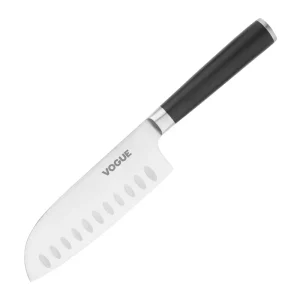
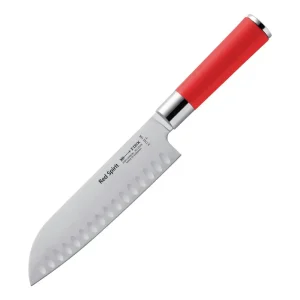
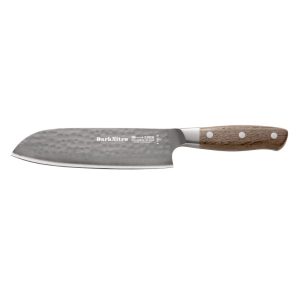
Why this santoku knive earns its place
A santoku is the Japanese answer to a Western chef's knife—shorter, lighter, and built for precision slicing rather than heavy chopping. The Vogue Tsuki Series 7 santoku brings authentic Japanese forging to the tool: a Damascus steel blade forged to 60° Rockwell hardness with a VG-10 stainless core. At 256 mm long and 130 grams, it's nimble enough for detailed work but substantial enough for real volume.
Santoku translates to "three virtues," referring to slicing vegetables, raw fish, and proteins—the jobs this blade handles best. The relatively flat profile, compared to a Western chef's knife, means you're using a push-slice motion rather than a rock, which creates cleaner cuts through delicate proteins without tearing the cell structure. That matters when you're slicing fresh fish for sashimi or raw beef for tartare. It matters equally when you're prepping thin vegetable slices where visual presentation counts.
The Damascus steel sheathing protects the hardened core against corrosion in a wet kitchen environment. The micarta resin handle provides reliable grip even when wet. Unlike a longer chef's knife that demands space and a specific cutting technique, a santoku works efficiently on a smaller board and suits cooks with smaller hands or those who prefer precise, controlled cuts over broad chopping motions. At this level of blade work-hardening and Damascus construction, you're holding a knife built to stay sharp and perform for years.