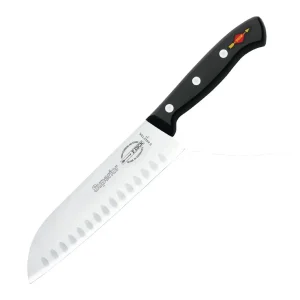
Dick 1778 Santoku Knife Brown 16.5cm GL531

£538.60

+vat

Availability: 999 in stock

Brand:

SKU: GL531

Product summary

Blade Length: 6.5″. Weight: 170g

Product description

The 1778 Jubilee knife series is a celebration of the 225th anniversary of the F.Dick company, comprising of a fantastic, exclusive knife range for all cooking fans. With the sharp and extremely thinly grounded blade, cutting and chopping in the kitchen becomes effortless. The knives are easy to guide and create a breathtaking clean cut. The beautifully designed ergonomic and weighted handles sits securely and comfortably in your hand.

Core of knife is crafted from a very thin layer of high-alloy double X VG-12 grade carbon steel
Handle is made plumwood for a comfortable hold and feel
All knives in the 1778 series are honed and sharpened by hand
Packed and presented in a gift box
Half bolster allows complete utilisation of the cutting edge and complete resharpening
Hand wash only

A 165mm forged carbon steel santoku knife from the Dick 1778 Jubilee series, designed for vegetables, fruit, and salad prep with a thin honed blade and intuitive flat-edge geometry.

Downloads

SPECIFICATION 15 facts · tap for all Gross weight0.17 kgMaterialCarbon SteelProduct codeGL531BrandDickGTIN / EAN4.00922E+12Range / seriesWüsthof Gourmet

Identity6

Brand Dicksite
GTIN / EAN 4.00922E+12catalogue
Product code GL531site
Range / series Wüsthof Gourmetcatalogue
Seo name Dick 1778 Santoku Knife 170mmcatalogue
Type Santoku Knivescatalogue

Size & weight3

External (W×D×H) 4050 × 159 × 189 mmcatalogue
Gross weight 0.17 kgcatalogue
Length 4050 mmcatalogue

Build & fittings4

Colour Browncatalogue
Construction Forgedcatalogue
Finish (exterior) Honedcatalogue
Material Carbon Steelcatalogue

Other stated facts2

Dishwasher safe Nocatalogue
Suitable for Salad and Fruit<multisep/>Vegetablescatalogue
THE WORKING VIEW

Why this santoku knive earns its place

The santoku is a Japanese knife principle built into a German forging tradition. Where a chef's knife is rocking and versatile, a santoku is precise and straight. The 165mm blade is shorter and taller than a comparable chef knife, with a flat edge that cuts downward in a single clean motion rather than rocking—perfect for the repetitive motion of brunoise, julienne, or peeling. This is the knife you pick up for vegetables, fruit, and salad, where a western chef's knife can feel clumsy by comparison.

F.Dick's 1778 Jubilee santoku is forged from carbon steel, which means it takes a thin, keen edge and holds it through hours of prep. The blade is honed sharp and ground fine—the kind of blade that glides through a tomato skin without crushing the flesh inside, or turns a carrot into near-transparent ribbons. The brown handle is weighted and balanced so the knife feels like an extension of your hand. At 170g, it's lighter than a chef knife, which matters when you're doing the delicate, detail-focused work a santoku is built for.

Like all carbon steel knives, this one requires hand washing and the occasional sharpening. The patina that develops is protective and normal—in a busy kitchen, it's seen as evidence of a tool doing its job. Honing between sharpenings keeps the edge aligned. Once you own a good santoku and establish the hand-care routine, it becomes obvious why Japanese cooks favour this geometry for precise vegetable work. It's not flashier than a chef's knife; it's more efficient for its intended task.

BEFORE YOU BUY

Questions, answered straight

A chef's knife rocks—the curve lets you use momentum and the blade stays in contact with the board throughout the cut. A santoku is flat; it cuts with a clean downward motion. The santoku is taller and narrower, better for fine detail work and vegetables. A chef's knife is more versatile across proteins and rough work. Most kitchens use both.

The specs list it for vegetables, fruit, and salad, and that's its sweet spot. The blade is fine-edged and designed for the delicate work vegetables require. Using it heavily on bones or frozen food will dull it faster. Stick to produce and your knife will repay the respect.

You don't. Use the same sharpening method you'd use for any chef's knife—a whetstone, honing steel, or professional sharpening service. The flat edge and straight spine don't require special technique; they just need a steady hand and a straight approach angle.

Not harder, just different. The flat edge concentrates the cutting action into a thin line, which means a dull santoku feels dull more noticeably than a dull chef's knife. But once sharp, it holds the edge very well. Regular honing (every few days) keeps it performing at its best.

Carbon steel oxidizes in the alkaline, high-heat environment of a dishwasher. A quick rinse and dry immediately after use—20 seconds—keeps the blade pristine. It's the same care any professional cook gives a good knife; it becomes automatic habit.

Very likely. Cooks who work heavily with vegetables and fruit often find the santoku geometry becomes their preferred knife for that work. The flat edge and blade height speed up precise cuts and reduce fatigue. It's not "better" than a chef's knife; it's purpose-built for a specific task, and that purpose is obvious the moment you use one.
See it in our Swansea showroom

Compare kit side by side and discuss delivery with the Craven team.

Dick 1778 Santoku Knife Brown 16.5cm GL531 Product Data

Brand Dick
Type Santoku Knives
Range Wüsthof Gourmet
Dimensions 4050(L)mm | 159&#189;(L)"
Material Carbon Steel
Colour / Finish Brown
Dishwasher Safe No
Suitable For Salad and Fruit<multisep/>Vegetables
Weight 170g
Manufacturer Ref 81642175H
If you have any questions about the Dick 1778 Santoku Knife Brown 16.5cm GL531 then please get in touch.

You may also be interested in...