
Your Fridge Is Not a Stockroom: How Overloading Costs Operators Money
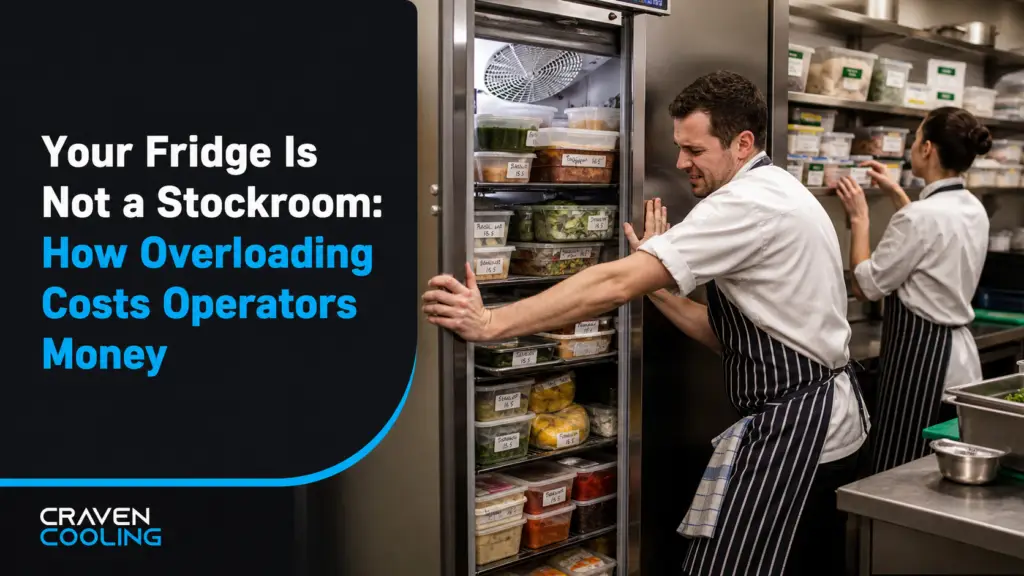
An overloaded commercial fridge usually starts as a sensible instinct: do not waste space, keep more stock ready, avoid another delivery, squeeze one more tub in before service. The trouble is that a fridge is not a cold stockroom. It is an airflow system. When shelves are packed hard against vents, products press into door seals and containers remove the air gaps, the cabinet can hold less safely while using more energy. This blog treats overloading as a stock-discipline problem: how to keep the cabinet working, when to change habits, and when the honest answer is more refrigeration capacity.
- Airflow is the cooling system: fan-assisted and ventilated cabinets need free circulation around the load.
- Blocked airflow creates warm spots: HACCP temperature logs may show irregular readings even when the controller looks normal.
- Overpacking can increase energy use: restricted airflow can make a cooler consume up to 30% more energy than necessary.
- Door pressure is a hidden fault: stock pressing against the liner can stop the gasket sealing properly and pull warm, moist air into the cabinet.
- Leave air gaps: operational guidance is to leave at least 5cm between stacked items and avoiding products pushed flat against the back wall.
This complements Craven’s maintenance and troubleshooting content by looking at the operator habit behind many warm-running fridge complaints. Cleaning coils and replacing seals matter, but a well-maintained cabinet still struggles if it is used as overflow storage every day.
The multi-brand angle matters here. If your team has outgrown a fridge, the answer might be a different cabinet, a second undercounter, a prep counter, a cold room or simply a better stock routine. Craven Cooling can look at the operation before recommending a product.
Table of Contents
The Margin Problem Hidden Inside a Packed Cabinet
Overloading is expensive because it attacks several margins at once. The compressor runs longer, energy use rises, food quality becomes less predictable, staff waste time hunting for stock, and old product gets trapped behind new product. None of this looks dramatic at first, which is why the habit lasts.
| Symptom | What it often means | Commercial effect |
|---|---|---|
| Warm top or back shelf | Air cannot circulate around the load | Shorter shelf life and poor logs |
| Door needs pushing shut | Stock is touching the liner or gasket | Warm air leaks and seal wear |
| Compressor seems constant | The cabinet cannot pull heat out efficiently | Higher energy use and component wear |
| Dates are hard to see | FIFO has broken down | Waste and food-safety risk |
Build a Loading Standard Staff Can Actually Follow
A loading rule only works if it is simple enough for a busy close-down. Mark the shelf fronts, train staff to leave rear vents clear, keep heavy items lower, and give fast-moving lines a predictable home. If a team has to make a judgement every time they restock, the fridge will gradually return to chaos.
Use labels on shelf edges so staff know where air needs to move and where stock must not touch the back wall.
This reduces reshuffling and keeps lighter, frequently used products easier to rotate.
If overflow constantly invades the service fridge, the storage plan is wrong.
Use HACCP Logs as an Early Warning System
Temperature logs are not just paperwork for inspections. They show when a cabinet is being asked to do too much. If readings rise after every big delivery, during every lunch rush, or on one shelf only, the issue may be loading pattern rather than a failing fridge.
Look for patterns: one warm shelf, longer recovery after restocking, ice forming near blocked vents, or staff reporting that the door is harder to close. Those clues tell you whether to change loading, reduce stock, repair seals or investigate a bigger capacity problem.
Know When the Fridge Is Too Small for the Business
Good habits cannot fix a permanent capacity gap. If the team follows the loading standard and still cannot hold stock safely, the answer is not “try harder”. It may be a larger upright, a second cabinet, a refrigerated prep counter, a walk-in cold room, or a different split between back-of-house and service refrigeration.
Craven Cooling can compare options across brands and cabinet types. The right upgrade protects stock, labour and energy use; the wrong upgrade simply gives the same bad loading habits more space to spread.
Capacity options
Add space where the stock actually livesUseful products
Examples for busy kitchensRelated guidance
Stop overloading becoming routineCraven Cooling view: Overloading is usually a symptom of a bigger system problem: wrong delivery rhythm, wrong prep split, too little backup storage, or a display cabinet being asked to act as a stockroom.
An overloaded fridge is an airflow and stock-management problem. Keep vents clear, leave air gaps, use FIFO, watch HACCP log patterns and treat constant overpacking as a capacity signal rather than a normal operating condition.


