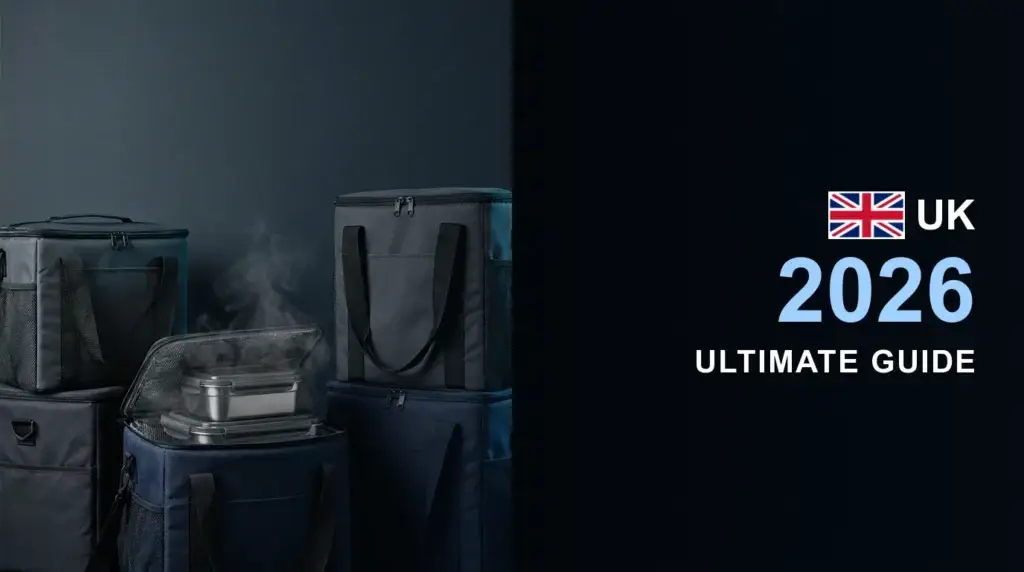
Hot & Cold Holding Temperatures for Food Delivery: The Complete UK Guide (2026)
Food does not stop being subject to temperature control the moment it leaves your kitchen. Under the Food Safety (Temperature Control) Regulations 1995, hot food must be held at 63°C or above and chilled food at 8°C or below, and that duty follows the food through loading, transit and the doorstep handover. Between those safe zones sits the danger zone (roughly 8°C to 63°C) where bacteria multiply, and the practical limit is the 2-hour out-of-temperature-control rule: food that spends more than two continuous hours in the danger zone should be discarded. This guide covers the two legal temperatures, the 2-hour clock, insulated boxes versus heated and refrigerated trolleys, last-mile heat loss, and the dispatch-and-arrival logging that proves you held the line.
- The two legal temperatures: the Food Safety (Temperature Control) Regulations 1995 set hot-hold at 63°C minimum and chilled-hold at 8°C maximum — applying in transit, not just on the counter.
- The danger zone: between roughly 8°C and 63°C bacteria multiply fastest. Every minute a delivery spends here is a minute on the clock; delivery kit exists to keep food out of it.
- The 2-hour rule: hot food may sit below 63°C for a single period of up to two hours before it must be reheated to 75°C or discarded; the clock is cumulative, not reset by each stop.
- Protection from contamination: retained Regulation (EC) 852/2004, Annex II requires food in transit to be protected from contamination — sealed containers, clean vehicles, covered loads.
- Insulated boxes buy time, not heat: a thermal box slows heat loss but adds no energy. Food loaded at 70°C may still cross the 63°C line inside 30–45 minutes on a long run.
- Heated and refrigerated trolleys hold, not just delay: a powered trolley maintains 63°C indefinitely on a plug or battery; a refrigerated one holds 8°C the same way — the answer for long or multi-drop routes.
- Log at both ends: record the core temperature at dispatch and at arrival (or on return of empties). A two-line record per run is your defence if a customer complains and the environmental health officer (EHO) asks.
- Reheat rule: food out of hot-hold but inside the 2-hour window must be reheated to at least 75°C (82°C in Scotland) before serving or re-holding — never in the delivery vehicle.
Delivery is the least-controlled link in the hot and cold chain, and the one an EHO is most likely to probe when a complaint lands. The kitchen has thermometers, wells and fridges; the van has whatever you put in it. A caterer who cooks to 75°C, holds to 63°C, then loads into an unheated box for a 40-minute drive has handed the last, most important stretch of the journey to physics. This guide sets out how to keep control of it — temperatures, timings, kit and paperwork.
It is for operators who move hot and cold food off-site: outside caterers, meals-on-wheels providers, dark kitchens and delivery-only brands, hospital and care-home ward service, event and banqueting teams, and restaurants running their own fleet. It covers holding temperature through transit. When ready, browse the heated food trolleys range at Craven Cooling or the full catering equipment catalogue.
Table of Contents
- Decision 1: The Two Legal Temperatures Through Transit
- Decision 2: The 2-Hour Out-of-Control Rule
- Decision 3: Insulated Boxes vs Heated/Refrigerated Trolleys
- Decision 4: The Last-Mile Heat-Loss Reality
- Decision 5: Temperature Logging on Dispatch & Arrival
- Decision 6: Choosing Heated Holding Kit
- Heated Holding Equipment We Stock
- Frequently Asked Questions
- Related Buying Guides
Decision 1: The Two Legal Temperatures Through Transit
UK food temperature law is built around two numbers and one gap. Hot food being held must sit at 63°C or hotter; cold food needing control at 8°C or colder. Between them lies the danger zone, where pathogenic bacteria such as Salmonella, E. coli and Clostridium perfringens multiply fastest — doubling in as little as 20 minutes at body temperature. The Food Safety (Temperature Control) Regulations 1995 set these limits, and they do not switch off at the kitchen door: food transported for sale or service is still “held”, and the duty travels with it.
| Zone | Temperature | What it means | Delivery implication |
|---|---|---|---|
| Hot-hold | 63°C and above | Bacteria do not multiply; the food is safe to hold and serve | Load hot, keep powered heat or a tight insulated box; probe on arrival |
| Danger zone | Above 8°C to below 63°C | Rapid bacterial growth; toxins can form that reheating will not destroy | Minimise time here; the 2-hour clock is running the whole time |
| Chilled-hold | 8°C and below | Growth slowed to a safe rate; the legal maximum for cold food | Load cold from a fridge, transport in refrigerated or ice-packed kit |
Two points fall out of the law. First, the temperature that matters is the core — the centre of the thickest part, not the surface: a tray of lasagne can read 63°C on top and 48°C in the middle. Second, the tolerances are limited — hot food may sit below 63°C for up to two hours, chilled above 8°C for up to four, before use or discard. These are a safety net, not a plan; the plan is to stay in the safe zone the whole way.
Decision 2: The 2-Hour Out-of-Control Rule and What It Means for Delivery
The 2-hour rule is the most useful practical guidance for anyone delivering hot food. Hot food is allowed one period of up to two hours below 63°C, after which it must be reheated to 75°C or thrown away. It cannot be cooled and re-entered into hot-hold to “restart” the clock — the danger-zone exposure is cumulative. For delivery, this turns an abstract regulation into a stopwatch you can run.
The rule is two hours because many food-poisoning bacteria double roughly every 20 minutes — two hours is about six doubling periods, the practical limit before numbers, and in some cases heat-stable toxins, reach a level later reheating cannot fix. That is the trap: reheating kills bacteria but does not destroy toxins some have already produced, so food that has spent too long in the danger zone can be reheated to 75°C, look and smell fine, and still make people ill. “Just heat it back up” is not a recovery plan once the window has closed.
The route-planning message is direct: sequence rounds to deliver inside the window with margin, or take the clock off the table with powered holding. A single 15-minute run in a well-loaded, pre-warmed box is usually fine; anything with multiple stops, over 45 minutes door-to-door, or mixed hot and cold favours a heated trolley or hot cupboard.
Decision 3: Insulated Boxes vs Heated and Refrigerated Trolleys
This is the core equipment decision, and it turns on one distinction: passive insulation slows heat transfer; powered equipment maintains temperature. An insulated box has no energy source — it resists heat flow, so food cools or warms more slowly than in the open. A heated trolley, hot cupboard or refrigerated trolley has a thermostat, holding a set temperature as long as it runs. It is a choice between buying time and buying maintenance.
| Method | How it works | Holds temperature? | Best journey length | Best for |
|---|---|---|---|---|
| Insulated delivery box / thermal bag | Passive insulation slows heat loss; no power | ✗ Delays only — food drifts toward ambient | Under ~20 minutes, single drop | Short local runs; takeaway; hot food loaded near-boiling |
| Insulated box + hot/cold packs | Insulation plus a heat or cold reservoir (eutectic packs) | ✗ Extends the delay; still finite | Up to ~30–40 minutes | Medium local rounds; chilled deliveries with ice packs |
| Heated food trolley / hot cupboard | Thermostatically heated, plugged in or battery/gas powered | ✓ Maintains 63°C+ indefinitely while powered | Any length while powered | Multi-drop, banqueting, ward service, events |
| Banqueting trolley (mobile hot hold) | Insulated mobile cabinet holding plated meals hot | ✓ Maintains hot-hold for plated service | On-site distribution; short transfers | Events, hospitals, care homes — plated meals to point of service |
| Refrigerated trolley / cold cabinet | Powered refrigeration holding a set chilled temperature | ✓ Maintains 8°C or below while powered | Any length while powered | Chilled multi-drop; mixed hot/cold rounds; long routes |
Read that table by journey time and drop count. A pizza three streets over is fine in an insulated bag; a 40-minute round of twelve hot lunches is not. Insulated boxes are the right answer for short runs and a false economy for anything longer — we stock or source them to specification. The powered options are where maintained temperature comes from, and the kit an EHO expects behind a serious multi-drop or event operation.
Insulated Delivery Box
Passive · buys minutes- No power; slows heat loss only
- Best for sub-20-minute drops
- Load food near-boiling for margin
- Stocked/sourced to specification
Heated Food Trolley
Powered · maintains 63°C+- Thermostatic hot-hold on a plug
- Mobile — wheels to the vehicle
- Multi-shelf for multi-drop rounds
- Clock never starts while powered
Banqueting Trolley
Powered · plated meals hot- Holds plated covers at temperature
- Insulated mobile cabinet
- Ward service, events, functions
- Delivers meals ready to serve
Hot Cupboard
Powered · bulk hot-hold- Static or mobile bulk holding
- Loads GN pans and plated stacks
- Dispatch staging before loading
- Keeps kitchen output at 63°C+
Decision 4: The Last-Mile Heat-Loss Reality
The last mile is where good intentions meet thermodynamics. Heat flows from hot food to cooler surroundings fastest at the start, when the gap is widest, then more slowly as it approaches ambient — so the first 20 minutes out of the well are the most dangerous, and loading food as hot as possible (near 75–80°C for wet dishes) buys the most margin. Three variables then decide how a delivery behaves, none on the spec sheet: food mass and moisture (a 6-litre pot of stew holds heat far longer than a single tray, wet better than dry), ambient conditions (a cold January van pulls heat out two to three times faster than a warm July one, while a hot van is the enemy of chilled loads), and opening frequency (every drop lets warm air escape, so a five-drop round resets the fall five times, each from a lower point).
That is the whole argument for powered holding on a serious route: an insulated box costs nothing to run but cannot guarantee food arrives safe on a long round, while a heated trolley costs pennies and does. The same applies in reverse for chilled, where a refrigerated trolley holds 8°C against a warm van that ice packs eventually lose against. Maintained temperature is a rounding error against the cost of the food.
Decision 5: Temperature Logging on Dispatch and Arrival
Everything above is undone if you cannot prove it. Retained Regulation (EC) 852/2004 requires HACCP-based food safety procedures, and transport is a step in that plan. In practice: probe the core at dispatch, probe again at arrival, and log both with a time. Two lines per run is all it takes — the difference between a defensible operation and a shrug when a complaint lands.
An ice-point check (0°C in melting ice) at the start of the day. A probe reading 3°C out turns a compliant record into a false one. Record the check alongside the log.
Into the centre of the thickest item — not the surface. Hot food should read 63°C+ (aim for 70°C+ for margin); cold 8°C or below. Log the reading, time and route reference, and sanitise the probe between hot and cold.
Straight from the well or fridge into a warmed box or a trolley already at temperature. Minimise the seconds food spends exposed — that gap is the first slice of the clock.
Probe the core again before handover and record it — for multi-drop rounds, the last drop as the worst case. A reading still at 63°C+ hot / 8°C or below cold proves the chain held.
Hot food below 63°C but inside the window can be served or reheated to 75°C at base; past it, discard. Record the reading, decision and reason — a failure handled correctly is stronger evidence than a record showing no failures ever.
Decision 6: Choosing Heated Holding Kit — Chafers, Heat Lamps and Trolleys
Once the round justifies powered holding, the kit divides into three jobs: staging (hot cupboards holding kitchen output before it loads), transport (heated and banqueting trolleys moving food to and around the point of service), and service holding (chafing dishes and heat lamps keeping food hot on the servery once it arrives). A serious operation needs one of each; a small one may combine roles in a single mobile heated cabinet.
Chafing dishes are the classic banqueting hot-hold — a water bath or element holding bulk or plated food on the serving line when you deliver to a venue then hold for a service window. Heat lamps do the complementary radiant top-heat, keeping plated meals, carvery joints and fried items hot at the pass without drying or steaming them. Both finish the job after transport. We stock or source heated food trolleys, banqueting trolleys and hot cupboards to match your route and venue, and source insulated delivery boxes and thermal delivery bags to specification for the short-run passive side.
UK Price Tiers — July 2026
Indicative UK costs, July 2026, ex VAT. Powered holding pays for itself the first time it prevents a wasted batch or a temperature-failure complaint.
Heated Holding Equipment We Stock
The service hot-hold layer below is stocked at Craven Cooling, July 2026. Prices ex VAT, 2-year parts warranty (UK & Ireland).
- Rectangular chafing dish with stand, 572x432x298mm
- Keeps bulk or plated food hot at the destination
- Water-bath hold protects moist dishes
- Presentable finish for front-of-house holding
The finishing layer once food arrives: holds it at 63°C+ through the service window on the buffet or carvery line, so the transport chain isn’t wasted at the last step.
View Chafing Dish →- Single heat lamp, black finish, 220V UK plug
- Radiant top-heat keeps plated meals hot at the pass
- Holds without drying or steaming the food
- Plug-and-play above a single plating point
Top-heat for the point of service: keeps a single carving or plating station at temperature after delivery — the complement to a chafing dish for dishes that shouldn’t sit in a water bath.
View Single Heat Lamp →- Double heat lamp, black finish, 220V UK plug
- Two lamps cover a wider carving or plating span
- Radiant heat — no soggy or dried-out food
- For busier delivered-buffet and event serveries
The double-lamp version for a wider servery: covers a longer carving or plating line, holding delivered food at 63°C+ where a single lamp would leave cold spots.
View Double Heat Lamp →The Delivery Temperature Checklist
Run this on every hot or cold delivery. If every line passes, the chain held from kitchen to doorstep.
-
✓
Probe calibrated at the start of the shift Ice-point or boiling check recorded. A miscalibrated probe makes every reading worthless.
-
✓
Food loaded hot (63°C+) or cold (8°C or below) Core probed and logged at dispatch with time and route reference. Aim above the floor for margin.
-
✓
Holding kit matched to the journey Insulated box for sub-20-minute single drops; powered trolley for anything longer or multi-drop.
-
✓
Box pre-heated / trolley pre-chilled; route inside the 2-hour window Kit at temperature before loading, and no meal more than two cumulative hours below 63°C — or the clock removed by powered holding.
-
✓
Load protected from contamination in transit Sealed containers, clean vehicle, hot and cold separated per Regulation 852/2004.
-
✓
Core probed and logged on arrival; failures acted on Reading at the worst-case final drop recorded. Reheat to 75°C inside the window, discard beyond it — and record reading, decision and reason.
Related reading: close the monitoring loop with our HACCP temperature checks guide, size the servery top-heat with how many heat lamps for a carvery or servery counter, keep stock in date with the HACCP date coding and stock rotation guide, and match the transport format to the setting in our food transport trolley for banqueting and ward service guide.
Temperature control follows food through delivery, not just on the counter. Under the Food Safety (Temperature Control) Regulations 1995, hot food holds at 63°C or above and chilled food at 8°C or below, with the danger zone between. The 2-hour rule allows a single period of up to two continuous hours below 63°C before food must be reheated to 75°C or discarded, cumulative across loading, transit and doorstep waiting. Insulated boxes only slow heat loss; powered heated trolleys, banqueting trolleys, hot cupboards and refrigerated trolleys maintain temperature at around 32p of electricity to remove the clock for a whole multi-drop round. Load hot, pre-heat the box or pre-chill the cold kit, sequence routes inside the window, and probe and log the core at dispatch and arrival under retained Regulation 852/2004 HACCP duties. Craven Cooling (Swansea showroom, 2-year parts warranty across the UK & Ireland) stocks the Steelite Creations chafing dish (£454.52 + VAT) and single (£382.25 + VAT) and double (£580.17 + VAT) heat lamps, and stocks or sources heated trolleys, banqueting trolleys, hot cupboards and insulated delivery boxes to specification: 01792 732702 or sales@cravencooling.co.uk.