
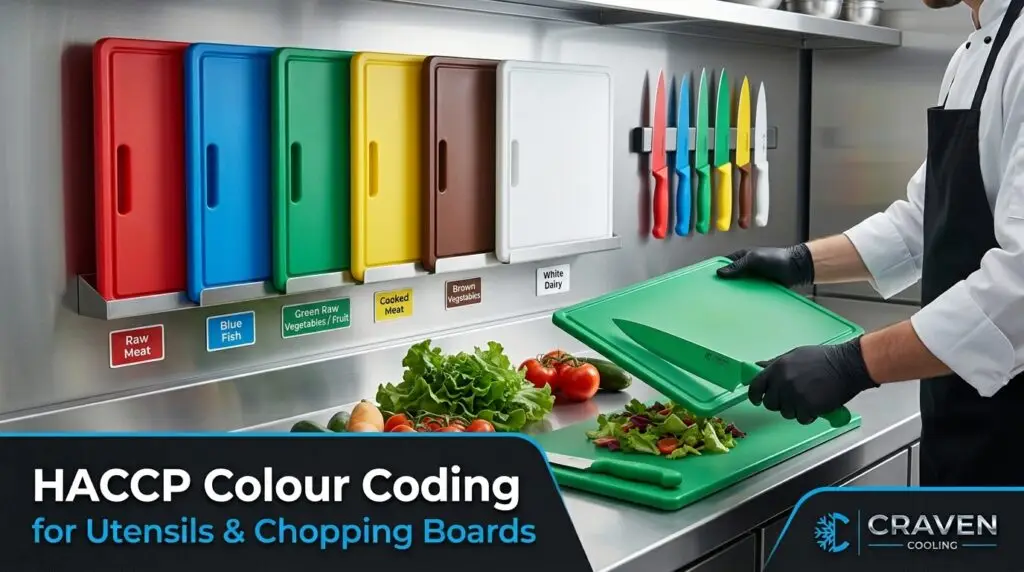
HACCP Colour Coding for Utensils & Chopping Boards
HACCP colour coding for chopping boards and utensils assigns a fixed colour to every food category so a board, knife, tong or spatula used on raw meat can never touch a ready-to-eat salad. The UK six-board standard is red for raw meat, blue for raw fish, green for salad and fruit, yellow for cooked meat, brown for root vegetables, and white for bakery and dairy — and the best kitchens match knife handles, tongs and spatulas to the same colours. It is the most effective barrier against the raw-to-ready pathogen transfer behind most kitchen food-poisoning outbreaks, what every Environmental Health Officer expects to see, and how you demonstrate the cross-contamination duties in retained Regulation (EC) 852/2004. Board colours are a separate system from cleaning-cloth colours.
- The UK six-board standard: RED — raw meat. BLUE — raw fish. GREEN — salad, fruit and herbs. YELLOW — cooked meat. BROWN — root and raw vegetables. WHITE — bakery and dairy.
- Match the utensils to the boards: best practice is colour-coded knife handles, tongs, spatulas and scoops in the same six colours, so the whole handling chain stays on one colour — a red knife never touches the green board.
- The legal basis: retained Regulation (EC) 852/2004 requires food businesses to prevent cross-contamination between and during operations. Colour coding isn’t named in the law — it is the industry-standard method of proving you meet it, and a core HACCP control.
- The hazard it controls: raw-to-ready-to-eat pathogen transfer. Raw meat, poultry and fish carry Salmonella, Campylobacter, E. coli O157 and Listeria; a ready-to-eat food gets no further cook, so any transfer goes straight to the customer.
- Board colours ≠ cleaning-cloth colours: the red/yellow/blue/green cloth-and-mop system codes areas of the building. Green means “salad” on a board and “kitchen zone” on a mop — two unrelated systems that share colours.
- Storage is half the system: store boards segregated in a colour-coded wall rack or slotted stand, upright and air-drying, so a wet red board never leans against a green one.
- Replace scored boards: deep knife grooves harbour bacteria that survive washing. Once a board is heavily scored, warped, stained or thinned, retire it — the plastic is a consumable.
- Cost to implement: the Hygiplas 6-piece colour-coded board set (450 × 300 × 10mm, W356) is £28.77 + VAT — about £4.80 + VAT per board — the fastest food-contact segregation win in any kitchen.
Most kitchen food-poisoning outbreaks begin not with a fridge failing but with a chef using the same board, knife or tongs for the raw chicken and then, minutes later, the coleslaw. Nothing looks wrong — the board was rinsed, the knife wiped — but rinsing does not sterilise, and the pathogens raw meat carries are now on a food that will never be cooked again. Colour coding closes that gap with a rule a first-day porter can follow: raw meat is red, salad is green, red never touches green. The board polices the rule.
This guide is for the people who run the pass under pressure — head and sous chefs, kitchen managers, restaurant operators, and the catering leads in care homes and schools where customers are most vulnerable. Browse the full colour-coded chopping boards range for the hardware itself.
Table of Contents
- 1. Why Colour-Code Boards and Utensils — The Law and the Hazard
- 2. The UK Six-Board Colour Standard Explained
- 3. Matching Utensils — Knives, Tongs and Spatulas
- 4. The Cross-Contamination Science — Raw to Ready-to-Eat
- 5. Storage, Air-Drying and Replacing Scored Boards
- 6. Implementing the System — Six Steps
- Costs and When to Replace a Board
- Frequently Asked Questions
- Related Buying Guides
Red, blue, green, yellow, brown, white — the UK board standard keeping raw and ready-to-eat apart
The retained EU hygiene regulation whose cross-contamination duties this demonstrates
+ VAT for the Hygiplas 6-piece board set — about £4.80 + VAT per board, all six UK colours
The classic incident isn’t dramatic: a chef bones a chicken on the nearest board, rinses it, and dices garnish tomatoes on the same surface with the same knife. The tomatoes are plated raw. If that chicken carried Campylobacter — found on the majority of raw retail birds in UK surveys — a portion is now on the plate, no cook step left. The fix costs about £4.80 + VAT: a red board and knife the chicken never leaves, a green board and knife the salad never leaves. No cheaper barrier exists in the food business.
Board colours code foods; cleaning colours code zones — never merge them
1. Why Colour-Code Boards and Utensils — The Law and the Hazard
Retained Regulation (EC) 852/2004 on the hygiene of foodstuffs is the backbone of UK food hygiene law. It requires every food business to maintain permanent procedures based on HACCP principles, and its Annex II requires that the premises protect food against contamination “between and during operations” — exactly the raw-to-ready cross-contamination this addresses. Nowhere does it say “colour-coded chopping board”; it says you must identify the hazard and control it, and leaves the method to you.
Colour coding is the control the industry settled on because it turns an invisible rule into a visible physical state. A written rule to “never prepare salad on a raw-meat board” depends on every chef remembering it through a Saturday-night rush; a green board with raw chicken on it is instantly wrong to everyone — the head chef, the commis, the agency cover and the EHO in the doorway. This is why the Food Standards Agency’s Safer Food, Better Business pack for caterers (see food.gov.uk) builds its cross-contamination “safe methods” around this separation of equipment by food type.
The hazard is the transfer of pathogens from raw foods, which carry them naturally, to ready-to-eat foods, which get no further cooking. Raw poultry routinely carries Campylobacter and Salmonella; raw red meat can carry E. coli O157; raw fish and shellfish carry Vibrio and Listeria. A cooked-meat platter, salad, cheese board or dessert has no kill step left, so a smear of raw juice on it goes to the plate alive. Colour keeps the raw-meat chain and the salad chain off the same surface.
2. The UK Six-Board Colour Standard Explained
The six-colour board standard below is used across UK professional kitchens, from single-site gastropubs to national contract caterers. It is a convention rather than a statute — but because chefs, suppliers, training providers and inspectors all recognise it, deviating recreates the confusion the system exists to remove. Adopt it as written: a chef who trained anywhere in the UK already knows red is raw meat and green is salad, so a bespoke scheme forces every new starter to unlearn it.
| Colour | Food category | Typical items | Notes |
|---|---|---|---|
| RED | Raw meat | Raw beef, lamb, pork, poultry, offal, raw burgers and sausages | Highest-risk chain. Red board and knife never touch anything served without cooking. |
| BLUE | Raw fish | Raw fish, shellfish, prawns, whole and filleted fish | Kept apart from raw meat for different spoilage flora and allergen (fish/crustacean) cross-contact. |
| GREEN | Salad, fruit & herbs | Leaves, tomatoes, cucumber, fruit, garnishes, fresh herbs | The ready-to-eat chain that most often gets contaminated. Green kit stays exclusively on RTE produce. |
| YELLOW | Cooked meat | Cooked ham, roast beef, cooked chicken, cold cuts, gammon | Ready-to-eat despite being meat. Never share a board with the raw red chain — the classic deli error. |
| BROWN | Root & raw vegetables | Potatoes, carrots, onions, swede, unwashed veg with soil | Keeps soil-borne organisms and grit off salad boards. These vegetables are destined to be cooked. |
| WHITE | Bakery & dairy | Bread, pastry, cheese, butter, cakes, dairy prep | A dedicated surface so flavours and allergens don’t migrate from other chains. |
A few points chefs get wrong. Yellow is cooked meat, a ready-to-eat category — cooked ham sliced on a board that earlier held raw pork is textbook cross-contamination, so yellow and red must never share. Blue is raw fish, not “seafood generally” — cooked prawns for a cocktail belong on a ready-to-eat surface, not the blue board. Brown covers root and raw vegetables that will be cooked; salad leaves and fruit eaten raw belong on green. Get those three right and the rest looks after itself.
The most dangerous slip is treating “meat” as one category. Raw meat (red) and cooked meat (yellow) are opposite ends of the risk scale. A slicer, board or knife that handled raw bacon in the morning and cooked ham in the afternoon is the deli version of the raw-chicken-then-salad error. Keep the two chains on separate colours and boards, ideally separate sections of the bench.
3. Matching Utensils — Knives, Tongs and Spatulas to the Board
A colour-coded board on its own only does half the job. Dice raw chicken on the red board, then use the same knife on the yellow board, and it has carried contamination across regardless of how many boards you own. The best kitchens extend the colour system to the whole handling chain — knife handles, tongs, spatulas, scoops and bowls. The families that complete it:
Chopping Boards
The foundation
- Six colours: red, blue, green, yellow, brown, white
- Commercial size 450 × 300 × 10mm
- Low-density polyethylene — kinder to knife edges
- Dishwasher-safe; retire when scored
Knives & Handles
The carrier chefs forget
- Handles matched to board colours
- One knife stays with one food category
- Prevents “clean board, dirty knife” transfer
- Sanitise between tasks; store in coded racks
Tongs & Servers
Front line and pass
- Coloured tongs for raw versus cooked handling
- Critical on grill and barbecue sections
- Separate tongs for raw meat and cooked plate
- Coded serving spoons for buffets
Storage Racks
Keeps the system honest
- Wall racks or slotted stands, colour-labelled
- Boards stored upright to air-dry
- Segregated so wet boards don’t touch
- Coded knife racks and holders
Craven Cooling stocks or sources colour-coded utensils, tongs and knife sets to pair with the boards, plus the wall racks that keep the set segregated and air-drying. Buy boards and utensils from the same colour family — shades of “red” and “brown” drift between manufacturers, and a faded board that reads as orange invites the wrong grab. And buy spares: when the only green knife is in the wash, “just use the blue one for a second” is how the system quietly fails.
+ VAT — Craven price, set of 6
All six UK board colours
- 450 × 300 × 10mm — standard commercial size
- Red, blue, green, yellow, brown, white
- Low-density polyethylene, knife-friendly
- Dishwasher-safe for daily sanitising
The complete food-contact colour system in one box: one board per food category, in the six UK colours every chef and EHO recognises. At about £4.80 + VAT per board it’s the fastest cross-contamination barrier a kitchen can buy. Pair it with a wall rack and matching coded knives.
4. The Cross-Contamination Science — Raw to Ready-to-Eat
Raw meat, poultry and fish are not “dirty” in a way that looks or smells wrong — they carry pathogenic bacteria as a normal part of the animal’s biology. Poultry is the standout: UK Food Standards Agency surveys have repeatedly found Campylobacter on the majority of raw retail chickens, the country’s most common cause of bacterial food poisoning. Raw beef and other meats can carry E. coli O157, so potent a tiny number of cells can cause serious illness, especially in children and the elderly. Raw fish adds Listeria and Vibrio.
Cooking kills these organisms once the centre is hot enough for long enough. Cross-contamination is dangerous because it delivers them onto a food that will not be cooked again — salad, a cooked-meat platter, cheese, a garnish. A board that held raw chicken, given a quick rinse, still carries viable Campylobacter in the surface film and every knife score; lay a lettuce leaf on it and it goes to the customer contaminated and raw.
A rinse removes visible debris and dilutes surface bacteria, but it does not sterilise a board and barely reaches the bottom of a deep knife groove — which is why a “clean-looking” board is the most dangerous kind. Wash with detergent, sanitise (a dishwasher at sanitising temperature or a two-stage clean-and-disinfect), and — the point of this guide — keep raw and ready-to-eat on separate coloured boards so cleaning between them never arises.
This is also why cooked meat gets its own colour: it is ready-to-eat while raw meat is a pathogen reservoir, so sharing a board is like preparing salad on the chicken board. The same logic separates blue (raw fish) from green (salad and fruit): different risk, different chain, different colour.
5. Storage, Air-Drying and Replacing Scored Boards
A colour system with perfect boards and no storage discipline is only half a system. If washed boards go back into a single wet stack, a red board leaning against a green one transfers exactly what the colours were meant to prevent. Two things make storage work: segregation and air-drying.
Store boards upright and separated in a colour-labelled wall rack or slotted stand, with air gaps so each dries fully. Bacteria need moisture to multiply, so a board dried upright in moving air is hostile while one left flat and wet under another is a warm damp sandwich. Hang or slot coded knives and utensils by colour, not into a shared block. Racks are cheap, and are what an inspector opens the cupboard hoping to see.
Every knife cut in a polyethylene board is a groove that a cloth, a rinse and often even a dishwasher jet cannot fully reach. Over months a heavily used board accumulates thousands of these grooves — a reservoir where bacteria and food residue harbour, protected from cleaning. This is why a board is a consumable, and why a low-density board kinder to knife edges also scores more readily. When one is deeply scored, stained, warped so it rocks, or worn thinner, retire it, keeping a replacement of each colour on the shelf.
How long a board lasts depends on use, not the calendar: a white bakery board may last a year or more, a red raw-meat board only a few months. Because the Hygiplas W356 set is £28.77 + VAT for six — about £4.80 + VAT per board — replacing a worn one is a trivial cost against running a scored, bacteria-harbouring surface in the raw-meat chain.
Boards upright and separated in a wall rack or slotted stand, so wet boards never lean together.
Boards dried upright in moving air, not stacked flat and damp — a wet stacked board is an incubator.
Wash with detergent then sanitise — a dishwasher at sanitising temperature or a clean-and-disinfect step. Rinsing alone is never enough.
Knife grooves harbour bacteria that survive cleaning. Bin any board heavily scored, warped, thinned, cracked or permanently stained — keep spares so it happens immediately.
Colour-coded knives, tongs and servers hung or slotted by colour — never mixed in a shared block.
6. Implementing the System — Six Steps
A colour system fails in implementation, not concept. Here is the rollout sequence that makes it stick, whether you’re a 40-cover gastropub or a multi-site care caterer.
Map every food to a colour: raw meat red, raw fish blue, salad and fruit green, cooked meat yellow, root veg brown, bakery and dairy white. Settle the awkward cases — cooked prawns, marinated meats, garnishes — on a chart so nothing is improvised mid-service.
Start with the Hygiplas 6-piece board set (W356, £28.77 + VAT) and add coded knives, tongs and servers in the same colours from one brand family so shades match. Buy a spare board and knife per high-use colour.
Fit a colour-labelled wall rack or slotted stand so boards store upright, separated and drying, and hang coded knives by colour. What kills the system is a single wet stack.
A laminated six-colour chart at the prep section, answering in two seconds: which colour, which food. Include your site-specific decisions so agency and relief chefs need no handover. Keep it physically apart from any cleaning-colour chart.
Cover the six board colours, the matching-utensils rule, and — critically — that board colours are a different system from cleaning-cloth colours (green means salad on a board, kitchen zone on a mop). Record who was trained, when and on what — every agency and casual chef included.
A 60-second check each shift: right colours on the right foods, knives with their boards, storage segregated, no board so scored it should be binned. A scored raw-meat board is coded contamination.
The most common training failure in the subject. UK kitchens run two separate colour systems that share some colours. This guide is the food-contact system — boards and utensils, coded by food category. The separate cleaning system codes areas of the building: red for washroom equipment, yellow for washbasins, blue for front of house, green for the kitchen zone. Green means “salad” on a board and “kitchen zone” on a mop; red means “raw meat” and “toilets”. Train them on two separate charts in two places. Our companion colour-coded cleaning systems guide covers the cleaning side in full.
Costs and When to Replace a Board
£28.77 + VAT
Hygiplas W356 — all six UK colours, 450 × 300 × 10mm
~£4.80 + VAT
The cost of replacing a single scored or worn board
We source
Colour-coded knives, tongs and servers to match — ask sales
We source
Colour-labelled board and knife racks for segregated air-drying
Treat the boards as a consumable. The operator who “saves” money by running a scored, warped raw-meat board another six months is running a colour-coded contamination-harbouring system — the colour is right, the hygiene is gone. At about £4.80 + VAT a board, condition-based replacement is the cheapest food safety decision you’ll make.
Family-run, Swansea showroom, 2-year parts warranty on equipment across UK & Ireland. We stock or source colour-coded boards, matching knife sets, tongs, servers and storage racks — tell us your menu and we’ll spec the lot.
Browse Catering Equipment
Call Sales — 01792 732702
Colour coding is one layer of a safe kitchen. Go further with our colour-coded cleaning systems guide for the separate cleaning-equipment system, the HACCP cleaning schedules guide for the paperwork, the choosing the right serving board material guide for presentation boards, and the food storage and wrapping guide for keeping raw and ready-to-eat apart in the fridge.
HACCP colour coding assigns a fixed colour to each food category so raw and ready-to-eat foods never share a surface. The UK six-board standard is red for raw meat, blue for raw fish, green for salad and fruit, yellow for cooked meat, brown for root vegetables, and white for bakery and dairy — and the best kitchens match knife handles, tongs and servers to the same colours. It is the industry-standard method of controlling raw-to-ready-to-eat cross-contamination, the pathway behind most kitchen food-poisoning outbreaks (raw poultry alone routinely carries Campylobacter), and it demonstrates the cross-contamination duties in retained Regulation (EC) 852/2004. Store boards upright and segregated in a colour-labelled rack, and retire any deeply scored or warped. Critically, board colours are a separate system from cleaning-cloth colours: green means salad on a board and kitchen zone on a mop. The Hygiplas 6-piece board set (450 × 300 × 10mm, W356) is £28.77 + VAT — about £4.80 + VAT per board. Call 01792 732702 or email [email protected].
Frequently Asked Questions
▼
▼
▼
▼
▼
▼
▼
▼


