Colour-Coded Cleaning Systems for Food Safety: The Complete UK Guide (2026)
A colour-coded cleaning system assigns a fixed colour to every cleaning zone in your premises — red for washrooms and sanitary fittings, yellow for washbasins and lower-risk washroom surfaces, blue for general front-of-house areas, green for kitchens and food areas — so that a cloth, mop or bucket used in one zone can never physically end up in another. It is the cheapest cross-contamination control you will ever buy, it is what Environmental Health Officers expect to see in any professional food operation, and it is how you demonstrate compliance with the cleanliness requirements of retained Regulation (EC) 852/2004. This guide explains the UK four-colour convention, what equipment gets coded, why cleaning colours are a completely different system from chopping board colours, how to build the audit trail, and how to implement the whole thing for less than the cost of a single wasted delivery.
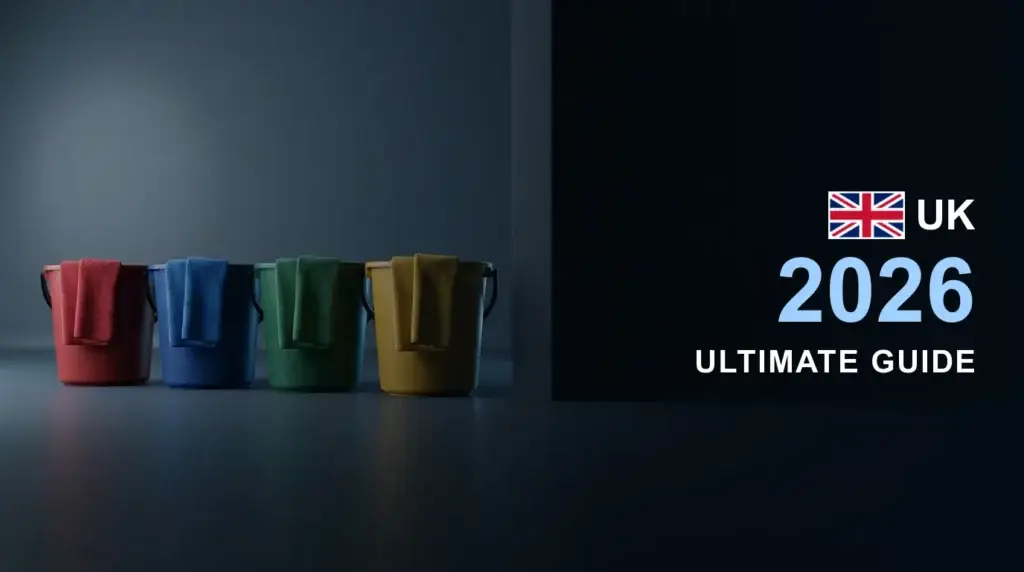
- The UK four-colour convention: RED — washroom floors, toilets, urinals (highest sanitary risk). YELLOW — washbasins, washroom sinks and surfaces. BLUE — general low-risk areas: front of house, offices, corridors, bar tops. GREEN — kitchens and food preparation areas.
- The legal basis: retained Regulation (EC) 852/2004 requires food premises, surfaces and equipment to be kept clean and maintained so as to avoid contamination. Colour coding is not named in the regulation — it is the industry-standard method of proving you meet it.
- What gets coded: cloths, mop heads, mop handles, buckets, brushes, dustpans, spray bottle triggers, scourers, squeegees, gloves and aprons. If it touches a surface, it carries a colour.
- Cleaning colours ≠ chopping board colours: the six-colour chopping board system (red raw meat, blue raw fish, yellow cooked meat, green salad and fruit, brown root vegetables, white bakery and dairy) is a separate food-contact system. Green means “kitchen zone” on a mop and “salad only” on a board. Train them as two systems or staff will merge them — dangerously.
- Storage is half the system: coded equipment must be stored segregated by colour, mops head-up, in a ventilated cupboard or wall rack. A red mop touching a green mop in a shared bucket defeats the entire scheme.
- EHO expectation: inspectors look for the colour chart on the wall, matching equipment in the right zones, segregated storage, and a signed cleaning schedule. A visible, working colour system directly supports the “confidence in management” element of your Food Hygiene Rating.
- Cost to implement: a full four-colour kit-out for a small site — mops, buckets, cloths, brushes and wall chart — runs £150–£300 + VAT. One cross-contamination incident costs more in stock disposal alone, before any enforcement action.
- Replacement cycle: disposable cloths daily or per-task; laundered microfibre cloths washed at 90°C and retired at 100–200 washes; mop heads laundered weekly minimum and replaced every 1–3 months in heavy use.
Cross-contamination via cleaning equipment is the failure mode nobody sees happening. Raw chicken juice wiped from a prep bench, the same cloth used an hour later on the pass; a mop that did the gents at 10 am doing the kitchen floor at noon. Nothing looks wrong. The surfaces gleam. But cleaning without segregation doesn’t remove contamination — it relocates it, evenly, across every surface in the building. Colour coding fixes this with brutal simplicity: the equipment physically cannot cross zones without the breach being visible to anyone in the room.
This guide is for operators who need the system to actually work under pressure — kitchen managers, publicans, café and restaurant owners, care home and school catering leads, contract cleaning supervisors. It covers the standard convention, the kit, the storage, the paperwork and the training that makes it stick. For the chemicals that go in those coded buckets, see our cleaning detergents and chemicals range; for the hardware itself, the cleaning equipment category.
Table of Contents
- 1. Why Colour-Code — The Law and the Logic
- 2. The UK Four-Colour Standard Explained
- 3. What Gets Coded — Cloths, Mops, Buckets and Beyond
- 4. Cleaning Colours vs Chopping Board Colours
- 5. Implementing the System — Seven Steps
- 6. Audit Trails and What the EHO Looks For
- Kit-Out Costs and Worked Example
- Frequently Asked Questions
- Related Buying Guides
1. Why Colour-Code — The Law and the Logic
Retained Regulation (EC) 852/2004 on the hygiene of foodstuffs is the backbone of UK food hygiene law. Annex II requires food premises to be kept clean and in good repair, requires surfaces and equipment in contact with food to be effectively cleaned and where necessary disinfected, and requires the layout and practices of the business to protect against contamination between and during operations. Nowhere does it say the words “colour-coded cleaning”. What it says is that you must have adequate procedures to prevent contamination — and then leaves the method to you.
Colour coding is the method the industry settled on decades ago because it solves the enforcement problem inside your own kitchen. A written rule that says “never use washroom cloths in food areas” depends on every staff member remembering, caring and being watched. A red cloth in a green zone depends on nothing — it’s instantly, visibly wrong to everyone including the newest kitchen porter, the agency cleaner who started an hour ago, and the EHO standing in the doorway. The system converts an invisible hygiene rule into a visible physical state. That’s the whole trick, and it’s why the Food Standards Agency’s Safer Food, Better Business guidance for caterers (see food.gov.uk) builds its cleaning and cross-contamination safe methods around exactly this kind of physical separation.
The microbiology backs it up. Cleaning cloths are close to ideal bacterial transfer devices: damp, warm, nutrient-loaded and pressed firmly against every surface they touch. A cloth used on a contaminated surface doesn’t sterilise itself between wipes — it inoculates the next surface, and the next. The same is true of mop water, which after a washroom floor is best thought of as a diluted culture medium. Segregation by zone doesn’t make any single cloth cleaner; it caps how far anything can travel.
2. The UK Four-Colour Standard Explained
The four-colour convention below is the one used across UK hospitality, contract cleaning and facilities management. It is a convention rather than a statute — but because agency staff, cleaning contractors and inspectors all know it, deviating from it creates exactly the confusion the system exists to remove. Adopt it as written unless you have a compelling site-specific reason not to, and if you do deviate, document why on the wall chart.
| Colour | Zone | Typical surfaces | Risk logic |
|---|---|---|---|
| RED | Washrooms — high risk | Toilets, urinals, washroom floors | Highest pathogen load in the building. Red equipment never leaves the washroom. |
| YELLOW | Washrooms — lower risk | Washbasins, taps, mirrors, washroom walls and doors | Separates basin-level cleaning from toilet-level cleaning so basin surfaces aren’t wiped with toilet cloths. |
| BLUE | General / front of house | Dining room, bar top, tables, corridors, offices, reception | Low-risk public areas. Blue keeps general dust-and-spill cleaning out of both the washroom and the kitchen chains. |
| GREEN | Kitchen & food areas | Prep benches, kitchen floors, walls, shelving, stores | Food areas get their own dedicated chain of equipment that has never touched anything else. |
Some operations add colours beyond the four — a fifth colour for external areas and bins, or a white set reserved for direct food-contact surfaces after disinfection. That’s legitimate, but resist the urge to over-engineer. Four colours is a system a 17-year-old weekend starter can hold in their head after one briefing. Seven colours is a quiz. Every colour you add increases both cost and the chance of a wrong-colour grab during a Friday rush, so add a colour only when a genuine zone exists that the four cannot cover.
3. What Gets Coded — Cloths, Mops, Buckets and Beyond
The system only works if it covers every item that touches a surface. Code the cloths but share the buckets and the mop water still migrates between zones. The standard kit list per colour zone:
Cloths & Wipes
The highest-risk item- Colour-coded microfibre or disposable cloths
- Disposables: discard per task or per shift
- Microfibre: launder at 90°C, retire at 100–200 washes
- Never “rinse and reuse” between zones
- Store dry — a damp folded cloth is an incubator
Mops & Handles
Code the whole assembly- Coded head AND coded handle — heads get swapped
- Launder heads weekly minimum
- Replace heads every 1–3 months in heavy use
- Store head-up, air-drying, by colour
- Flat mops with coded pads work the same way
Buckets & Wringers
The forgotten carrier- One bucket per colour — no exceptions
- Mop water is the main cross-zone vector
- Empty, rinse and invert after every use
- Never store a mop standing in the bucket
- Coded wringer inserts where fitted
Brushes, Bottles & PPE
Complete the chain- Deck scrubs, dustpans and brushes per zone
- Coded trigger sprays — label chemical AND zone
- Gloves and aprons coded in washroom zones
- Squeegees for washroom and kitchen floors
- If it touches a surface, it carries a colour
Two practical notes from sites that run this well. First, buy everything in the same brand family if you can — colour shades vary between manufacturers, and a faded “red” that reads as orange next to a bright red invites mistakes. Second, order spares of everything at kit-out. When the only green mop head is in the laundry, the pressure to “just borrow the blue one for a minute” is exactly how the system dies. A spare head per colour costs a few pounds and removes the excuse permanently.
4. Cleaning Colours vs Chopping Board Colours — Two Systems, Not One
This is the single most common training failure in the whole subject. UK kitchens run two separate colour systems that happen to share some colours, and staff who have only half-learned them will merge them into one confused mess. The cleaning system codes areas of the building. The chopping board system codes categories of food. Green on a mop means “kitchen zone equipment”. Green on a chopping board means “salad and fruit only”. Red on a bucket means “toilets”. Red on a board means “raw meat”. Same colours, unrelated meanings.
| Board colour | Food category | Contrast with cleaning system |
|---|---|---|
| Red board | Raw meat | Red cleaning kit = washroom toilets and floors |
| Blue board | Raw fish | Blue cleaning kit = front of house and general areas |
| Yellow board | Cooked meat | Yellow cleaning kit = washbasins and washroom surfaces |
| Green board | Salad and fruit | Green cleaning kit = the entire kitchen zone |
| Brown board | Root vegetables | No brown in the standard cleaning convention |
| White board | Bakery and dairy | White cleaning kit only where a site adds a food-contact set |
Train them as two systems, on two separate wall charts, hung in two different places — the board chart at the prep bench, the cleaning chart in the cleaning store. When you brief new starters, say the sentence out loud: “these colours mean rooms, those colours mean foods, and they have nothing to do with each other.” It sounds laboured. It prevents the porter who “helpfully” scrubs the green salad boards with the green kitchen-floor brush.
- 450 × 300 × 10mm — standard commercial size
- Red, blue, yellow, green, brown, white
- Low-density polyethylene, knife-friendly
- Dishwasher-safe for daily sanitising
- Covers the full raw-to-ready food separation
The companion system to your coded cleaning kit: one board per food category, in the standard UK colours every chef and every EHO recognises. At under £5 + VAT per board it’s the fastest food-contact segregation win available — pair it with a wall-mounted rack so the set stores separated and air-dries.
View Board Set →5. Implementing the System — Seven Steps
A colour system fails in implementation, not in concept. Here is the rollout sequence that works, whether you’re a 30-cover café or a multi-site contract caterer.
Walk the site and assign every room to a colour: washroom high-risk (red), washroom basins (yellow), general and front of house (blue), kitchen and food stores (green). Decide the awkward cases now — staff room, cellar, external bin store — and write the decision down. Ambiguity discovered mid-shift becomes improvisation.
Per zone: mop head, mop handle, bucket, cloths, brush, dustpan, spray bottles — all in zone colour, all in one brand family so shades match. Add one spare mop head and a spare pack of cloths per colour so laundry gaps never force a cross-zone borrow.
A ventilated cleaning store with wall brackets per colour, mops hung head-up to air-dry, buckets inverted, cloths in labelled tubs. If space is tight, four wall hooks and four labelled shelf sections do the job. What kills the system is a single wet heap in the corner where every colour marinates together.
A laminated colour chart in the cleaning store and a second by the kitchen hand-wash station. It should answer the question in two seconds: which colour, which zone. Include your site-specific decisions (bins, cellar, staff room) so agency and relief staff need zero verbal handover.
Every line of your cleaning schedule should name the zone, the task, the frequency, the chemical, the dilution, the contact time — and the colour of the equipment used. That single column is what turns a colour habit into an auditable procedure under your food safety management system.
The briefing covers: the four colours, the two-systems point (cleaning colours versus board colours), storage rules, and what to do when the right colour isn’t available (get the spare — never borrow). Record names, date and content of the training. That record is audit gold.
A 60-second weekly walk: right colours in right zones, storage segregated, mop heads not overdue, cloths not grey. Log the check. Budget cloth and mop-head replacement as a standing consumable line — worn-out coded kit is coded contamination.
6. Audit Trails and What the EHO Looks For
An Environmental Health Officer inspecting under the Food Hygiene Rating Scheme scores three things: hygiene practices they observe, the structure of the premises, and confidence in management — the paperwork and systems that show the good practice happens when nobody’s watching. A colour-coded cleaning system feeds all three, but only the audit trail feeds the third. Here’s what a complete trail looks like:
-
✓
Zone map and colour chart The laminated chart on the wall, dated, showing the four colours, their zones and your site-specific decisions. This is the document version of the system.
-
✓
Cleaning schedule with colour column Task, area, frequency, chemical, dilution, contact time, equipment colour, and a signature box per completion. Kept current, kept signed — a schedule with three blank weeks is worse than no schedule.
-
✓
Training records Who was trained on the colour system, when, by whom, covering what. Include agency and casual staff — they are the people most likely to breach it innocently.
-
✓
Replacement and laundering log When mop heads were last replaced, how cloths are laundered (on-site 90°C wash or laundered service) or disposed. Shows the coded kit is actually clean, not just colour-matched.
-
✓
Weekly spot-check record The 60-second walk, logged with date, initials and any corrective action. Corrective actions recorded honestly (“blue cloth found in kitchen — removed, retraining given”) strengthen the file, not weaken it.
On inspection day, the sequence usually runs: the officer sees the chart, then looks for the equipment matching it in the zones, then opens the cleaning store to check segregation, then asks a member of staff — not the manager — what the colours mean. That last step is the real test. A system that lives only in the manager’s head scores nothing. If your newest starter can answer, you’ve passed the only exam that matters.
Kit-Out Costs — UK Price Tiers and Worked Example
Set the consumable line and forget the debate: cloths and mop heads are not durable goods. The operator who “saves” £140 a year by running grey cloths and matted mop heads is running a colour-coded contamination distribution system — the colours are right and the hygiene is gone.
Colour coding is one layer of a hygienic kitchen. Go deeper with our COSHH chemical storage and dilution guide, the floor cleaning chemical guide for matching chemistry to flooring, the hands-free hygiene equipment guide for taps, dispensers and door hardware, and the compliant commercial washroom guide for the red and yellow zones themselves.
Colour-coded cleaning assigns fixed colours to building zones — red for toilets, urinals and washroom floors, yellow for washbasins and washroom surfaces, blue for front of house and general areas, green for kitchens and food areas — so cleaning equipment physically cannot migrate contamination between zones. It is the industry-standard method of demonstrating the contamination-prevention duties in retained Regulation (EC) 852/2004, and it is what EHOs expect to see: chart on the wall, matching kit in the zones, segregated head-up storage, a cleaning schedule with a colour column, and training records. Code everything that touches a surface — cloths, mop heads and handles, buckets, brushes, spray bottles, PPE — and hold spares per colour so nobody ever borrows across zones. Critically, cleaning colours and chopping board colours are two unrelated systems: green means “kitchen zone” on a mop and “salad only” on a board — the Hygiplas 6-piece board set (£28.77 + VAT) covers the food-contact side in the standard six UK colours. A full four-colour kit-out costs £150–£300 + VAT, roughly £479 + VAT for year one with consumables — the cheapest food safety infrastructure you will ever buy. Craven Cooling stocks or sources the full cleaning equipment and chemicals range: call 01792 732702 or email sales@cravencooling.co.uk.