
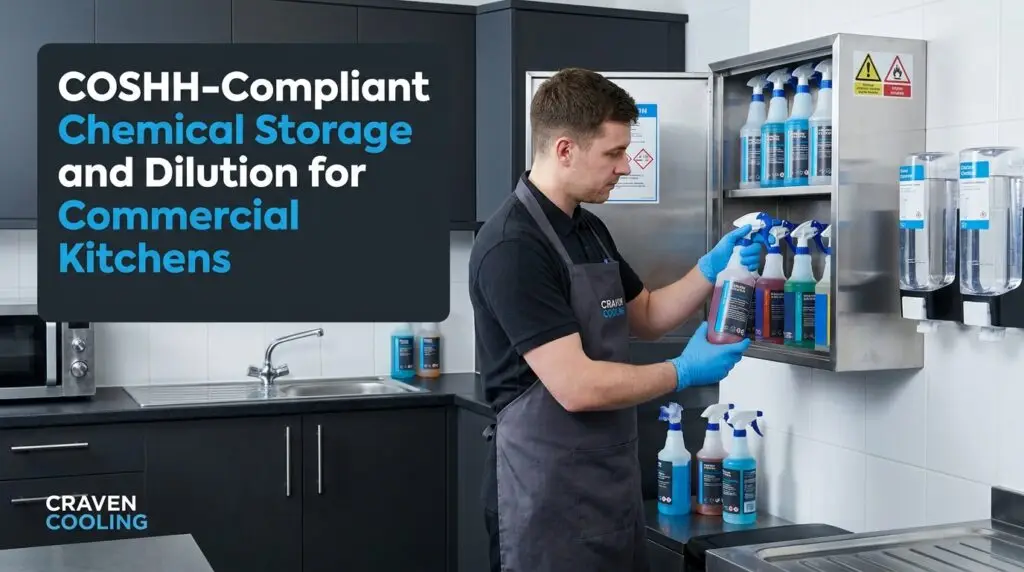
COSHH-Compliant Chemical Storage and Dilution for Commercial Kitchens
Every UK commercial kitchen that uses cleaning chemicals falls under the Control of Substances Hazardous to Health Regulations 2002 (COSHH). That means a written risk assessment, safety data sheets on file, segregated storage keeping chlorine products physically apart from acids, controlled dilution rather than free-pouring, the right PPE, and signed training records. This guide walks through each requirement in the order an inspector checks them — including the one genuinely life-or-death rule: never mix chlorine bleach with acid descaler, because the reaction releases chlorine gas.
- The law: the Control of Substances Hazardous to Health Regulations 2002 (COSHH) require every employer to assess the risks of hazardous substances, prevent or control exposure, and train staff. There is no small-business exemption — a two-person café is covered the same as a hotel group.
- Safety data sheets (SDS): your chemical supplier must provide a 16-section SDS for every hazardous product. Keep them in a folder (paper or digital) that staff can actually reach mid-shift — an SDS locked in the manager’s office fails the point of having one.
- The never-mix rule: chlorine-based products (bleach, chlorinated sanitisers) mixed with acids (descaler, toilet cleaner, some limescale removers) release chlorine gas. This is the single most dangerous chemical error made in UK kitchens — store them on separate shelves and never combine residues in a bucket, sink, or drain.
- Storage: chemicals must be stored away from food and food-handling areas (retained Regulation (EC) 852/2004, Annex II) — a lockable COSHH cupboard or dedicated store, low-level shelving for 5L concentrates, and original labelled containers only.
- Dilution control: free-pouring concentrate wastes 30–50% of chemical spend and produces solutions that are either unsafe or ineffective. Pelican pumps (30ml per stroke), dosing taps, and pre-measured sachets bring every make-up to the manufacturer’s stated ratio.
- PPE: the SDS section 8 tells you what to wear. For most kitchen concentrates that means nitrile gloves and eye protection when decanting or diluting; ready-to-use trigger sprays usually need gloves only.
- Sanitiser standards: the Food Standards Agency (food.gov.uk) advises using disinfectants and sanitisers that meet BS EN 1276 or BS EN 13697 — and following the stated contact time, typically 30 seconds to 5 minutes.
- Records: keep the COSHH assessment, SDS folder, dilution charts, and signed training records. If an EHO or HSE inspector asks and there is nothing on paper, the assumption is that it never happened.
Chemical storage gets the least attention of any kitchen compliance area until something goes wrong — a burned hand, a fumes evacuation, or an inspector finding bleach stored above descaler in an unlabelled lemonade bottle. None of the requirements are expensive or complicated. What they demand is a system: one place for chemicals, one sheet per product, one dilution method, one training record per person. This guide sets that system out in full, with the real regulation names and the practical detail generic COSHH posters leave out.
This guide is for the people who run UK commercial kitchens — owner-operators, head chefs, kitchen managers, catering managers in schools, care homes and hospitals, and multi-site operators standardising practice across venues. It covers cleaning and sanitising chemicals in food premises; industrial process chemicals and pest control are out of scope. When ready to standardise your range, browse the cleaning detergents and chemicals range at Craven Cooling.
Table of Contents
Sections in every safety data sheet — sections 2, 4, 7 and 8 are the ones kitchen staff actually need
Typical chemical spend wasted by free-pouring concentrate instead of measured dosing
Number of times chlorine products and acids should ever meet — in a bottle, bucket, sink or drain
Sodium hypochlorite (bleach, chlorinated machine detergents) reacts with any acid — descaler, limescale remover, some toilet cleaners — to release chlorine gas; with ammonia glass cleaners it forms chloramine vapour. Both damage airways in a confined pot-wash room within minutes. The classic incident is not deliberate mixing: it is descaler poured into a sink still holding bleach residue, or a spray bottle “topped up” with the wrong product. One product per bottle, rinse between chemicals, chlorine and acid on different shelves. Injuries from a mixing incident are reportable under RIDDOR 2013.
Chlorine gas — the product of bleach + acid. Evacuate, ventilate, call 999 if anyone is affected
Step 1: What COSHH 2002 Actually Requires of a Kitchen
COSHH is not a certificate you buy or a poster you laminate. The Control of Substances Hazardous to Health Regulations 2002 place a set of duties on the employer, and the Health and Safety Executive publishes free practical guidance at hse.gov.uk/coshh. For a commercial kitchen, the duties break down like this:
| COSHH duty | What the regulation says | What it means in a kitchen |
|---|---|---|
| Risk assessment | Assess the risk to health from hazardous substances before work starts (Regulation 6) | List every chemical on site; note who uses it, how, and what could go wrong. One page per product suffices. |
| Prevention or control | Prevent exposure, or where not reasonably practicable, adequately control it (Regulation 7) | Swap the nastiest products for safer equivalents where you can; control the rest with dilution systems, ventilation, PPE, and storage. |
| Use of controls | Ensure control measures are actually used and maintained (Regulations 8–9) | Dosing pumps serviced, gloves stocked in the right size, cupboard actually locked. A control that exists but is not used counts against you. |
| Information & training | Provide employees with suitable information, instruction and training (Regulation 12) | Every chemical user shown the SDS, dilution rate, PPE and first-aid response — with a signed record kept. The duty EHOs check first. |
| Emergency planning | Plan for accidents, incidents and emergencies (Regulation 13) | Spill kit or absorbent materials, eyewash access, and staff who know the evacuate-and-ventilate response to a fume incident. |
The practical shape of compliance is a ring binder (or shared folder) containing four things: the chemical inventory, one COSHH assessment per product, the SDS set, and the training log. Multi-site operators should standardise the chemical list first — five products doing the work of fifteen makes every other step cheaper and safer.
Most kitchens can run on five or six products: neutral detergent, a sanitiser meeting BS EN 1276 or BS EN 13697, degreaser, machine warewash detergent and rinse aid, and descaler. Every extra product multiplies assessments, segregation problems, and the chance of a wrong-bottle error at 11pm on a Friday. Cut the range first — rationalising from twelve products to six typically trims chemical spend 20–30% as well.
Step 2: Safety Data Sheets — Getting Them, Reading Them, Filing Them
Suppliers of hazardous chemicals are legally required to provide a safety data sheet, and every SDS follows the same 16-section format. You do not need to read all sixteen sections — four of them do the work in a kitchen:
| Section | Title | What you use it for |
|---|---|---|
| Section 2 | Hazards identification | The pictograms and hazard statements — tells you whether this is an irritant, a corrosive, or worse. This drives your storage and PPE decisions. |
| Section 4 | First aid measures | What to do for skin contact, eye contact, ingestion, inhalation. Print this section and keep it with the first aid kit — nobody reads a PDF during an eye splash. |
| Section 7 | Handling and storage | Storage temperature, incompatible materials (this is where “keep away from acids” appears on chlorine products), and container guidance. |
| Section 8 | Exposure controls / personal protection | The PPE specification — glove material, eye protection, ventilation requirements. Buy the PPE this section names, not the PPE that happens to be in the cupboard. |
Getting the sheets is straightforward: every reputable supplier publishes them on the product page or supplies them with the first order. Check revision dates annually — sheets change when formulations change. Two filing rules save inspections: the folder lives where the chemicals are used (by the pot wash, not the office), and the folder must match the shelf — delisted products out, new products in the same week. An EHO who finds mismatches will reasonably conclude the system is decorative.
A caustic degreaser at 1:50 in a trigger bottle is far less hazardous than the 5L concentrate it came from. Your COSHH assessment should cover both states: who handles the concentrate (trained staff, gloves and goggles) and who handles the dilution (everyone). The highest-risk moment in the whole chemical lifecycle is the 30 seconds of decanting — control that and you have controlled most of the risk.
Step 3: Segregated Storage That Passes Inspection
Retained Regulation (EC) 852/2004 requires that cleaning agents and disinfectants are not stored in areas where food is handled. COSHH adds the segregation and access logic. Combining the two gives you four workable storage formats:
Lockable COSHH Cupboard
Typical cost £150–£450 + VAT
- Steel, lockable, hazard-signed
- Best for: cafés, small kitchens
- Holds 10–20 × 5L containers
- Site away from food prep & heat
- Integral sump catches leaks
Dedicated Chemical Store
Room or large cage
- Best for: hotels, care homes, schools
- Ventilated, cool, frost-free
- Shelf-level segregation by chemical family
- Concentrates stored below shoulder height
- Restricted-access door
Bunded Shelving
Retrofit for existing stores
- Drip trays contain a full 5L spill
- Stops shelf-to-shelf cross-drip
- Chlorine shelf and acid shelf separated
- Cheap insurance against leaking caps
- Wipe-clean, chemical-resistant
Point-of-Use Caddies
Day-tank system
- Only diluted, labelled bottles leave the store
- Caddy per section: pot wash, front of house
- Nothing hazardous stored under sinks
- Return to store at close
- Makes the daily clean auditable
Whatever the format, the segregation logic is the same. Chlorine products on one shelf; acids on another, physically separated. Caustics low down, because a splash from shoulder height finds a face. No concentrates above eye level, nothing on the floor where a mop bucket can strike it, and nothing — ever — in a food or drink container: bleach decanted into an empty water bottle remains one of the most common causes of accidental chemical ingestion in UK workplaces.
Concentrates stay in the supplier’s labelled container until the moment of dilution. A label damaged beyond reading makes the container unknown — dispose via your waste contractor, never guess.
Trigger bottles get a printed label: product name, ratio, date made up, key hazard. Suppliers sell pre-labelled bottles matched to their concentrates for pennies. An unlabelled spray bottle is an automatic inspection note.
Chlorine sanitisers lose strength fast in warm, bright storage — a bottle on a sunny windowsill can drop below effective concentration within days. Cool, dark, frost-free, never above or beside food or packaging.
Lock the cupboard or store; keys stay with trained staff. This matters double in schools, care homes and hospitals where pupils, residents or patients may reach kitchen areas.
First in, first out — chemicals age. Quarterly cull: leaking caps, crusted threads, discontinued products, mystery bottles. Part-used containers go to a licensed waste route, not down the drain.
Chlorine bleach / chlorinated sanitiser + acid descaler = chlorine gas on contact. Bleach + ammonia glass cleaner = chloramine vapour. Caustic oven cleaner + aluminium containers = hydrogen gas and a split container. Separate shelves, separate spill trays, and separate colour-coded bottles. If two incompatible products are found stored lip-to-lip on the same shelf, an inspector reads it as a system failure, not bad luck.
Step 4: Dilution Control — From Free-Pour to Dosing Systems
Dilution is where COSHH compliance and cost control meet. Every concentrate has a stated ratio — typically 1:20 to 1:100 for degreasers and surface cleaners — and both directions of error cost you. Over-concentrated solutions are a skin and residue hazard and burn money; under-concentrated sanitiser fails to kill, a food safety failure under your HACCP plan even though the surface looks clean. Free-pouring by eye reliably produces both errors in the same shift.
| Method | How it works | Accuracy | Typical cost | Best for |
|---|---|---|---|---|
| Free-pour “glug” | Tip concentrate into bucket by eye | ✗ ±100% or worse | Free (appears to be) | Nothing. Wastes 30–50% of spend and fails COSHH control expectations. |
| Pelican pump | Screw-on pump dispensing a fixed 30ml per stroke | ✓ Good | £3–£8 + VAT per pump | Small kitchens; the cheapest step-change in control available. |
| Dosing cap / chamber bottle | Squeeze concentrate into a measuring chamber built into the bottle | ✓ Good | Often free with product range | Trigger-spray make-up at the sink; low training burden. |
| Wall-mounted dosing unit | Plumbed venturi unit mixes water and concentrate at a fixed ratio at the push of a button | ✓ Excellent, locked ratio | £80–£300 + VAT installed per station | Any kitchen making up 10+ bottles or buckets a day; removes concentrate handling entirely. |
| Pre-measured sachets / tablets | One sachet or tablet per bottle or bucket of water | ✓ Excellent | Higher per-litre cost | Multi-site operators wanting identical strength at every venue with zero equipment. |
Whichever method you choose, put a dilution chart on the wall where bottles are made up — product, ratio, dose per bottle, contact time, PPE — and train the water-first habit: always add concentrate to water, never water to concentrate, so any splash is dilute rather than neat.
Step 5: PPE and Spill Response
PPE under COSHH is the last line of control, not the first — the hierarchy is substitute the product, engineer the exposure away (dosing units), then protect the person. For the handling that remains, SDS section 8 is the shopping list. A kitchen chemical PPE station looks like this:
-
✓
Nitrile gloves in at least two sizes
Nitrile, not latex (allergy risk) and not thin vinyl (food-service, not chemical protection). For prolonged caustic contact, longer-cuff heavier-gauge gauntlets per the SDS. -
✓
Eye protection at the decanting point
Safety glasses or goggles hung next to the dosing station, not in a drawer. Concentrate splash to the eye is the injury that section 4 of every caustic SDS is written for. -
✓
Apron for oven-clean and deep-clean jobs
A chemical-resistant apron for the weekly caustic jobs. Chef whites soak and hold concentrate against the skin — that is how delayed caustic burns happen. -
✓
Eyewash provision
10–15 minutes of gentle running water is the standard response to eye contact. If the chemical store is remote from a sink, wall-mount sealed eyewash bottles and check expiry dates quarterly. -
✓
Spill materials
Absorbent granules or pads, a dedicated dustpan, heavy gloves. A 5L concentrate spill is a slip hazard and a chemical exposure at once — contain, absorb, ventilate, dispose. -
✓
First aid alignment
The first aider should know which chemicals are on site, with SDS section 4 printouts to hand to paramedics. Burns: running water, 20 minutes, no creams.
A sharp chlorine or “swimming pool” odour after chemicals have been used or mixed means: stop work, get everyone out, ventilate from outside the affected area, and do not re-enter to “see if it’s cleared”. Anyone coughing or struggling to breathe needs fresh air and medical attention — call 999 if symptoms persist. Then investigate which two products met and fix the storage or procedure gap the same day.
Step 6: Training and Records — The Evidence Layer
Under COSHH Regulation 12, staff using hazardous substances must receive suitable information, instruction and training; retained Regulation (EC) 852/2004 requires food handlers to be trained appropriately to their role, which includes the chemical side of cleaning. Neither demands a paid course — both demand that the training happened and can be shown to have happened.
Before a new starter touches any chemical: walk the store, show the SDS folder, demonstrate dilution, name the PPE, state the never-mix rule out loud. Twenty minutes, signed and dated by both parties.
A new chemical entering the kitchen triggers a five-minute team briefing: what it is, what it replaces, ratio, contact time, PPE. Add the SDS to the folder and the product to the dilution chart the same day.
Once a year, re-walk the system: assessments still accurate, SDS revision dates checked, shelf layout still segregated, staff still fluent in the spill response. Update, re-sign, re-date.
Training log, COSHH assessments, SDS folder, dilution charts. Producing the folder in two minutes changes the tone of an entire inspection.
What a Compliant Setup Costs — July 2026
£200–£400
Lockable COSHH cupboard, pelican pumps, labelled bottles, laminated charts, PPE station
£500–£1,000
Larger cupboard or caged store, bunded shelving, 1–2 wall dosing stations, spill kit
£1,000–£2,500
Dedicated ventilated store, multi-product dosing wall, site-wide labelling, eyewash stations
Per-venue basis
Standardised 5–6 product range, identical charts and training pack at every site
Indicative UK costs, July 2026, ex VAT. Compare that spend with the cost of one lost service day after a fume evacuation — the compliance kit is the cheap side of the ledger.
Craven Cooling stocks a range of cleaning detergents and chemicals and sources dosing bottles, COSHH storage and site-standard chemical ranges to specification. Call 01792 732702 or email [email protected] with your product list and venue count for a consolidated quote.
In this guide ↓
- Key facts and the real regulation names
- The six steps of a COSHH-compliant chemical system
- Safety data sheets — the four sections that matter
- Segregated storage formats and the never-mix rules
- Dilution control methods and the free-pour cost calculation
- PPE, spill response and the fume protocol
- Training records and the annual review
- FAQ — eight compliance questions answered
The Inspection-Day Checklist
Run this monthly. If every line passes, a chemical-focused inspection holds no fear.
-
✓
Chemical inventory matches the shelf
Every product on site has an assessment and an SDS. No orphan bottles, no mystery containers. -
✓
Chlorine and acid products physically separated
Different shelves with a gap or barrier. Check after every delivery — the person unpacking is the person most likely to break the layout. -
✓
Nothing stored in food or drink containers
And no chemicals above or beside food, packaging or food-contact disposables anywhere on site — including front-of-house under-sink cupboards. -
✓
Every in-use bottle labelled
Product, ratio, date. Faded labels replaced; trigger heads matched to the right bottles. -
✓
Dosing equipment working
Pumps dispense the stated dose; dosing units hold their ratio; the wall chart matches the store. -
✓
PPE stocked and in date
Gloves in all needed sizes, eye protection at the decanting point, eyewash in date, spill materials replenished. -
✓
Training log current
Every current chemical user has a signed entry; leavers archived; new starters signed off before first solo shift. -
✓
Assessment review date in the diary
COSHH assessments reviewed within the last 12 months or after any change of product, supplier or incident.
Family-run, with a Swansea showroom and a 2-year parts warranty on equipment across the UK & Ireland. We stock cleaning chemicals and source dosing systems, bottles and COSHH storage to specification — one order, one invoice, every site the same.
Browse Cleaning Chemicals
Call Sales — 01792 732702
Related reading: pair your chemical system with the right zoning approach in our colour-coded cleaning systems guide, match products to surfaces with the floor cleaning chemical guide, close the compliance loop with the commercial kitchen first aid and compliance checklist, and reduce touch-point contamination with our hands-free hygiene equipment guide.
COSHH 2002 applies to every UK commercial kitchen using cleaning chemicals, with no small-business exemption. Compliance is a six-part system: a risk assessment per hazardous product (Regulation 6), controls following the substitute–engineer–protect hierarchy (Regulation 7), a safety data sheet folder kept where chemicals are used, segregated storage keeping chlorine physically apart from acids and everything away from food per retained Regulation (EC) 852/2004, measured dilution instead of free-pouring (which wastes 30–50% of chemical spend), and signed training records under Regulation 12. The life-safety rule is absolute: never mix chlorine products with acid descaler — the reaction releases chlorine gas, and resulting injuries are reportable under RIDDOR 2013. Use sanitisers meeting BS EN 1276 or BS EN 13697 and honour the contact time. A compliant setup costs £200–£400 for a café, £1,000–£2,500 for a hotel — trivial against one fume evacuation. Craven Cooling (Swansea showroom) stocks cleaning chemicals and sources dosing systems and COSHH storage to specification: 01792 732702 or [email protected].
Frequently Asked Questions
▼
▼
▼
▼
▼
▼
▼
▼


