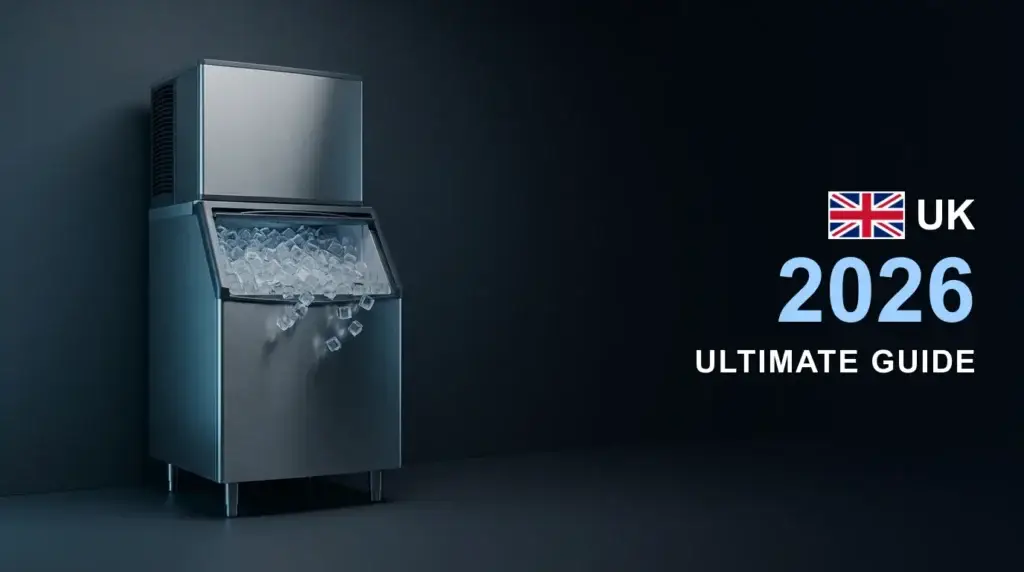
Commercial Ice Machine Buying Guide (UK): Capacity, Compliance & Total Cost of Ownership
Match ice production capacity (0.5 kg/cover restaurants, 1 kg/cover bars) to demand plus 50% safety margin. Water inlet: 1.5–6 bar with filtration. F-Gas compliance requires R290 or R452A (HFC banned 1 January 2020). Budget £2,000–2,400/year operating cost. Ice is classified food under HACCP—daily sanitization and monthly deep cleans mandatory. This guide sizes machines, calculates true cost of ownership, and covers UK compliance requirements for Hoshizaki ice makers.
Key Facts: Commercial Ice Makers (UK, 2026)
- Ice sizing formula: 0.5 kg per cover (restaurants) or 1 kg per cover (bars), plus 50% safety margin = daily requirement in kg.
- Production vs storage mismatch: A 600 kg/day machine with 18 kg bin fills in 45 minutes—separate ice storage bins are essential for busy venues.
- Water inlet requirement: 1.5–6 bar pressure with mandatory sediment + carbon filtration; replace filters every 6–12 months.
- F-Gas compliance: Virgin HFC refrigerants (GWP > 2,500) banned from 1 January 2020. Specify R290 (natural propane, GWP 3) or R452A (transition HFO blend).
- HACCP food safety: Ice is classified as food. Daily scoop sanitization, monthly deep cleans, food-grade filter mandatory, waste water disposal per Building Regulations.
- Running costs: 200 kg/day machine costs £1,300–1,500/year electricity (13–15 kWh/24h at 27p/kWh non-domestic rate) plus £200/year water = ~£1,500–1,700 annual operating cost.
- UK regulations: UKCA marking (post-Brexit), BS EN IEC 60335-2-89 safety compliance, PAT testing typically annual, Building Regs Part J+F for gas appliances if applicable.
- Price tiers: Entry £600–£1,500, mid-volume £2,000–£3,500, professional £3,500–£6,000, specialist/remote £6,000+.
65 kg
Typical entry-level production capacity (24 hours)
£1,500–1,700
Annual running cost (electricity + water)
1 Jan 2020
F-Gas 2024/573 virgin HFC ban effective date
Table of Contents
—
## Decision 1: Which Ice Type for Your Venue?
Crescent Ice
Slow-melt champion. Hoshizaki’s signature edge-design ice. Holds cold longest—ideal for bars, cocktails, and premium venues. Slower production than flake; requires dedicated machines.
Best for: Premium bars, cocktail lounges, hotels.
Flake Ice
Fast cooling. Wet, dense ice particles. Excellent for food display, fish counters, quick-chill applications. Integrates easily into existing cold displays.
Best for: Restaurants, fish counters, kitchen prep.
Nugget Ice
Chewable and fast-melt. Soft, compressed ice pellets. Popular in healthcare, QSR, and upscale casual dining. Low water content speeds cooling.
Best for: Casual dining, healthcare, soft drink service.
Full Cube Ice
Modular and premium. Solid ice cubes ideal for premium spirits, cocktails, and display. Slower melt than flake; requires larger storage.
Best for: Premium cocktail bars, spirits service.
Bullet / Gourmet Ice
Specialty cocktail format. Small, dense bullet-shaped ice. Trendy for craft cocktails. Higher cost per kg; requires specialist machine.
Best for: Boutique bars, cocktail clubs.
Combination Systems
Flexible production. Modular machines can switch between flake and cube in same unit. Ideal for multi-functional venues with varied demand.
Best for: Hotels, event venues, multi-concept operators.
### Ice Type Comparison: What Matters Most
| Ice Type |
Melt Rate |
Production Speed |
Storage Footprint |
Ideal Application |
| Crescent |
Slow (12–14 hrs) |
Medium (140–210 kg/day) |
High (large capacity bin) |
Premium bars, cocktails, hold-time critical |
| Flake |
Fast (3–4 hrs) |
High (200+ kg/day) |
Low (scoop/dispense) |
Display, kitchen prep, fast-cooling |
| Nugget |
Very fast (2–3 hrs) |
High (180–240 kg/day) |
Medium |
Healthcare, QSR, beverage service |
| Full Cube |
Slow–medium (8–10 hrs) |
Low–medium (120–180 kg/day) |
High |
Premium spirits, cocktails, display |
| Bullet |
Medium (6–8 hrs) |
Medium (100–150 kg/day) |
Medium–high |
Craft cocktails, boutique bars |
—
## Decision 2: Matching Production Capacity to Actual Demand
### The Real Ice Equation
Your daily ice requirement is
not a guess—it’s calculated from covers and venue type:
**Restaurants (casual to fine dining):**
– Formula: Number of covers × 0.5 kg ice per cover + 50% safety margin
– Example: 100 covers/day → 50 kg base + 25 kg buffer = 75 kg/day minimum ice machine
**Bars and Nightlife:**
– Formula: Number of covers × 1 kg ice per cover + 50% safety margin
– Example: 80 covers/day → 80 kg base + 40 kg buffer = 120 kg/day minimum ice machine
**Combined Venue (restaurant + bar):**
– Sum both calculations, then apply 50% safety margin to total
– Example: Restaurant 75 kg + Bar 120 kg = 195 kg base + 97.5 kg buffer = ~290 kg/day
### Critical: Production vs. Storage Mismatch
**Most venues get this wrong.** A 600 kg/day machine with an 18 kg storage bin fills its bin in 45 minutes and overflows without dedicated external storage. Budget accordingly:
–
Production under 100 kg/day: 25–35 kg built-in storage adequate for many venues
–
Production 100–250 kg/day: Minimum 50 kg external ice bin recommended
–
Production 250+ kg/day: 100+ kg modular storage bins essential—consider multiple units
### Production Capacity Comparison Table
| Machine Type |
Daily Output (kg) |
Built-in Bin (kg) |
Recommended Venue Size |
External Storage Needed? |
| Undercounter/Compact |
60–80 kg |
15–25 kg |
Small restaurant / cocktail bar |
Optional (high-volume venues) |
| Modular Medium |
140–210 kg |
30–50 kg |
Restaurant 120 covers / Bar 80 covers |
Recommended |
| Modular Large |
275–350 kg |
50–80 kg |
Large restaurant / Hotel bar |
Essential (100+ kg bin) |
| Remote/Professional |
500+ kg |
100+ kg |
High-volume hospitality / Banqueting |
Multiple 100+ kg bins |
—
## Decision 3: Cooling Type—Air, Water, or Remote Condenser?
### Air-Cooled (Standard, ~85% of venues)
– ✓ Simplest installation, lowest capital cost
– ✓ No water supply required for cooling
– ✗ Sensitive to ambient temperature (30°C+ reduces output 30%+)
– ✗ Requires well-ventilated space (minimum 150mm clearance rear/sides)
– ✗ Noise 75–80 dB (not suitable for open dining)
**Best for:** Kitchens, back-of-house, cellars, ventilated venues.
### Water-Cooled (Space-efficient, premium venues)
– ✓ Compact footprint (no rear clearance needed)
– ✓ Cooler operation (15–20 dB quieter than air-cooled)
– ✓ Ambient temperature independent
– ✗ Requires dedicated water supply + drain
– ✗ Higher capital cost (£500–1,500 premium)
– ✗ Monthly chemical treatment and annual servicing essential
**Best for:** Open-plan kitchens, noise-sensitive venues, space-constrained bars.
### Remote Condenser (Boutique/Banqueting)
– ✓ Silent operation in main venue (noise outside)
– ✓ Maximum flexibility in placement
– ✗ Highest capital cost (£3,000–8,000+)
– ✗ Requires specialist installer and annual gas-engineer certification
– ✗ Complex commissioning and decommissioning
**Best for:** High-end hotels, wedding venues, banqueting, silent bars.
—
## Water Supply & Filtration: The Foundation of Ice Quality
### Inlet Pressure Requirements
Commercial ice machines require
1.5–6 bar (20–80 psi) inlet water pressure to operate correctly.
– **Below 1.5 bar:** Machine won’t dispense water reliably; ice output drops 20–30%
– **Above 6 bar:** Risk of water hammer, seal damage, and burst connections—install pressure regulator
– **Mains supply check:** Most UK premises deliver 2–4 bar; if unsure, install a pressure gauge (£15–25)
### Mandatory Filtration: Sediment + Carbon
Why both? Sediment clogs water passages and nozzles; chlorine/taste contaminants degrade ice quality and damage seals.
– **Sediment filter:** 20–50 microns; removes rust, silt, mineral deposits. Replace every 6 months or when pressure drop exceeds 0.5 bar.
– **Carbon filter:** Removes chlorine, organic compounds, odours. Replace every 6–12 months (every 3 months in high-chlorine areas).
– **Dual-cartridge units:** Convenient; cost £40–80 per set. Budget £80–160/year for replacement cycles.
**Food safety note:** Use food-grade certified cartridges (NSF mark). Inferior filters void HACCP compliance and warranty.
### Water Hardness & Scale Prevention
Soft water is ideal. Hard water (above 7°dH) reduces machine lifespan. Options: water softener (£800–1,500 + £150/year) or accept shorter lifespan with scale-inhibiting cartridges.
—
##
F-Gas Compliance & Refrigerant Selection
### What’s Changing 1 January 2020?
From 1 January 2020, virgin HFC refrigerants with GWP > 2,500 are banned for new commercial refrigeration equipment under UK Regulation 2024/573.
### What This Means for Ice Machines
**Banned as of 1 January 2020:**
– R404A (GWP 3,900)
– R422D (GWP 3,145)
– R134a (GWP 1,550—actually allowed until 2031, but phasing down)
– Any virgin HFC you’ve used historically
**Allowed options for new equipment:**
– **R290 (Propane):** GWP 3, future-proof, now standard. Widely available, cheap to service.
– **R452A (HFO/HFC blend):** GWP 2,100, transition option. Slightly higher servicing costs.
– **R600a (Isobutane):** GWP <1, found in compact units, excellent efficiency.
Avoid R404A machines—they'll require retrofit or replacement within 5 years.
---
## Operating Costs: Electricity, Water & Maintenance
### Annual Electricity Consumption
A 200 kg/day machine runs 13–15 kWh/24h = 4,745–5,475 kWh/year at 27p/kWh (non-domestic UK rate) = £1,280–1,480/year. Warm ambient temps and older compressors increase consumption.
**Budget line:** £1,300–1,500/year for electricity on a mid-size machine. Add 10–15% if sited in a warm kitchen.
### Water Consumption
Ice production requires approximately 2.8 litres of water per kg of ice (accounting for evaporation and purge cycles).
- **200 kg/day machine:** 560 litres/day = 204,400 litres/year
- **At commercial water rate (£1/1,000 litres):** ~£200/year
- **Sewerage (waste water):** Additional £150–200/year (charged separately by water company)
**Total water/sewerage cost:** ~£350–400/year. Varies by region; London and South East slightly higher.
### Maintenance & Servicing
**Annual costs:**
- Gas engineer certification (if not part of breakdown cover): £150–250/year
- Filter replacements: £80–160/year
- Water softener salt (if applicable): £150–200/year
- Annual service/inspection: Often bundled with breakdown cover
**Breakdown cover (recommended):** £200–400/year for 24/7 callout. Covers parts and labour, which is essential in hospitality—downtime costs far exceed premiums.
### Total Cost of Ownership (5-year horizon)
For a typical 200 kg/day mid-range ice machine:
- **Purchase price:** £2,500–3,500
- **Annual operating costs:** £2,000–2,400 (electricity + water + filtration + maintenance)
- **5-year total:** £12,500–15,500
- **Cost per kg ice (assuming 200 kg/day, 350 days/year, 24,500 kg/year over 5 years):** £0.51–0.63 per kg
That's broadly in line with outsourced ice delivery (typically £0.40–0.60/kg), so the real case for an owned machine is control of supply and consistent quality rather than a big per-kg saving.
---
## Featured Machines: 4 Real Hoshizaki Solutions
### Featured Product 1: FM-60KE-HC Flake Ice Maker (65 kg/day)
**Ideal for:** Small restaurants, fish counters, fast-food prep
- **Production:** 65 kg/day (flake ice)
- **Storage:** 18 kg bin
- **Refrigerant:** R290 (HFC-free, F-Gas compliant)
- **Cooling:** Air-cooled
- **Water inlet:** 1.5–6 bar, sediment + carbon filter required
- **Dimensions:** 545W × 632D × 820H mm
- **Power:** 1.8 kW / 230V single phase
- **Price:** £1,200–1,350
**Why choose:** Fast cooling for food display; no external storage needed for small venues. R290 future-proof.
**Link:**
View FM-60KE-HC Flake Ice Maker
—
### Featured Product 2: KM-210ABE-HC Crescent Ice Maker (210 kg/day)
**Ideal for:** Medium restaurants, hotel bars, casual dining chains
– **Production:** 210 kg/day (crescent ice—Hoshizaki signature)
– **Storage:** 47 kg modular bin
– **Refrigerant:** R290 (HFC-free, F-Gas compliant)
– **Cooling:** Air-cooled
– **Water inlet:** 1.5–6 bar
– **Dimensions:** 545W × 632D × 1,005H mm
– **Power:** 2.1 kW / 230V single phase
– **Price:** £2,400–2,650
**Why choose:** Mid-market capacity; crescent ice holds cold longest for premium venues. Built-in 47 kg storage handles most daytime peaks. R290 economics excellent.
**Link:**
View KM-210ABE-HC Crescent Ice Maker
—
### Featured Product 3: KMD-270ABE-R452 Crescent Modular (275 kg/day)
**Ideal for:** High-volume bars, large hotels, event venues requiring R452A
– **Production:** 275 kg/day (crescent ice)
– **Storage:** Fits into modular bin system (up to 80 kg)
– **Refrigerant:** R452A (transition HFO/HFC blend; GWP 2,100—lower than R404A)
– **Cooling:** Air-cooled
– **Water inlet:** 1.5–6 bar
– **Dimensions:** 545W × 632D × 1,075H mm
– **Power:** 2.4 kW / 230V single phase
– **Price:** £3,200–3,600
**Why choose:** Large-venue capacity; R452A specified for manufacturers with existing tooling. Modular format allows stacking with external bins for venues needing 300–500 kg/day.
**Link:**
View KMD-270ABE-R452 Crescent Ice Maker
—
### Featured Product 4: KM-140C-HC-W Crescent Undercounter (138 kg/day)
**Ideal for:** Compact bars, café-restaurant hybrid, boutique venues with space constraints
– **Production:** 138 kg/day (crescent ice)
– **Storage:** 47 kg integrated bin
– **Refrigerant:** R290 (HFC-free, F-Gas compliant)
– **Cooling:** Air-cooled, compact footprint
– **Water inlet:** 1.5–6 bar
– **Dimensions:** 545W × 632D × 820H mm (undercounter profile)
– **Power:** 1.9 kW / 230V single phase
– **Price:** £2,000–2,250
**Why choose:** Space-efficient undercounter format fits tight bar arrangements. 138 kg/day supports ~100–150 covers/day restaurant + bar blend. R290 future-proof.
**Link:**
View KM-140C-HC-W Crescent Undercounter Ice Maker
—
## UK Price Tiers: What to Expect
Entry Level
£600–£1,500
Compact/undercounter, 60–80 kg/day, 15–25 kg bin. Air-cooled.
Ideal: Small café, cocktail bar, kitchen prep.
Mid-Volume
£2,000–£3,500
Modular, 140–210 kg/day, 30–50 kg bin. Air or water-cooled.
Ideal: Restaurant 100+ covers, medium bar.
Professional
£3,500–£6,000
High-capacity, 275–350 kg/day, modular bins. Air, water, or compact remote.
Ideal: Large hotel, chain restaurant, event venue.
Specialist
£6,000–£12,000+
Remote condenser, 500+ kg/day, multi-unit systems. Bespoke cooling.
Ideal: Banqueting, luxury hotel, high-volume nightlife.
**Price variability:** UK pricing is 5–15% higher than Northern Europe due to post-Brexit tariffs and logistics. Italian brands (Brema, Electrolux) often undercut Asian brands on entry-level machines. Japanese brands (Hoshizaki, Scotsman) command premium for durability and service network.
—
## Compliance & Food Safety: HACCP, UKCA & PAT Testing
### Ice as Food: HACCP Classification
**Critical point:** Ice is classified as
food under UK food hygiene regulations (
Food Safety Act 1990,
retained EU Regulation 852/2004). This means:
– **Daily scoop sanitization:** Wash and sanitize the ice scoop (typically stainless steel) at end of service using 100 ppm chlorine solution or approved sanitiser.
– **Monthly deep clean:** Remove bin, drain residual water, clean interior surfaces with food-grade sanitiser, check drain clearance.
– **Food-grade water filter:** Mandatory. Non-approved filters void HACCP compliance and machine warranty.
– **Waste water disposal:** Comply with Building Regulations Part F (foul drainage). Ice machine drain runs to kitchen waste or mains sewerage—not to potable water circuits.
**Audit point:** Environmental Health Officers inspect ice machine hygiene during food business inspections. Non-compliance results in improvement notices.
### UKCA Marking (Mandatory Post-Brexit)
All commercial ice makers sold in the UK from **1 January 2021** must carry **UKCA (UK Conformity Assessed) marking**, replacing CE marking.
– UKCA mark visible on machine nameplate
– Ensure manufacturer provides UK Declaration of Conformity (DoC) alongside machine
– Hoshizaki, Scotsman, Brema all carry UKCA for UK/NI distribution
**Check before purchasing:** Legacy stock (pre-2021) with CE marking only may not be legal for new installation in UK premises.
###
BS EN IEC 60335-2-89: Commercial Refrigeration Safety
Ice makers must comply with this British Standard covering:
– **Electrical safety:** Insulation, earthing, protective overloads
– **Thermal safety:** Safe operating temperature, overpressure protection
– **Mechanical safety:** Secure fastening, protected moving parts
– **Refrigerant containment:** Sealed system, pressure relief devices
**Your responsibility:** Appoint a qualified installer (REFCOM-registered engineer, or equivalent). Installation certificate should accompany DoC.
###
Electricity at Work Regulations 1989 (EAW) & PAT Testing
Commercial fixed refrigeration equipment (ice makers, freezers) typically requires **annual Portable Appliance Test (PAT)** under EAW, though risk-based assessment may permit longer intervals (up to 3 years for low-risk venues).
– **PAT scope:** Electrical safety inspection, insulation resistance, protective device testing
– **Cost:** £15–25 per machine, often bundled with annual maintenance contract
– **Provider:** NICEIC or equivalent approved electrical contractor
– **Record-keeping:** Maintain PAT certificates on file—required during Health & Safety inspections
—
## Installation & Siting: Ambient Temperature Derating
### Ambient Temperature Impact
Output drops with warmth: 21°C=100%, 25°C=95%, 30°C=70%, 32°C=55%. Above 35°C, risk of compressor overload. Warm kitchens lose 30–45% output on peak days. Spec 20–25% larger if above 25°C regularly, or choose water-cooled.
### Ideal Siting
– **Cellars & walk-ins:** Optimal (12–15°C). Machines perform at 110–120% rated capacity.
– **Back-of-house kitchens with ventilation:** Good (18–22°C). Maintain 150 mm clearance rear/sides for air-cooled units.
– **Open-plan kitchens:** Challenging. Ambient easily 26–30°C during service. Spec 25% larger or specify water-cooled.
– **Outdoor venues:** Not recommended for air-cooled machines. Remote condenser or water-cooled essential.
—
## Total Cost of Ownership Calculator
Ice Maker TCO Calculator (5-year horizon)
Machine purchase price
£2,500
Annual electricity (200 kg/day, 14 kWh, 27p/kWh)
£1,380/year
Annual water & sewerage (560 L/day)
£350/year
Annual filter replacements (sediment + carbon)
£120/year
Annual breakdown cover & servicing
£250/year
5-year cumulative operating cost
£8,470
Total 5-year cost of ownership
£10,970
Assumed ice production: 200 kg/day
24,500 kg over 5 years
Cost per kg ice (5-year average)
£0.45/kg
**Comparison:** Outsourced ice delivery typically costs £0.40–0.60 per kg, so running your own machine works out broadly the same on cost. The real gains are ice on demand and never running short at peak, not a lower price per kg.
—
## Pre-Purchase Checklist: What to Verify
- Refrigerant specification: Confirm R290 or R452A (not R404A, R422D, or older legacy refrigerants). Check nameplate for “R290” or “HFC-free” label.
- UKCA marking: Visible on nameplate. Manufacturer provides UK Declaration of Conformity (DoC).
- Water inlet pressure: Confirm your mains supply is 1.5–6 bar. Install gauge (£15–25) if unsure. Pressure regulator required if above 6 bar.
- Filtration readiness: Ensure sediment + carbon filter cartridges are in stock and budget replacement cycle (6–12 months).
- Storage bin capacity: Match 50% of daily production. Example: 210 kg/day machine pairs with 100+ kg external bin (not just 47 kg built-in).
- Cooling type suitability: Air-cooled for ventilated kitchens (150 mm clearance required). Water-cooled for space-constrained open venues. Remote for noise-sensitive areas.
- Ambient temperature: If kitchen regularly exceeds 25°C, spec machine 20–25% larger or choose water-cooled.
- Installation & commissioning: Budget £200–500 for REFCOM engineer to fit, test, issue compliance certificate, and verify water filtration.
- Breakdown cover availability: Confirm provider covers your region, covers parts + labour, and offers 24/7 callout.
- Warranty & spares availability: Check machine has 2-year parts warranty, and that sediment/carbon filter cartridges are stocked locally (avoid 6-week delivery delays).
—
## Installation Steps: Site Preparation to First Ice
1
Electrical Supply Verification
Confirm 230V single-phase (or 400V three-phase). Check circuit breaker rating. Qualified electrician required if new circuit needed.
2
Water Supply & Pressure Check
Install pressure gauge and verify 1.5–6 bar inlet. If above 6 bar, fit regulator (£25–60). Below 1.5 bar, contact water company or install pump.
3
Filter Cartridge Installation
Install sediment + carbon filter upstream of inlet. Use NSF-marked cartridges. Replace every 6–12 months or when pressure drop exceeds 0.5 bar.
4
Siting & Ventilation Setup
Position with 150 mm clearance (air-cooled). Ambient 18–25°C ideal. Secure to floor. Ensure bin is level.
5
Drain & Waste Water Connection
Connect drain to kitchen waste outlet or mains sewerage (not potable supply). Ensure drain is clear and runs downhill. Check Building Regulations Part F compliance.
6
Commission & Test
REFCOM engineer commissions machine, verifies water pressure, circulation, electrical safety (PAT), and refrigerant integrity. Obtain commissioning certificate and UK Declaration of Conformity.
7
Training & HACCP Setup
Staff trained: daily scoop sanitization (100 ppm chlorine), monthly deep clean, filter schedule. Post checklist. Schedule annual PAT. Register with Environmental Health.
8
Arrange Ongoing Support
Sign up for breakdown cover (£200–400/year) and maintenance contract. Keep commissioning cert, PAT, and filter logs on file.
—
## All Featured Machines Comparison Table
| Machine |
Ice Type |
Daily Output |
Bin Capacity |
Refrigerant |
Cooling |
Price |
Best For |
| FM-60KE-HC |
Flake |
65 kg |
18 kg |
R290 |
Air |
£1,200–1,350 |
Small restaurant, fish counter, prep |
| KM-140C-HC-W |
Crescent |
138 kg |
47 kg |
R290 |
Air |
£2,000–2,250 |
Compact bar, café-restaurant hybrid |
| KM-210ABE-HC |
Crescent |
210 kg |
47 kg |
R290 |
Air |
£2,400–2,650 |
Medium restaurant, hotel bar, casual dining |
| KMD-270ABE-R452 |
Crescent |
275 kg |
Modular (80 kg) |
R452A |
Air |
£3,200–3,600 |
High-volume bar, large hotel, event venue |
—
## Related Guides & Further Resources
**From Craven Cooling:**
–
Bottle Coolers & Refrigeration Equipment
– Commercial Freezer Buyer’s Guide (forthcoming)
– Glass Washer Selection & Water Chemistry (forthcoming)
**External References:**
– F-Gas Regulation 2024/573 (UK retained EU Law 517/2014): Accessed via Environment Agency
– BS EN IEC 60335-2-89: Commercial refrigeration safety—available from BSI (£200+)
– REFCOM Register: Refrigeration & Heat Pump engineers (www.refcom.org.uk)
– Environmental Health Guidance on Food Safety Act 1990 & HACCP
—
## Decision Summary: Ice Machine Selection Flowchart
**Start here:** How many covers per day?
– **Under 80 covers (restaurant only):** FM-60KE-HC (65 kg/day flake) or KM-140C-HC-W (138 kg/day crescent undercounter). Budget £1,200–2,250.
– **80–150 covers blended (restaurant + bar):** KM-140C-HC-W (138 kg/day) or KM-210ABE-HC (210 kg/day). Budget £2,000–2,650. Add external 50+ kg ice bin if peaks exceed 150 covers.
– **150–250 covers blended (large restaurant, medium nightlife):** KM-210ABE-HC (210 kg/day) with 100 kg external bin, or KMD-270ABE-R452 (275 kg/day modular). Budget £2,400–3,600 + bin costs (£500–800).
– **250+ covers (hotel, banqueting, high-volume nightlife):** KMD-270ABE-R452 (275 kg/day) + multiple 100 kg external bins, or dual-machine setup. Budget £6,500–12,000 total. Consider water-cooled or remote condenser.
—
Ready to Spec Your Machine?
Craven Cooling stocks all featured Hoshizaki models and can deliver across the UK within 7–10 days. Our team will verify your venue size, ambient conditions, and siting requirements—then recommend the exact machine and storage configuration you need.
Request a Quote
Email Sales Team
Phone: 01792 732702 | Email: sales@cravencooling.co.uk
—
## Key Takeaway: Total Cost of Ownership Wins
A £1,200 machine costs £1,300–1,500/year to run and lasts 5–6 years. A £2,500 R290 machine costs nearly the same annually but lasts 7–8 years and handles double the demand. True cost includes purchase, electricity, water, filters, maintenance, compliance, and siting constraints. Spec wisely for 7–10 year reliability; cheap machines need replacing in 3–4 years.
—
## Frequently Asked Questions
Q: My mains water pressure is above 6 bar—will my ice maker fail? ▼
A: High inlet pressure above 6 bar can damage inlet valves, seals, and water passages. Install a pressure regulator (£25–60) upstream of the filter. This reduces inlet to safe 1.5–4 bar range. Most UK mains supply 2–4 bar, so regulators are rarely needed—but always check with a pressure gauge first.
Q: Can I use non-food-grade water filters to save money? ▼
A: No. Ice is classified as food under HACCP regulations. Non-food-grade filters void warranty, fail Environmental Health audits, and may leach contaminants into ice. Use NSF-marked food-grade cartridges only. The cost difference (£5–10 per cartridge) is negligible vs. compliance risk.
Q: What’s the difference between R290 and R452A refrigerants? ▼
A: R290 (propane, GWP 3) is the future-standard natural refrigerant—Hoshizaki’s current standard for new -HC models. R452A (HFO/HFC blend, GWP 2,100) is a transition option for legacy tooling. Both comply with F-Gas ban. R290 is cheaper to service (propane readily available) and more efficient. R452A is slightly more expensive to service due to rarity. New machines should specify R290.
Q: My kitchen is very warm (28–30°C in summer)—should I buy a larger machine? ▼
A: Yes. Spec 20–25% larger production capacity to offset ambient temperature derating (output drops ~30% at 30°C vs 21°C). Alternatively, specify water-cooled or remote condenser to eliminate ambient sensitivity. Air-cooled machines in warm kitchens will struggle to meet peak demand on hot days.
Q: How often should I replace water filter cartridges? ▼
A: Every 6–12 months for standard food-service venues, or sooner if your water is hard/heavily chlorinated. Some high-chlorine areas need 3-month cycles. Watch for pressure drop (gauge on filter housing)—if drop exceeds 0.5 bar, change cartridge immediately. Record all changes in your maintenance log for audit purposes.
Q: Is PAT testing really required for my ice machine annually? ▼
A: Yes, under Electricity at Work Regulations 1989. Fixed commercial refrigeration is typically classified as annual or low-risk (3-year interval). Environmental Health inspectors will check records during food safety audits. Failure to maintain PAT compliance can result in improvement notices. Include PAT costs (£15–25/year) in your breakdown cover contract.
Q: Can I use my ice machine to freeze water for other purposes (not for drinks/food)? ▼
A: No. Once HACCP-classified equipment is installed for food ice production, UKCA certification and food safety compliance apply to all output. If you need non-food ice, you must source from a separate, non-food-certified machine or buy commercial ice. Mixing food and non-food ice exposes your venue to regulatory risk.
Q: What happens if my ice maker breaks down during service? ▼
A: Downtime = lost revenue. Breakdown cover (£200–400/year) typically covers 24/7 emergency callout, parts, and labour—this is non-negotiable for hospitality venues. Check your cover includes weekend/bank holiday callout; some budget providers exclude these. Budget 3–5 hours for an engineer to diagnose and repair most common faults (water inlet blockage, compressor reset, valve replacement).
—
See it live
Ice machines — in stock now
Guide Summary
Selecting a commercial ice maker is a three-part decision: (1) calculate daily requirement using 0.5 kg/cover (restaurant) or 1 kg/cover (bar) plus 50% safety margin; (2) match production capacity to storage bin (minimum 50% of daily output); (3) choose cooling type (air-cooled standard, water-cooled for space, remote condenser for noise). Water supply (1.5–6 bar inlet, sediment + carbon filter, 6–12 month replacement) is non-negotiable for ice quality and HACCP compliance. F-Gas compliance requires R290 or R452A refrigerants (HFC banned 1 Jan 2020). Running costs average £2,000–2,400/year (electricity + water + filters + maintenance). Mid-range machines (£2,000–3,500) run at broadly the same cost per kg as outsourced ice, with the advantage of guaranteed supply on demand. UK regulations mandate UKCA marking, BS EN IEC 60335-2-89 safety compliance, annual PAT testing, and HACCP food safety protocols (daily scoop sanitization, monthly deep clean). Featured Hoshizaki machines range £1,200–3,600; all are R290 or R452A compliant and stock in the UK with 7–10 day delivery. Total cost of ownership is broadly comparable to outsourced delivery, while an owned machine removes any reliance on deliveries at busy venues. Spec conservatively for ambient temperature (warm kitchens lose 30% output at 30°C) and opt for breakdown cover to avoid peak-time downtime. Installation requires REFCOM-certified engineer for commissioning, pressure testing, and compliance certification.
---