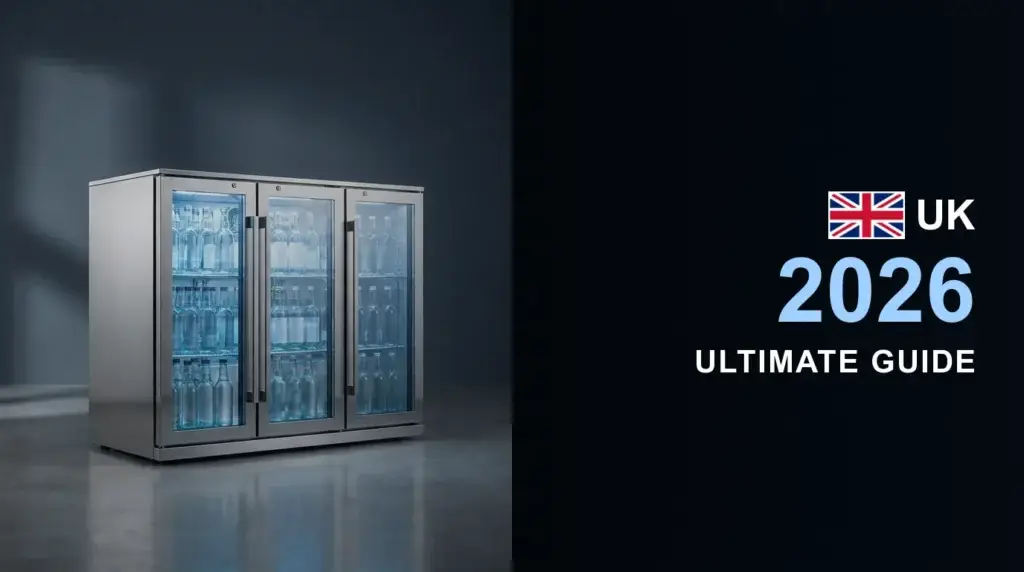
Commercial Bottle Fridge & Back-Bar Cooler Buying Guide: The Complete UK Guide (2026)
A commercial bottle cooler — also known as a bottle fridge, back-bar fridge or upright bottle display — is the chilled glass-fronted unit behind every UK pub, hotel bar, restaurant, and club. This guide covers the only three decisions that matter on purchase day: refrigerant compliance under F-Gas, sliding vs hinged doors, and capacity-by-bottle-count for your actual service profile — plus the GAMKO Maxiglass range stocked at Craven Cooling.
- F-Gas update: from 1 January 2020, virgin HFC refrigerants with GWP >2500 are banned for new commercial refrigeration in the UK. Modern bottle coolers must use R600a (isobutane, GWP <1) or R290 (propane, GWP 3). The GAMKO Maxiglass range uses R600a as standard.
- Capacity rule: a 500-litre upright bottle cooler holds approximately 480 × 330 ml bottles, or 12-15 standard wine bottles per shelf. Plan for peak service stock plus 24-hour reload buffer.
- Sliding vs hinged doors: sliding doors are non-negotiable for behind-the-bar units where staff have less than 600 mm of clearance. Hinged doors swing 90° and need that space twice over.
- Temperature range: commercial bottle coolers run +2 to +18°C — covers beer at +4°C, white wine at +8°C, mineral water at +10°C, soft drinks at +6°C. Single set-point unless dual-zone.
- Energy: a typical 500 L upright runs 2.7-3.5 kWh per day at 25°C ambient = ~£300 per year at 27p/kWh (UK non-domestic 2026 average). EEI rating 65-75 typical for modern R600a units.
- UK price tiers (ex VAT, April 2026): entry compact undercounter £400-£900; mid-range 500 L upright with sliding doors £2,000-£2,800; pro keg coolers £2,000-£3,500; specialist multi-deck back-bar £3,500-£6,000+.
- Lead time: stocked GAMKO Maxiglass units typically ship in 5-10 working days; factory-spec colour and door configurations 4-8 weeks.
- Toughened safety glass: any glass-fronted unit on the front line of the bar must use BS EN 12150 toughened glass — fractures into harmless particles, not shards.
The bottle cooler is the most-photographed piece of kit behind a UK bar — and one of the most consistently mis-specified. Cellar managers buy on capacity headline number; F&B managers buy on price; almost nobody runs the maths on the energy bill or the F-Gas compliance window. The result: pubs running 12-year-old back-bar units full of HFC refrigerant they will struggle to service after January 2020, on energy bills £400 a year higher than they need to be.
This guide is written for the trade buyer making that decision: pub manager, hotel F&B, restaurant ops, club ops, or operator setting up a new bar. We cover what the F-Gas rules actually say in 2026, how the GAMKO Maxiglass range stocked at Craven Cooling stacks up against the lower-spec units a quick search will throw up, and the capacity-by-bottle-count maths nobody publishes. Browse the full Craven Cooling chilled refrigeration range when you’re ready to spec.
In this guide ↓
- Key facts and 2026 UK reference numbers
- The decisions that matter on purchase day
- UK price tiers and what each tier buys you
- Stocked products at Craven Cooling — verified specs and prices
- Year-one total cost of ownership worked example
- UK compliance checklist
- Installation and use checklist
- FAQ — eight buyer-objection questions answered
Decision 1: Refrigerant — R600a, R290, or Avoid
This is the question buyers most often skip and most often regret. The refrigerant in the unit you buy in 2026 determines what it will cost to run, repair, and dispose of for the next decade.
| Refrigerant | GWP | F-Gas status | Found in |
|---|---|---|---|
| R600a (isobutane) | <1 | Permitted, no phase-out | GAMKO Maxiglass, modern back-bar units |
| R290 (propane) | 3 | Permitted, no phase-out | Hoshizaki ice makers, modern Tefcold, some bottle coolers |
| R134a | 1,430 | Phase-down quotas; servicing more expensive | Older units 2010–2018 |
| R422D | 2,729 | Banned for virgin from 2026 (recycled OK to 2032) | Some 2015–2019 commercial units |
| R404A | 3,922 | Banned for virgin from 2026 (recycled OK to 2032) | Pre-2020 commercial refrigeration |
Decision 2: Sliding or Hinged Doors?
The single most-mis-specified bottle cooler is the one bought with hinged doors for a 600 mm bar back. Door swing geometry is the single non-negotiable spec for behind-the-bar units.
| Factor | Sliding doors | Hinged doors |
|---|---|---|
| Bar-back clearance needed | 600 mm (staff space only) | 1,050 mm (door swing + staff space) |
| Energy efficiency | Smaller air-loss zone; better in busy bars | Larger air-loss zone when door open |
| Stocking speed | Slightly slower (one shelf at a time) | Full-shelf access |
| Door longevity | Tracks need cleaning; rollers replaceable | Hinges fail after 50,000+ opens |
| Noise | Quieter — no slamming | Self-closing hinge can be noisy |
| Best for | Behind-the-bar, busy pubs, hotel bars | Walk-around prep areas, larger kitchens |
Decision 3: Capacity by Bottle Count, Not Litres
Manufacturers list capacity in litres. Bar managers buy stock in cases. The gap between those two numbers is where overstocking, understocking, and missed reorders happen.
| Unit volume | 330 ml beers | 500 ml beers | 750 ml wines | Best for |
|---|---|---|---|---|
| 200 L undercounter | ~180 | ~110 | ~36 | Cocktail bar undercounter |
| 315 L low-height | ~280 | ~170 | ~55 | Tight pub backs, hotel mini-bar |
| 500 L upright | ~480 | ~290 | ~95 | Standard pub back-bar |
| 700 L upright (3-door) | ~660 | ~400 | ~130 | Wider bars, busy hotel |
| 900 L double upright | ~840 | ~510 | ~165 | High-volume sites, festival vendors |
Five Types of Commercial Bottle Cooler
Upright Single-Door
From £900 ex VAT- One sliding or hinged door
- 200–315 L capacity
- Best for compact pub backs
- Lower energy draw
Upright Double / Triple Door
From £2,000 ex VAT- 2–3 sliding or hinged doors
- 500–700 L capacity
- The pub workhorse
- GAMKO MG3/500 series
Undercounter Bottle Cooler
From £400 ex VAT- Sits beneath the bar surface
- 200 L typical
- For premium/cocktail product
- Tefcold UR series, Koldbox
Keg Cooler
From £2,000 ex VAT- Holds full or half kegs
- 9-gallon × 2–6 kegs typical
- Cools the keg before draught
- GAMKO FK2 series
Multi-Deck Back-Bar
From £3,500 ex VAT- Open-front shelf display
- Customer-facing impulse retail
- Higher energy use vs glass door
- For delis/hotel cafés rather than pure bar
UK Bottle Cooler Buying Tiers (April 2026)
Pricing splits cleanly into four brackets. The middle two cover 80% of UK pub and bar deployments.
GAMKO Maxiglass Bottle Coolers Stocked at Craven Cooling
Stocked April 2026. All GAMKO Maxiglass units use R600a refrigerant (GWP <1) — fully future-proofed for F-Gas. Prices ex VAT.
- 500 L gross / 468 L net volume
- ~480 × 330 ml bottles capacity
- External: 900 × 530 × 1,800 mm
- Temperature: +2 to +18°C
- Refrigerant: R600a (GWP <1)
- Power: 275 W / 220-240V single phase
- Energy: ~3.23 kWh/24h, EEI 65.8
- Dimmable LED lighting, flat shelves
The standard UK pub back-bar fridge. Two large sliding glass doors, 480-bottle capacity, R600a refrigerant, dimmable LEDs to support evening visual merchandising. The right call for any standard 900 mm bar back where space behind the unit is limited and the unit gets opened 200+ times per service.
View GAMKO MG3/500SD →- 500 L gross volume
- Two large hinged glass doors
- Same capacity as the sliding-door MG3/500SD
- Refrigerant: R600a (GWP <1)
- Best for walk-around prep areas, larger bars
- Self-closing hinges, full-shelf access
The hinged-door sibling of the MG3/500SD. £122 cheaper but needs ~450 mm clearance for the door swing — only choose this configuration if the bar back has the depth, or the unit is in a walk-around prep area. Otherwise stick with the sliding door variant.
View GAMKO MG3/500GCS →- 315 L undercounter, low-height
- Three sliding glass doors
- ~280 × 330 ml bottle capacity
- Refrigerant: R600a (GWP <1)
- Sits under bar at 850 mm height
- Best for tight pub backs, hotel mini-bars
The low-height GAMKO. Perfect for a pub back with limited vertical space, or where the space above the bar is needed for spirits display and optics. Three sliding doors give zone-by-zone access. R600a refrigerant matches the rest of the Maxiglass range.
View GAMKO LG3/315SD →- 290 L gross volume
- Holds 2× 50 L kegs or 4× 30 L kegs
- Two solid doors, left-hinged
- Refrigerant: R600a (GWP <1)
- Drop-in temp: 4-6°C for keg dispense
- Right-hinged version (FK2-25/8R) also stocked
The keg cooler the rest of the back-bar plumbs into. Holds two 50 L kegs or four 30 L kegs at draught dispense temperature, with the second door on the left for line and CO2 gas access. Uses R600a — the right call for any new pub installing in 2026.
View GAMKO FK2-25/8L →Year-One Total Cost of Ownership
The headline price on a back-bar fridge is rarely the biggest line on the year-one spreadsheet. Here’s what a GAMKO Maxiglass MG3/500SD actually costs to put behind a busy UK pub bar for the first 12 months.
Two takeaways. First, a £600 grey-import bottle cooler running R404A or R134a easily lands at £900–£1,200 of energy over 5 years more than the GAMKO Maxiglass — wiping out the headline price saving by year three. Second, the F-Gas service-cost gap is real: a service top-up on the R404A unit costs roughly 4× the equivalent on R600a if a leak develops in years 4–6, when grey-import warranty has long since lapsed. Buy proper kit, plug it in, run it for 10 years.
UK Compliance Checklist for a Commercial Bottle Cooler
Five items to tick before a bottle cooler legally takes its place behind a UK bar. Your insurer and EHO will both ask.
From 1 January 2020, virgin HFC refrigerant with GWP >2500 is banned for new and serviced equipment. Always specify R600a or R290 on new orders. If you have a pre-2020 R404A unit on your premises, plan replacement before service costs spiral.
Any glass-fronted unit on the front line of a public bar must use toughened safety glass per BS EN 12150 — fractures into harmless particles, not large shards. The GAMKO Maxiglass range uses BS EN 12150 toughened glass as standard. Confirm in writing on any new order from any supplier.
The unit must be maintained safe under EAW 1989. Bar appliances are typically high-use and warrant visual inspection every 3–6 months and full PAT test annually. Records retained. PAT failure can void public liability insurance on the premises.
Equipment placed on the UK market must bear UKCA marking (formerly CE) per BS EN IEC 60335-2-89 commercial refrigeration safety standard. Grey-import units sometimes still carry only CE — UKCA conformance is the minimum buy bar for a registered UK pub or restaurant.
Bottled drinks are not food in the strict sense, but the unit must be capable of holding contents below 8°C if any food product (sandwiches, cheese plates, garnishes) ever enters it. Daily temperature checks on a probe thermometer, monthly recorded log. Most modern units have built-in digital read-outs that satisfy EHO inspection.
Installation & Operating Checklist
-
✓
Confirm clearance for door type Sliding doors: 600 mm staff space behind. Hinged doors: 600 mm + door swing. Measure twice before ordering.
-
✓
Ventilation gap above and behind Minimum 50 mm to wall behind, 100 mm above for condenser exhaust. R600a units run cool; lack of ventilation triples compressor cycles and energy use.
-
✓
Stable, level base Bar floors are rarely flat. Adjust unit feet to spirit level — refrigeration loop needs to drain correctly. Most units have ±10 mm adjustment per foot.
-
✓
Initial 24 hr pull-down empty Plug in, leave empty and at maximum cool for 24 hours before stocking. Avoids overworking the compressor on first service.
-
✓
13A plug — dedicated socket recommended 275–350 W draw on 500 L units sits comfortably on 13A. Avoid daisy-chained extension leads — voids warranty.
-
✓
Daily clean and weekly deep clean Wipe interior shelves daily. Weekly remove shelves, clean drip channel, vacuum condenser grille at rear/underneath. Blocked condensers are the #1 cause of warm beer.
-
✓
Daily probe-thermometer temp check Confirm internal temperature against the digital readout — a £8 probe thermometer satisfies EHO. Log weekly.
-
✓
Annual service Refrigeration engineer check on door seals, refrigerant charge, condenser clean, electrical safety. Most premier R600a units run faultless for 8–12 years.
All Featured Bottle Coolers at a Glance
| Model | Volume | Doors | Refrigerant | Trade price ex VAT |
|---|---|---|---|---|
| GAMKO LG3/315SD ★ | 315 L | 3× sliding | R600a | £2,025 |
| GAMKO FK2-25/6L | 210 L keg | 1× solid | R600a | £2,050 |
| GAMKO FK2-25/8L ★ | 290 L keg | 2× solid (left) | R600a | £2,179 |
| GAMKO FK2-25/8R | 290 L keg | 2× solid (right) | R600a | £2,179 |
| GAMKO MG3/500G | 500 L | 2× hinged | R600a | £2,218 |
| GAMKO MG3/500GCS | 500 L | 2× hinged glass | R600a | £2,446 |
| GAMKO MG3/500SD ★ | 500 L | 2× sliding | R600a | £2,568 |
★ = Recommended pick for typical UK pub deployment. All GAMKO Maxiglass units use R600a refrigerant — F-Gas compliant.
For glass washing, see our commercial glass washer buying guide. For ice production, read the commercial ice maker buying guide. For the cellar side of a pub setup, see the beer cellar cooling buying guide. For wine storage, see the commercial wine cabinet buying guide.
A commercial bottle cooler — back-bar fridge — is the chilled glass-fronted unit behind every UK pub, hotel bar, and restaurant. Three decisions matter on purchase day: refrigerant (R600a or R290 only — F-Gas bans virgin HFC GWP >2500 from January 2020), door type (sliding for behind-the-bar with limited clearance; hinged for walk-around prep areas), and capacity (500 L holds ~480 × 330 ml bottles, the standard UK pub workhorse spec). Year-one total cost of ownership on a £2,568 GAMKO Maxiglass MG3/500SD lands around £3,156 ex VAT including ~£318 of energy at 27p/kWh — recoverable in service-life advantages versus £600 grey-import R404A units that face escalating refrigerant servicing costs. Craven Cooling stocks seven GAMKO Maxiglass units in the £2,025–£2,568 range, all R600a, all UKCA-marked, all BS EN 12150 toughened safety glass — the standard UK pub back-bar specification.