
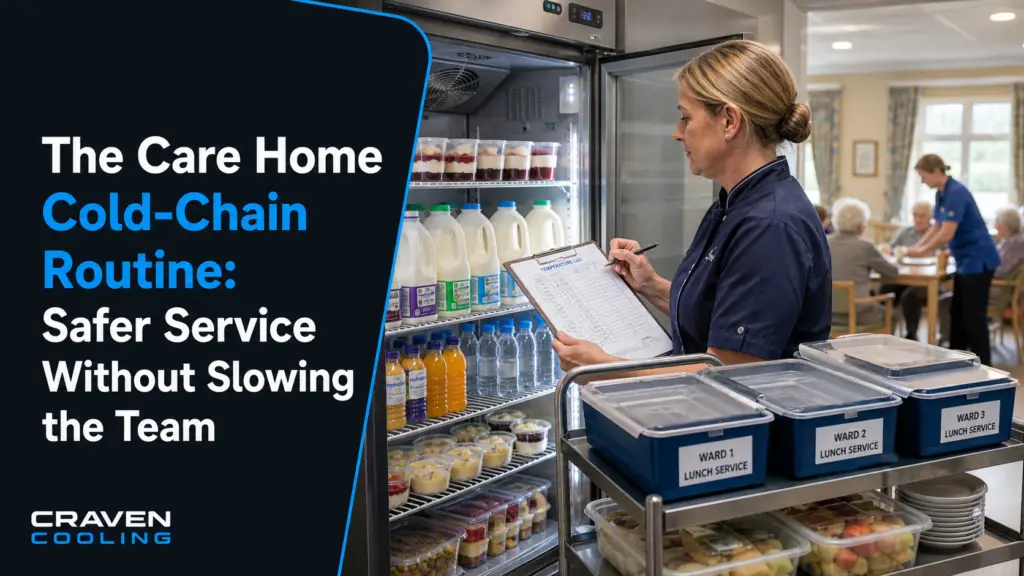
The Care Home Cold-Chain Routine: Safer Service Without Slowing the Team
Care homes need safe chilled storage without slowing breakfast, hydration, texture-modified meals or ward service. The cold-chain routine has to fit the team, not live in a folder nobody opens.
- Routine wins: simple checks beat complicated paperwork
- Service windows: breakfast and hydration need staging
- Records: logs must be easy for shifts
- Transport: food movement affects temperatures
- Backup: failure planning matters in care
Craven has care-home buffet/laundry/tableware content; this is a refrigeration routine for care settings.
Table of Contents
Name the Pressure Before the Product
Start with the service problem in plain language: warm stock, slow glass turnaround, staff walking too far, wasted food, weak records or a queue that forms at the same place every day. Once the pressure is visible, the equipment conversation becomes more useful.
Check Whether Routine Fixes Are Enough
Cleaning, siting, loading, staff training and records may fix the issue before new kit is needed. If the same weakness keeps returning, the equipment may be under-sized, poorly placed or no longer fit for the way the site trades.
- ✓Look for repetition. A one-off problem is different from a daily workaround.
- ✓Check the records. Logs, service notes and waste patterns make the case clearer.
- ✓Ask the team. Staff usually know where the work slows down.
Use Tools to Put a Number on It
Craven’s calculators and checkers help turn a vague frustration into a number or a shortlist. That gives the operator a better brief for finance, servicing or a product quote.
Link the Fix to the Commercial Outcome
A good fix should protect food safety, reduce staff drag, improve sales, reduce waste or lower risk. If it cannot be connected to one of those outcomes, it may not be the next priority.
| Question | What it reveals |
|---|---|
| Does it protect safe stock? | Food-safety and waste risk |
| Does it remove a repeated delay? | Labour and service pressure |
| Does it improve sales visibility? | Retail and display value |
| Does it simplify records? | Inspection readiness |
The Manager Check Before You Spend Money
Before committing to a repair, replacement or new piece of equipment, step back and write a short operational brief. What happens in the busiest hour? Which member of staff notices the problem first? Which product, service point or customer experience is affected? Which records prove the pattern? That brief is often more useful to Craven Cooling than a vague request for “a bigger fridge” or “a better machine”.
For The Care Home Cold-Chain Routine: Safer Service Without Slowing the Team, the strongest buying decision comes from matching equipment to the way the site actually trades. A pub, café, restaurant, care home and convenience store can all own the same category of kit and need different answers because their peak periods, staffing, stock movement and inspection pressure are different.
| Manager question | Why it improves the brief |
|---|---|
| When does the issue appear? | Separates peak-load problems from all-day faults. |
| Who works around it? | Shows the labour cost and training risk. |
| What record proves it? | Turns opinion into evidence: logs, wastage, service notes or sales gaps. |
| What would success look like? | Defines whether the answer is safer food, faster service, lower waste or more sales. |
Use the tool
Make the issue measurableCraven Cooling view: Craven’s advantage is not pushing one brand at every problem. It is helping the operator decide whether the answer is a routine, a service call, a different layout or a better-specified piece of kit.
The Care Home Cold-Chain Routine: Safer Service Without Slowing the Team is about turning a real operating pressure into a practical equipment, servicing or workflow decision. Start with the problem, check routine fixes, use the relevant Craven tool and then choose the next action.


