Why this serving tray earns its place
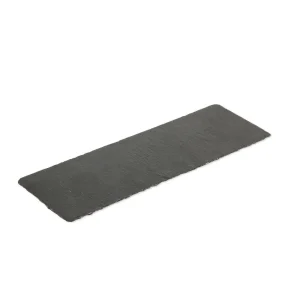
31 cm long by 160 mm across is a serving length rather than a serving area, and that changes what it is good at. A long narrow tray takes a run of six or eight of the same thing — canapés out to a room, breads down the length of a table, a line of desserts along a counter — and keeps them in a readable order that a square tray turns into a cluster. It also fits where the space actually is in a working room: along a bar top, down the middle of a laid table, across the front edge of a counter, on the narrow strip of pass that is not already covered.
Length is also what you have to handle for. A tray of this proportion wants both hands at the ends rather than one under the middle, because loaded at the extremes it will tip on a single point of support — worth knowing before it goes out to a room full of guests. The 15 mm rim earns its place here for the same reason: it stops items travelling to one end and off the edge as the tray moves. The hammered finish is the reason the steel stays presentable. On a long surface a mirror polish reflects the room's lighting in a hard streak down its length and shows every fingerprint from every hand that has moved it; hammering breaks that into scattered facets, so the tray reads as texture and picks up cutlery drag and handling marks without looking scratched. Stainless does the rest — no staining from citrus, oil or vinegar, no smell carried from one service into the next, back to clean silver with a wipe.