Why this serving tray earns its place
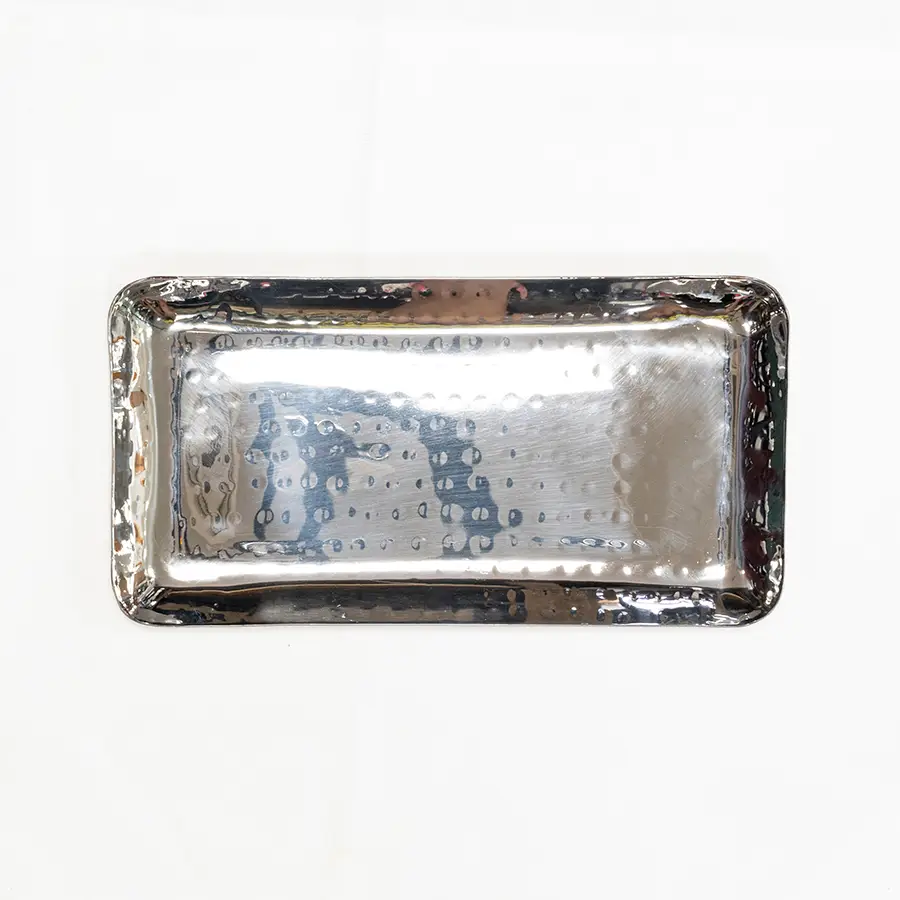
The proportion is what this one is for. At 26 cm long by 135 mm across it is a strip rather than a slab, and a strip is how food gets served in a line — three tapas in order, a flight of two coffees and a bake, a row of cheese with its crackers, a set of dips read left to right. A narrow tray also earns its place on a busy table: it runs down the centre between covers, or sits across a table edge, where a square of the same area would push into someone's setting. On a counter the same shape gives you a defined lane for one product line without committing half the surface to it.
The hammered surface does two jobs. It scatters light instead of reflecting it, so the tray reads as texture rather than as a bright rectangle competing with the food, and it takes the punishment of service — fingerprints, cutlery drag, the marks left when a plate is slid rather than lifted — into a pattern that already looks worked. A flat mirror finish shows all of that within a week. The 15 mm rim gives a clear edge to the presentation and keeps a dish from walking off when the tray is picked up, without becoming a wall that has to be lifted over. Steel is the practical part: oil, vinegar and citrus from a dressing or a marinade sit on it without staining, nothing carries over from a strong-smelling service to the next, and it comes back to clean silver with a wipe.