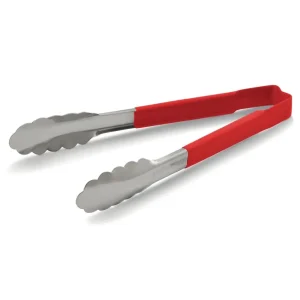
Why this tong earns its place
250 mm is the length most kitchens settle on. It gives enough reach to work from the near side of a full gastronorm, over a hot pan or across a service counter with your hand and cuff well clear of the food, and it still closes precisely enough to take a single piece rather than a handful. Shorter than this and you end up reaching into the pan; longer and you start to lose the feel of what you are holding. It is the tong that does everything — plating at the pass, portioning out of a tray, turning something part-way through, lifting out of hot water — which is why kitchens rack them in numbers rather than keeping one.
Stainless is the obvious build for something that spends its life between a hot pan and a wash. It goes straight back into service, it does not take on the colour of a curry or the smell of yesterday's fish, and it can be scrubbed hard without the finish going dull. The part worth watching is the spring. A tong that has been dropped, bent, or left closed under a stack of weight stops sitting square, and the first sign is food slipping out of the tips at exactly the wrong moment. Wash them open so water reaches the pivot, and pull anything out of the rack whose arms no longer meet cleanly.