
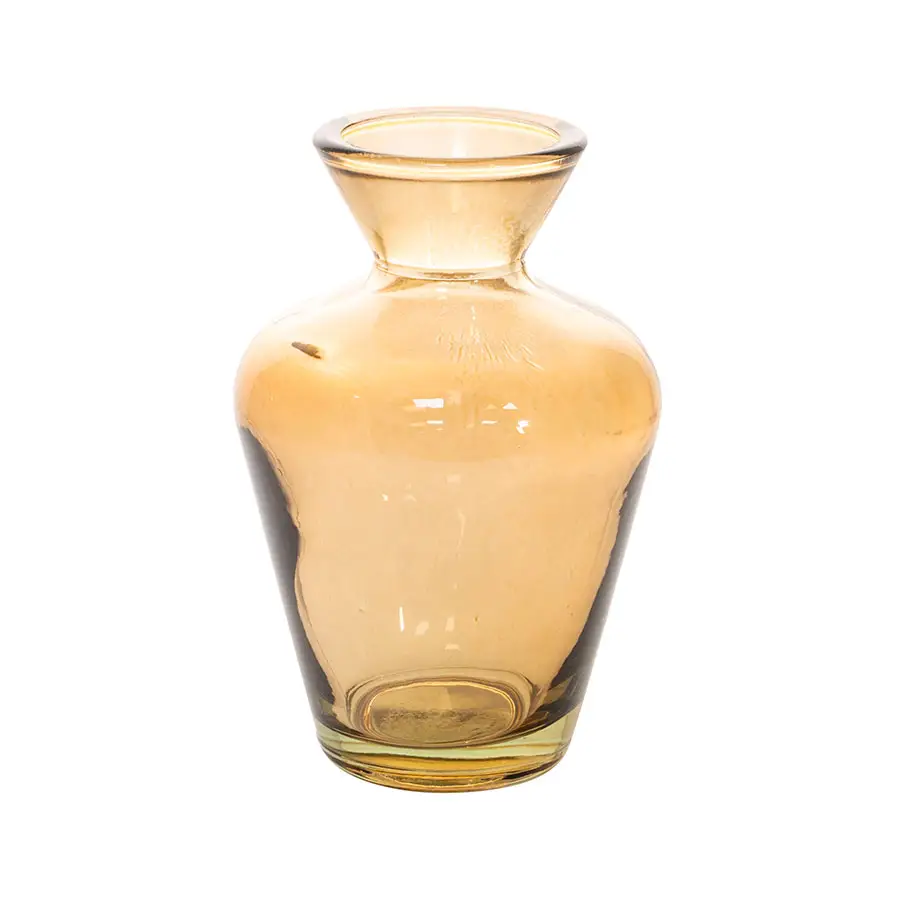
Why this vase earns its place
A copper tone is a decision about light, not just colour. Warm glass comes alive under low, warm lighting — candlelight, filament lamps, the tail end of a winter afternoon — where it picks up whatever light is in the room and throws a little of it back onto the cloth. Cool colours go flat in those conditions and this one does the opposite, which is why warm glass tends to end up in rooms with dark wood, leather and brass rather than white and grey ones. It reads best from autumn into the new year, when the dining room is running on artificial light for most of its opening hours.
The working size is 70 x 110 mm, and both numbers matter. 110 mm stays below the eye line across a two-top so conversation is not conducted around it, and a 70 mm body leaves the cover free for the things that have to be there. It takes one stem or a couple of short ones rather than a bunch — the scale that keeps it upright on a table carrying drinks and plates. Plain glass, with no cut or moulded pattern, means nothing to trap grease and nothing to fight with a patterned cloth or a busy table setting.
Recycled glass varies, and in a warm tone that variation is easy to see and worth having: shade shifts a little between pieces, small bubbles sit in the wall, and a room of them looks made rather than stamped. Practically, a 70 mm body takes a bottle brush and not a cloth, and coloured glass shows water marks and limescale more plainly than clear, so drain and dry them before they go back to store. They are small enough to go over on a busy table, so keep a few spare and a table never has to go out bare.


