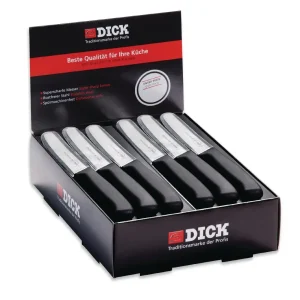
Why this utility knive earns its place
A fully forged blade is harder than stamped. Dick's 1905 range starts from that foundation: German stainless steel worked as one piece, no seams, no weak points. At 12.7cm, this blade is the workhorse utility knife — small enough to control with precision, long enough to handle a tomato or an apple without sawing. The serrated edge bites into bread crust without crushing, and it holds juice-soft items like courgettes or stone fruit without the flesh breaking apart.
Forged construction is the difference between a knife that lasts and one that chips. The blade is tempered to hold an edge through hundreds of cuts, and the handle is scaled and balanced for a hand working at pace. In a working kitchen, you'll grab this more often than you think — peeling, trimming, quick cuts on the pass, bread service, prep work that doesn't need a chef's knife.
The serrated edge means you don't need to sharpen it as often as a straight blade. It grabs and cuts rather than relying on a razor edge, which suits a tool that lives in a busy drawer. Professional kitchens cycle these through the wash along with the rest of their knives, and they outlast the cheaper utility knives by years.