


Why this santoku knive earns its place
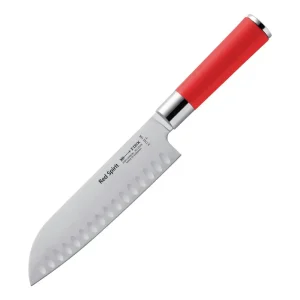
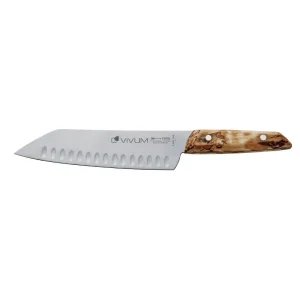
The santoku is the Japanese working knife, and Dick's 1905 version brings German steel and engineering to that principle. Where a Western chef knife is narrow and tapered, the santoku blade is broad and flat — it moves straight down and straight back up, with minimal rocking. This geometry suits rapid vegetable slicing and fine prep work, especially if your kitchen rhythm is fast and your cutting board is your primary workspace.
The Dick 1905 santoku at 17.8 cm is a compact, agile tool. It weighs just 0.33 kg, which means it's responsive and won't tire your wrist through long prep sessions. The blade is German stainless steel with that same carefully ground edge that holds sharpness through hard work. The construction is what sets this knife apart: symmetrical steel rings are forged inseparably into the moulded handle, creating a one-piece structure that won't separate, split, or fail.
Professional kitchens appreciate the santoku for its precision. The straight blade and flat heel make it ideal for slicing fish, poultry and vegetables with clean strokes. The broad spine gives you control, and the steel geometry means you can sharpen it repeatedly without losing performance. This is a working knife — German precision applied to a Japanese design that has earned its place in every serious kitchen.