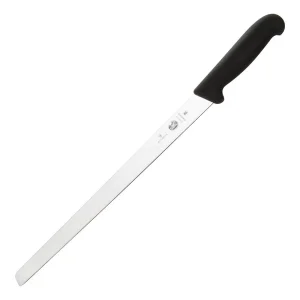
Why this carving fork earns its place
The carving fork is not a knife. It's the hand tool that steadies a roast, joint or large piece of meat while the carving knife does the cutting—and it's essential to the craft. This Victorinox version is 280 mm long overall, with a 15 cm handle of dense rosewood that feels warm and secure in your grip. The tines are carbon stainless steel, professionally sharpened at the points to grip the meat without slipping. The handle is riveted, not glued, so it will outlive the original owner.
Professional carvers rely on the fork's weight and balance as much as its sharpness. At 100 grammes, it's heavy enough to hold a large joint steady without fatigue, yet light enough to angle and turn the meat with precision. The rosewood handle tells you immediately that this is a high-end tool—catering firms and fine-dining restaurants stock these in sets, replacing them slowly over years. This is not the sort of knife you throw away when the handle cracks.
The fork works in partnership. Pair it with a carving knife of matching length (30 cm or longer), and you have the traditional setup for tableside carving. The stamped construction of the tines means they're robust, not delicate—they'll take the occasional knock in service and keep working. Not dishwasher safe (the heat and water will crack the wood and dull the tines), but hand-washing takes seconds.