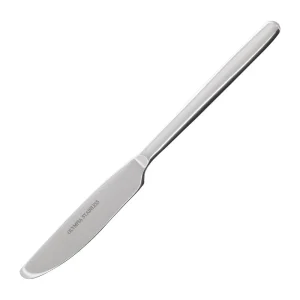
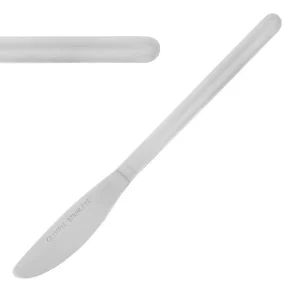
Why this knive earns its place
Four inches is the length you reach for when the cut needs control rather than reach. A cook's knife is worked from the handle with the blade doing the travelling; a short vegetable knife is worked with the fingers close to the edge — trimming, turning, dicing a shallot in the hand, taking the tops off a tray of something small. The plain edge matters here. Teeth tear as they cut and leave a ragged face, which shows on anything going out raw or on a plate; a plain edge parts what it goes through cleanly, which is what you want on a garnish, a fine dice or anything that will sit under a light.
Taking the point off changes where the knife can live. A pointed 4in blade is the one that ends up loose in a drawer, in a bowl of prep, or handed over a pass edge-first, and it is short enough that people stop treating it as dangerous. Rounded, it cannot puncture — so it can sit on a table, travel in a box to an event, or be issued to staff who are not knife-trained, with the worst-case injury reduced to a cut. What you give up is piercing and coring, which need a point and should stay with another blade. Behind that it is stainless steel, which handles a day of wet, acidic veg without staining and washes off clean, and black — a colour outside the HACCP codes of red, blue, yellow, green, brown and white, so it reads as general kitchen use rather than being tied to a raw or ready-to-eat station.