Why this riser earns its place
A flat counter buries everything behind the front row. Whatever is at the back is invisible to someone standing at the glass, and a long buffet table reads as one continuous surface with no focus anywhere on it. A riser is the fix, and 150 mm is a genuinely useful amount of height — enough to bring a second tier clear over the top of the first, so a customer sees both at once and the display has a shape rather than a horizon.
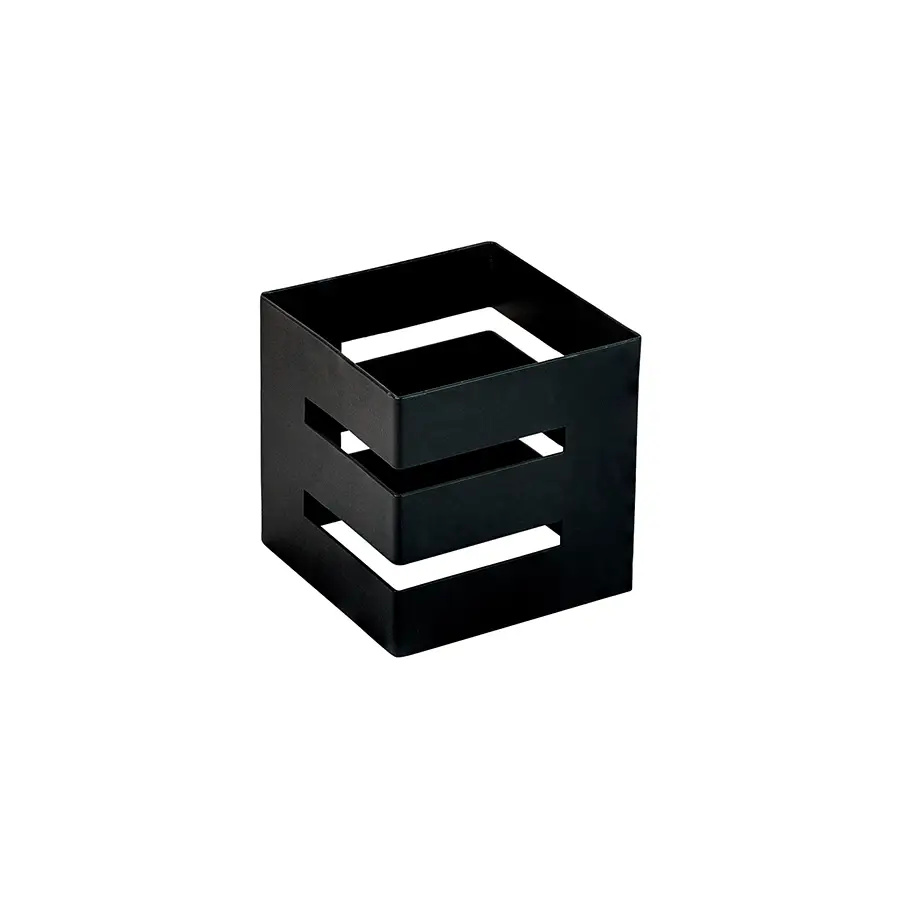
The dimensions are equal on all three axes, 150 × 150 × 150 mm, which makes it straightforward to work with. It stands the same whichever face goes down, so a stand can be built without anyone checking orientation, and a square footprint groups tight against neighbouring pieces without the crescent-shaped dead space a round base leaves between them. On a small café counter, where every hundred millimetres is fought over, that is the difference between a display that fits and one that does not.
Matt black is a deliberate choice for something that stands under counter lights. A polished finish throws reflections back at the customer, picks up every fingerprint from a service reset, and produces glare in a photograph — which matters when the counter is also the marketing. A matt surface absorbs the light instead and disappears behind what is on it, so the food carries the display. Underneath it is stainless steel, so it wipes down between services, takes the knocks of being built and struck daily, and does not chip the way painted timber or ceramic does once it has been through a season of functions.