
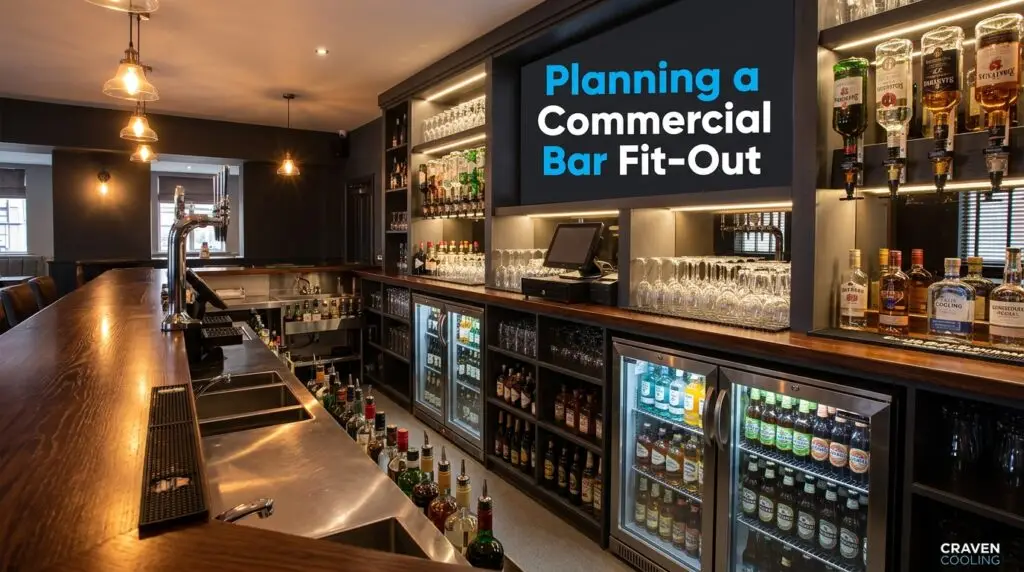
Planning a Commercial Bar Fit-Out
A commercial bar fit-out is a workflow problem before it is a shopping list. Get the zoning right — a dispense zone where drinks are built, a prep zone for cocktails and garnish, and a wash zone that keeps dirty glass off the service run — and everything else follows: where the back-bar refrigeration sits, how the cellar or keg cooling feeds the taps, where the glasswasher lands, how the drainage falls, and how many amps the counter needs. This guide works through the fit-out in build order, with the numbers a bar needs — litres of keg cooling, kilos of ice per hundred covers, and the legal measures under the Weights and Measures Act 1985 that must be built into the kit from day one.
- Zone the bar in three: a dispense zone (taps, well, speed rail, glass access), a prep zone (cocktails, garnish, jiggers), and a wash zone (glasswasher, drop sink, drainage). Every service point needs its own dispense zone so bartenders never share a well.
- Legal measures are law, not house style: under the Weights and Measures Act 1985 gin, rum, vodka, and whisky by the glass go out in 25ml or 35ml or multiples; draught beer and cider serve in stamped or CE/UKCA-marked Third, Half, and Pint glasses to line or brim. Build the legal line into the kit.
- Refrigeration takes 40–50% of the budget: back-bar fridges, bottle coolers, keg coolers, and glass frosters absorb the biggest slice and set the counter layout. Craven Cooling stocks or sources all four to spec.
- Cellar and dispense temperatures are best practice, not law: a cellar held at 11–13°C with lager and keg lines dispensing at 3–8°C via python line cooling is industry best practice for quality — not a statutory temperature.
- Power the bar properly: ice machines, glasswashers, and remote cooling packs each want a dedicated circuit — never a shared ring behind the counter. Plan the electrical load before the joinery is built, not after.
- Drainage falls, not puddles: the wash zone, drip trays, ice wells, and glasswasher all need waste to a floor gully with the correct fall; retro-fitting drainage into a poured floor is the most expensive mistake in a bar build.
- The four stocked lines: the Olympia Single Bottle Bar Optic Holder (£5.85 + VAT), Steelite DWH Hammered Ice Tongs 6-pack (£149.42 + VAT), RCR Cristalleria Tattoo Dual Jigger 24-pack (£153.91 + VAT), and Vogue Stainless Steel Double Sink with Double Drainer 2400mm (£596.21 + VAT) equip the measures, ice, and wash layers today.
- Ice programme sized to Saturday: a wet-led bar uses roughly 0.5–1kg of ice per cover, a cocktail-led bar 1–1.5kg. Size the machine to the busiest night plus a derating margin, never to the average Tuesday.
- Speed rail geometry: everything for the top ten drinks within one step and one reach of the well. Every avoidable step per drink costs 3–5 seconds, hundreds of times a night.
Bars go wrong at fit-out in a predictable order: the drainage floods the wash zone; the electrical load trips a breaker at 9pm; the refrigeration was bought to fill the counter gap so beer goes out warm; and the “measures” turn out to be unstamped at the trading standards visit. Every one of those failures is designed out on paper before a single unit is delivered.
This guide is for operators planning a new pub, bar, or cocktail bar, and for refits where the layout has outgrown the trade. It covers the fit-out as a sequence — zoning, refrigeration, cellar and keg, glasswash, drainage and power, ice, and measures — separating what you source to spec (the cooling and wash layer) from what you can basket today (measures, tools, wash sink). Browse the bar fridges and bottle coolers category and the commercial glassware range when ready.
Table of Contents
- Decision 1: Bar Zoning and Workflow
- Decision 2: Back-Bar Refrigeration
- Decision 3: Cellar, Keg and Line Cooling
- Decision 4: Glasswash Placement, Drainage and Power
- Decision 5: The Ice Programme
- Decision 6: Measures, Speed Rails and the Fit-Out Sequence
- Bar Equipment We Stock
- Frequently Asked Questions
- Related Buying Guides
Legal single spirit measures under the Weights and Measures Act 1985 — pick one house measure and display it
Share of the equipment budget the refrigeration layer typically absorbs — spec it first
Ice per cover in a cocktail-led bar — size the machine to Saturday, not Tuesday
Everything on the back bar can be swapped after opening. The two things fixed at first fix are the floor drainage and the electrical circuits. Get the falls to the gully wrong and the wash zone puddles; under-size the circuits and the ice machine and glasswasher fight over one breaker at peak. Cutting drainage into a poured floor after the bar is built routinely costs £3,000–£8,000 and closes the venue while it happens. Plan both from the equipment schedule before the joinery drawings are signed off.
Typical cost of cutting drainage into a poured floor after fit-out — versus getting it right at first fix
Decision 1: Bar Zoning and Workflow
Before you choose a single unit, draw the bar as three working zones. Every good bar — a two-metre counter or a twelve-metre hotel bar — is the same three zones repeated and scaled. Get the zoning right on paper and the equipment schedule writes itself; get it wrong and no kit rescues a bar where the bartender walks four steps for ice on every drink.
Dispense zone
Where drinks are built
- Taps, ice well, speed rail, stamped measures
- Under-counter bottle coolers within a reach
- Clean glass access at the point of build
- One full dispense zone per service point
Prep zone
Cocktails and garnish
- Jiggers, shakers, strainers, bar spoons
- Garnish tray, prep board, small sink
- Glass froster within reach for up serves
- Sited beside, not across, the dispense zone
Wash zone
Dirty glass off the run
- Glasswasher, drop-off sink, drainer
- Drainage to a floor gully with correct fall
- Dirties enter without crossing service flow
- Clean glass lands back at the dispense zone
The golden triangle
How the zones connect
- Build, garnish, wash within a pivot
- No zone crosses another’s traffic
- Restock and waste routes kept separate
- Scale the triangle, don’t stretch it
Two rules govern the layout. First, dirty glass must never cross the service run: the wash zone takes dirties in at one end and returns clean, racked glass to the dispense zone in a one-way loop. Second, duplicate the full dispense zone for every service point rather than making two bartenders share one well and rail — sharing a well halves each bartender’s speed. For counter fabrication that carries the zoning through, see the bar counters and stations category — we stock or source to fit your run.
The most expensive fit-out mistakes are frozen in at the joinery stage: a well two steps from the taps, a glasswasher at the wrong end of the bar, an ice bin nobody can reach without turning their back on the customer. Once the carcass is built and the drainage is cast into the floor, changing the zoning means starting again. Mark up the equipment schedule against a scaled plan, walk every core-list drink through it on paper, then sign off the joinery drawings.
Decision 2: Back-Bar Refrigeration
Refrigeration is the spine of the fit-out and the first thing to specify in detail — it sets the counter layout, the electrical plan, and roughly half the budget. Four unit types cover almost every bar, and Craven Cooling stocks or sources all of them to your volume and counter dimensions:
Back bar fridges
- Under-counter, glass doors, lit display
- Size by bottle count: a 3-door unit holds ~300 bottles
- Hold packaged beer, mixers, wine at 3–5°C
- Sliding doors save aisle space behind a narrow bar
Bottle coolers
- The workhorse merchandiser for high-rotation lines
- Restock from the top, serve from the front
- Plan 1.5 nights of stock chilled at all times
- Warm bottles need 4+ hours to pull down
Keg coolers
- For sites without a cellar — keg fridge plus python
- Lager and keg ales dispense at 3–8°C
- Size by keg count on the busiest line-up
- Leave line-cleaning access in the layout
Glass frosters
- Sub-zero cabinet chills glasses to -5°C or below
- Frosted glass keeps a Martini cold 5+ minutes longer
- The visible quality cue cocktail bars trade on
- Counter-top or under-counter formats
The sizing rule is the same across all four: count the chilled stock you need on the busiest night — every packaged line at 1.5 nights of cover, every keg on the board, plus glasses for the froster — and buy to that number, not to the counter gap. Undersized refrigeration serves warm lager at 10pm and never pulls product down before last orders. Because it decides where the under-counter units sit within each dispense zone, refrigeration belongs in the first layout conversation, not the top-up at the end.
| Unit | Job | Typical hold temp | Size by |
|---|---|---|---|
| Back bar fridge | Lit display of packaged beer, mixers, wine | 3–5°C | Bottle count (3-door ≈ 300 bottles) |
| Bottle cooler | High-rotation merchandiser at the dispense zone | 3–5°C | 1.5 nights of the fast lines chilled |
| Keg cooler | Draught cooling where there is no cellar | 3–8°C dispense | Kegs on the busiest line-up |
| Glass froster | Sub-zero glass chilling for up serves and premium lager | -5°C or below | Glass bank per busy hour |
Craven Cooling stocks or sources the full cooling layer: back bar fridges, keg coolers, glass frosters, and bar counters and stations. Call 01792 732702 or email [email protected] with your counter run and busiest-night stock list and we’ll size the layer end to end — with 2-year parts warranty across the UK & Ireland.
Decision 3: Cellar, Keg and Line Cooling
Draught quality is won or lost across the chain from the cellar to the tap. There are two ways to feed the taps: a cooled cellar with cellar buster fans and python line cooling up to the bar, or — for sites with no cellar — a keg cooler cabinet under or behind the bar. The choice is set by the building, but the temperature targets are the same either way.
| Factor | Cooled cellar + python | Keg cooler cabinet |
|---|---|---|
| Best for | Sites with a cellar or plant room and multiple lines | Sites with no cellar, or a small line-up |
| Cellar / store temp | 11–13°C (best practice), cellar buster or pack cooling | Kegs held cold in the cabinet itself |
| Dispense temp | 3–8°C at the tap via python line cooling | 3–8°C at the tap, short line run |
| Line length | Long runs stay cold in the python bundle | Keep runs short — long uncooled lines warm the pour |
| Fit-out note | Plan the python route and cellar power at first fix | Leave keg-swap and line-cleaning access in the layout |
Whichever route the building dictates, two things must be designed in, not bolted on. First, line-cleaning access: keg lines are cleaned on a roughly weekly cycle, and a cooler boxed in with no access makes that a battle every week. Second, the python or line route: a long uncooled run warms the beer in the last two metres and undoes the cooling — keep runs short, insulated, and accessible. Craven Cooling stocks or sources keg coolers to your line-up; beer, gas, and lines come from your brewery or dispense contractor, but the cabinet and its siting are ours to get right.
Decision 4: Glasswash Placement, Drainage and Power
This is the section that decides whether the bar floods on Saturday. Glasswashing, drainage, and electrical load are the three services that are cheap to plan and ruinous to retro-fit — and they all live in the wash zone.
Glasswasher placement
One under-counter glasswasher per main service point, sited inside the station. A 400–450mm basket machine on a 2–3 minute cycle turns roughly 16 pint glasses per basket — but only if it sits where dirty glass arrives and clean glass returns without crossing the service run. Beside it goes the drop-off sink and drainer: the Vogue Stainless Steel Double Sink with Double Drainer 2400mm (£596.21 + VAT) is the wash-zone spine a busy bar needs — two bowls for wash and rinse, drainers both sides so dirty glass lands one end and clean the other.
Drainage and floor falls
Every wet point — the glasswasher, drop-off sink, ice well, and tap drip trays — needs waste to a floor gully, and the floor needs the right fall to carry it there. This is a first-fix decision cast into the floor, which is why it heads the list of expensive fit-out mistakes.
-
✓
Falls to a floor gully at every wet point
Glasswasher, sink, ice well, and tap drip trays all drain to a gully with the correct fall, planned from the equipment schedule at first fix. -
✓
A drain pump where the waste run is above the machine base
If the glasswasher sits below gully level, spec a drain pump at purchase — retro-fitting one means pulling the machine and the plumbing. -
✓
Ice well and tap trays drained, not bailed
An ice well drains meltwater continuously and a plumbed tray catches pour spill — neither should ever need emptying by hand mid-shift. -
✓
Sealed, sloped floor finish behind the bar
A non-slip, sealed floor falling gently to the gully is a Workplace (Health, Safety and Welfare) Regulations 1992 basic for a floor staff work on all night.
Power planning
Behind-the-bar electrical load is heavier than most first-time operators expect, and must be planned from the equipment schedule before the joinery is built. The rule is simple: heavy, cycling loads get dedicated circuits.
An ice machine cycles hard and runs constantly — give it its own circuit so it never shares a breaker with the glasswasher, the classic 9pm trip.
Heating elements and drain pump draw hard on cycle; a dedicated supply keeps the wash zone running through the busiest hour without nuisance trips.
Back-bar fridges, bottle coolers, and any remote or cellar pack want their own protected supplies — refrigeration must never drop out because a blender tripped the socket ring.
Blenders, tills, froster, and small tools sit on the general ring — sized with headroom, RCD-protected, never daisy-chained through extension leads.
The bar is a permanently wet environment with heavy electrical load. Every circuit behind the counter must be RCD-protected, every socket sited away from splash, and the whole installation signed off by a qualified electrician to current wiring regulations. Portable equipment goes on a PAT-testing rota; HSE guidance on maintaining portable electrical equipment applies to everything plugged in behind a bar. This is not a place for a general-purpose ring and a bank of extension leads.
Decision 5: The Ice Programme
Ice is an ingredient with a supply chain, and running out at 10pm on a Saturday is the classic new-bar failure. An ice machine is rated per 24 hours, but a Saturday night draws its ice in a four-hour window, so storage matters as much as production. Size the machine to the busiest night plus a derating margin:
Two things the worked example bakes in. First, the derating margin: ratings are quoted at 10°C air and water, and a hot back room in August cuts real output 20–30%, so buy above the raw demand figure. Second, storage: the 60kg bin is the buffer that carries the four-hour peak, since production is steady but demand spikes. Every dispense zone then needs its own insulated ice well, drained continuously, so nobody walks for ice mid-drink.
Treat the machine as food equipment, because ice is food: filter the supply, sanitise the bin weekly, and store the scoop outside the bin. This is where the Steelite DWH Hammered Ice Tongs (6-pack, £149.42 + VAT) earn their place: one at every dispense zone means there is never a reason for a hand, or a glass, to enter the well. A single chipped rim condemns the bin and empties it entirely.
Site the ice well dead-centre in each dispense zone, drained to the floor gully, with the speed rail across its front and tongs at the side. A bartender should reach ice, spirit, mixer, and glass from one standing position. Get the siting wrong — well two steps from the taps — and every drink costs an extra reach that multiplies across 400 drinks a night.
Decision 6: Measures, Speed Rails and the Fit-Out Sequence
The final decision layer is the one trading standards check first: the measures on the rail. Getting it right is cheap, and it must be built into the station layout, not added afterwards.
Legal measures — optics vs free-pour vs jigger
Under the Weights and Measures Act 1985, gin, rum, vodka, and whisky sold by the glass must go out in 25ml or 35ml, or multiples of the one house measure you choose and display. Beer and cider on draught must be served in stamped or CE/UKCA-marked Third, Half, and Pint glasses, filled to the line or brim. For those four spirits sold straight, free-pouring is an offence — you use stamped optics or thimble measures. Cocktails are the exception: a mixed drink of three or more liquids is exempt, which makes a 30ml/60ml jigger legal on the cocktail station.
| Method | Legal for straight spirits? | Best for | Notes |
|---|---|---|---|
| Stamped optics | ✓ Yes — stamped valve | High-volume house pours | Fastest and most stock-controllable; shelf-mount holder per bottle |
| Stamped thimble measures | ✓ Yes — stamped | Premium and back-shelf ranges | Slower than optics; looks right for premium bottles |
| Cocktail jigger (30/60ml) | No for straight spirits | 3+ liquid cocktail builds (exempt) | Legal only under the cocktail exemption; keep stamped kit alongside |
| Free-pour | No — an offence | Nothing sold as a straight measure | Never for the regulated four straight; trading standards test-purchase |
In practice most good bars run all three, zoned by task: stamped optics on the house four for speed and millilitre-level stock control, thimbles for premium ranges, and jiggers on the cocktail station for the exempt builds. The Olympia Single Bottle Bar Optic Holder (£5.85 + VAT) shelf-mounts each house-pour bottle for a stamped valve — at that price, optic-mounting the regulated four is the cheapest compliance upgrade in the whole fit-out. The RCR Cristalleria Tattoo Dual Jigger (24-pack, £153.91 + VAT) covers the cocktail station’s 30ml and 60ml builds; keep stamped 25ml/35ml thimbles on the rail beside it for anything sold straight.
Speed rail and pours-per-minute layout
A dispense zone is a cockpit built for speed: ice well in the centre, speed rail across its front with the top ten pouring brands, jiggers and stamped measures on the rail, shakers and strainers within a hand’s reach, garnish at eye level, glass access at the build point, and the glasswasher inside the station. The test is simple — a bartender should build any drink on the core list without moving their feet.
Count the movements to see why it matters. A gin and tonic built from a well-laid station is glass, ice, stamped measure, pour, mixer, garnish — around eight seconds. The same drink with the spirit on a back shelf and ice two steps away is twenty. Across 400 drinks on a Saturday, that gap is roughly 80 minutes of service time per bartender — the entire argument for the speed rail and for duplicating the full dispense zone at every service point.
The fit-out sequence
Do the build in this order and each stage sets up the next; do it out of order and you retro-fit.
Dispense, prep, and wash zones marked, service points counted, dirty-glass loop kept off the service run. Walk every core drink through it on paper first.
Floor gullies and falls from the equipment schedule; dedicated circuits for ice machine, glasswasher, and refrigeration. Cast into the floor, they cannot move later.
Back-bar fridges, bottle coolers, keg cooling or cellar plus python, and glass frosters sized to the busiest night and positioned within each dispense zone.
Double sink with drainers, under-counter glasswasher inside each station, auto-doser and drain pump specified, drip trays both sides.
Machine sized to Saturday with derating margin and storage bin, insulated wells drained at every dispense zone, tongs at each well.
Stamped optics on the house four, thimbles and jiggers on the rail, speed rails loaded to the drinks list — the quick, cheap layer on top of everything already right.
UK Price Tiers — July 2026
£6–£155
Optic holders, jigger packs, ice tongs — the legal and speed layer, + VAT
£400–£900
Stainless double sink with drainers — the wash-zone spine, + VAT
£1,000–£2,000
Under-counter machine fitted, per station — sourced to spec, + VAT
£2,500–£8,000
Back bar, bottle coolers, keg cooling, froster — sourced to spec, + VAT
Bar Equipment We Stock
The measures, ice, and wash layers below are stocked at Craven Cooling, July 2026 — the parts of the fit-out you can put in a basket today while the cooling and glasswash layer is specified to your bar. Prices + VAT, 2-year parts warranty across the UK & Ireland.
+ VAT — Craven Cooling price
Cheapest compliance upgrade
- Shelf-mount holder for one inverted bottle
- Pairs with stamped 25ml/35ml optic valves
- Consistent legal pours on house spirits
- Stock control to the millilitre
At £5.85 + VAT a bottle position, optic-mounting the regulated four (gin, rum, vodka, whisky) is the cheapest compliance and stock-control upgrade in the whole fit-out.
+ VAT — Craven Cooling price
One per dispense zone
- 203mm hammered stainless tongs
- 6 per pack — one per station plus spares
- Hands and glasses stay out of the ice well
- Presentation-grade for table and garnish service
The tool that protects the ice programme. A glass dipped in the well means condemning the whole bin — tongs at every dispense zone make the right way the easy way.
+ VAT — Craven Cooling price
- Dual-ended 30ml / 60ml crystal jigger
- 24 per pack — one at every station, spares in the drawer
- For cocktail builds (3+ liquid drinks, measure-exempt)
- Repeatable specs = consistent drinks and pour cost
The cocktail station’s precision layer. Keep stamped 25ml/35ml thimbles alongside for straight spirit serves — the Tattoo covers the exempt cocktail builds.
+ VAT — Craven Cooling price
The wash-zone spine
- 2,400mm stainless double sink, double drainer
- Two bowls — wash and rinse, or drop and clean
- Drainers both sides for a one-way glass loop
- Hygienic, drainable stainless for a wet zone
The backbone of the wash zone: dirty glass lands one end, clean returns the other, and the double bowl handles renovation washes alongside the glasswasher.
Craven Cooling stocks or sources the full cooling and wash layer to spec: back bar fridges, keg coolers, glass frosters, and commercial glassware. Call 01792 732702 or email [email protected] with your counter run, service points, and busiest-night stock list and we’ll spec the layout end to end.
In this guide ↓
- Key facts and 2026 UK reference numbers
- Zoning the bar — dispense, prep, and wash zones
- Back-bar refrigeration sized to the busiest night
- Cellar, keg, and python line cooling as best practice
- Glasswash placement, drainage falls, and power planning
- Ice programme sized to Saturday, with worked example
- Legal measures under the Weights and Measures Act 1985
- Stocked products at Craven Cooling — verified specs and prices
- FAQ — eight buyer-objection questions answered
All Bar Equipment We Stock or Source
| Model / format | Layer | Role in the fit-out | Trade price + VAT |
|---|---|---|---|
| Olympia Single Bottle Optic Holder ★ | Measures | Stamped-optic mount for house spirits | £5.85 |
| Steelite DWH Hammered Ice Tongs 6-Pack ★ | Ice service | One per dispense zone, hands out of the well | £149.42 |
| RCR Tattoo Dual Jigger 30/60ml 24-Pack ★ | Cocktail measures | Exempt cocktail builds, one per station | £153.91 |
| Vogue Double Sink + Double Drainer 2400mm ★ | Wash zone | Wash-zone spine and renovation washing | £596.21 |
| Back bar fridges & bottle coolers | Refrigeration | Chilled display and high-rotation stock | Sourced to spec |
| Keg coolers | Draught cooling | Dispense for sites without a cellar | Sourced to spec |
| Glass frosters | Refrigeration | Sub-zero glass chilling for up serves | Sourced to spec |
| Commercial glassware (stamped pint, wine, cocktail) | Serving | Legal serve sizes by drink | Stocked / to spec |
★ = Stocked at Craven Cooling. Refrigeration, keg cooling, and glasswashing sourced to specification. Prices July 2026, + VAT.
Send us your counter run, service points, and covers and we’ll spec the lot — zoning, back-bar cooling, keg and froster layer, glasswashing, drainage and power notes, ice, and the measures kit. See it side by side at the Swansea showroom. 2-year parts warranty across the UK & Ireland.
Browse Bar Equipment
Call Sales — 01792 732702
Related Buying Guides
Opening from scratch? Start with the essential bar equipment checklist for a new pub or cocktail bar. For the station-speed detail behind the dispense zone, read speed rail and fast-service bar equipment explained. Getting the draught right? See serving draught beer at the right temperature. And to build the glass bank against your serve list, read how to stock commercial bar glassware.
A commercial bar fit-out is a workflow problem: zone the bar into a dispense zone (taps, well, speed rail, glass access), a prep zone (cocktails, garnish, jiggers), and a wash zone (glasswasher, sink, drainage), with dirty glass kept off the service run and a full dispense zone per service point. Refrigeration takes 40–50% of the budget — back-bar fridges and bottle coolers at 3–5°C, keg coolers dispensing at 3–8°C, and glass frosters at -5°C or below — all sized to the busiest night and sourced to spec. Cellar 11–13°C and dispense 3–8°C via python line cooling are industry best practice, not law. Drainage falls and dedicated circuits (ice machine, glasswasher, refrigeration) are first-fix decisions that are ruinous to retro-fit. Size the ice machine to Saturday — around 200kg/24hr with a storage bin for a 150-cover cocktail bar. Measures are law under the Weights and Measures Act 1985: gin, rum, vodka, and whisky in 25ml or 35ml or multiples through stamped optics and thimbles, beer in stamped or CE/UKCA-marked Third, Half, and Pint glasses, with the cocktail exemption covering 3+ liquid builds on a 30/60ml jigger. Craven Cooling stocks the Olympia optic holder (£5.85 + VAT), Steelite hammered ice tongs (£149.42 + VAT per 6), RCR Tattoo dual jigger (£153.91 + VAT per 24), and Vogue double sink with double drainer 2400mm (£596.21 + VAT), and sources the refrigeration, keg cooling, and glasswashing to spec. Call 01792 732702 or visit the Swansea showroom; 2-year parts warranty UK & Ireland.
Frequently Asked Questions
▼
▼
▼
▼
▼
▼
▼
▼


