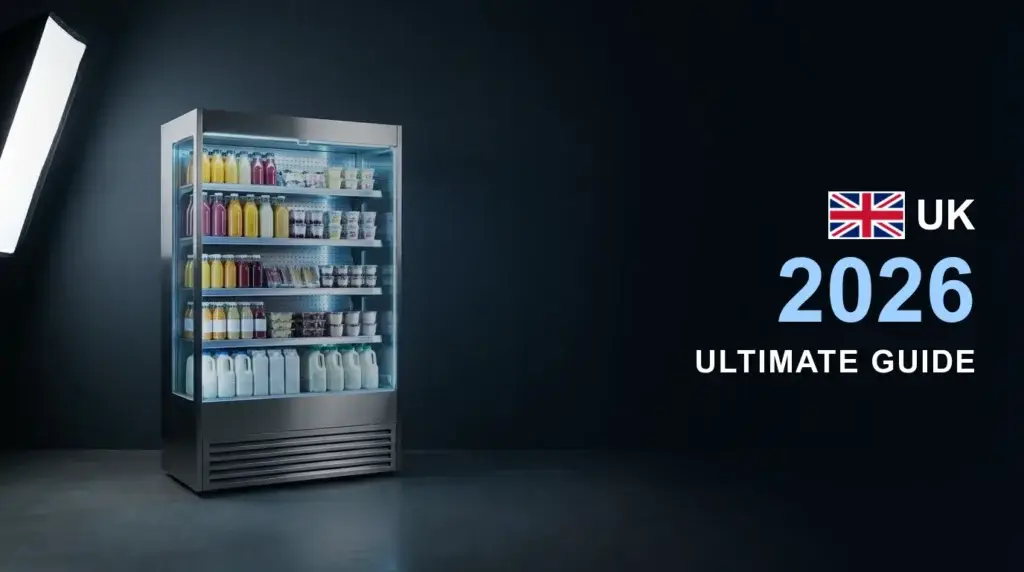
Commercial Multideck Display Fridge Buying Guide: The Complete UK Guide (2026)
A multideck display fridge — the stacked glass-fronted chilled cabinet lining convenience store counters, takeaway service lines, hotel grab-and-go sections, and delicatessen departments — is the single most-specified piece of commercial kitchen equipment in the UK. This guide cuts through manufacturer spec sheets to cover the three decisions that matter on purchase day: EU 2019/2024 EcoDesign Tier 2 compliance (mandatory since September 2023), open-front vs glass-door energy economics (£738/year gap on a 1m unit), and matching the right brand to your operation instead of the operation to one catalogue. We cover climate class M3 vs H4, F-Gas refrigerant rules, night blind payback timescales, and featured multideck ranges from Frost-Tech, Polar, Tefcold, Williams, Cossiga, Oscartielle and Arneg — because Craven Cooling stocks from 12+ brands, not one.
- EU 2019/2024 EcoDesign Tier 2 (mandatory since 1 Sept 2023): all new commercial display cabinets must meet EEI ≤80%; vertical supermarket cabinets EEI <65%. Cabinets not meeting Tier 2 cannot be placed on UK market. This is the single biggest 2026 spec change — old stock is officially obsolete.
- Energy gap: glass-door vs open-front 1m multideck: glass-door ~3.0 kWh/24h, open-front ~10.5 kWh/24h. At 27p/kWh (UK non-domestic 2026), that’s £296/year vs £1,034/year — a £738/year payback gap. Night blinds on open-fronts recover 30–50% of that loss for roughly £800–£1,200 per unit.
- Climate Class M3 (Class 3) standard: 25°C ambient, 60% RH — typical UK retail. Class H4 (Class 4) for warm/poorly-ventilated spaces: 30°C, 55% RH. Buying wrong climate class = cabinet fails in summer peak — verify this in writing on any quote.
- F-Gas update: virgin HFC GWP >2500 banned from 1 January 2020. All new multidecks ship with R290 (propane, GWP 3) or R600a (isobutane, GWP <1). Confirm refrigerant on every order — grey importers still move older stock.
- Capacity decoder: a standard 1.0m (1000mm) multideck with 4 shelves holds ~85–110 display units (depending on product type: compact jars, cans, bottles, or meal trays). A 1.3m unit ~110–140. A 2.0m unit ~180–230. Linear metre matters more than headline litres — plan for peak-service stocking plus 24h reload window.
- UK price tiers (ex VAT, April 2026): entry compact 0.9m glass-door 600–1000L £1,200–£1,600; mid-range 1.3m multideck 900L–1300L £1,600–£2,400; open-front supermarket-grade 2.0m+ remote condenser £2,800–£5,500+; premium Italian/Danish brands (Cossiga, Williams) same footprint +40–60% premium.
- Night blinds for open-front: motorised blinds drop energy consumption 30–50% overnight. Payback 1–2 years. Not statutory but strongly recommended by EHO and insurance underwriters for competitive running cost on busy service lines.
- Plug-in vs remote condenser: plug-in (integral compressor) for 1–2 units, dumps heat into shop, simpler wiring. Remote for runs of 3+ units — heat removed to plant room/exterior, lowers running cost by 10–15%, specialist install. Craven sources both patterns across 12+ brands.
The multideck display fridge is the most-underspecified piece of equipment in UK food retail. Convenience store managers buy on price alone; hotel procurement buys on the cheapest compliance tick; restaurant kitchens inherit whatever was there five years ago. The result: cabinets that miss EU energy standards by a country mile, display surfaces that sweat and frost in summer, and running costs 50% higher than they need to be.
This guide is written for the trade buyer making that decision: convenience store owner, hotel F&B operations, restaurant/takeaway chain, supermarket buyer, catering kitchen manager, or food retail operator specifying multideck refrigeration for the first time. We cover the three non-negotiable specifications (EcoDesign Tier 2, climate class, refrigerant type), the energy maths everyone gets wrong, how to read capacity spec correctly, and how Craven Cooling’s multi-brand sourcing strategy — stocking from Frost-Tech to Cossiga to Arneg — matches the right cabinet to your operation instead of forcing your operation into one brand’s catalogue.
In this guide ↓
- Key facts and 2026 UK compliance reference numbers
- Three critical decisions: open-front vs glass-door, plug-in vs remote, climate class M3 vs H4
- Energy cost maths and payback timescales
- Multideck decoder: capacity by footprint and product type
- UK price tiers — what each band buys you
- Featured stocked and lead-gen products: Frost-Tech, Polar, Tefcold, Williams, Cossiga, Oscartielle, Arneg
- Total cost of ownership calculator worked example
- UK compliance checklist: EU 2019/2024, F-Gas, BS EN ISO 23953, food temp regs
- Installation and operation checklist
- FAQ — eight buyer objections answered
Decision 1: Open-Front vs Glass-Door Multideck
This is the single biggest specification decision on a multideck — and the energy maths are so polarised that it’s surprising buyers don’t run them more often. On a 1.0m unit, the difference is not small:
| Specification | Open-front multideck (1.0m) | Glass-door multideck (1.0m) |
|---|---|---|
| Daily energy (25°C ambient) | ~10.5 kWh/24h | ~3.0 kWh/24h |
| Annual consumption | 3,832 kWh | 1,095 kWh |
| Annual cost @ 27p/kWh | £1,034 | £296 |
| Year 1 energy saving | £738 | |
| EEI rating (Energy Efficiency Index) | 75–85 (open-front typically higher) | 45–65 (better compliance margin) |
| Customer visibility | Unobstructed — perfect for self-select takeaway | Through glass — slight product blur in busy areas |
| Staff restocking speed | Full-width fast access | Hinge or slide doors — one shelf at a time |
| Night-time payback add-on | Night blinds recover 30–50% (~£350–£520/year), payback 1.5–2 years | Night blinds add £5–10k/unit for 10% gain — not cost-effective |
| Best for | Busy takeaway, convenience store self-select, visible product display | Hotel grab-and-go, quieter retail, energy-conscious operators |
Decision 2: Plug-In (Integral) vs Remote Condenser
The location of the refrigeration system — in the cabinet base, or in an external plant room — determines installation cost, running cost, and scalability:
| Factor | Plug-in (integral compressor) | Remote condenser system |
|---|---|---|
| Best for how many units? | 1–2 cabinets | 3+ cabinets in a run |
| Heat rejection | Dumped into shop — increases air-con load in summer | Ducted to plant room or exterior — no shop heat load |
| Installation cost | £0–£200 (plug and play) | £1,500–£3,500 (pipework, electrical, ducting) |
| Running cost saving vs plug-in | — | 10–15% annual energy saving (condenser efficiency) |
| Space requirement | Cabinet footprint only | Plant room, roof, or dedicated external space needed |
| Noise | Compressor hum in shop | Condenser noise isolated to plant area |
| Maintenance access | On-site, rapid engineer visit | Plant room access needed — usually simpler for engineer |
| Best-for scenarios | Hotel 1–2 cabinet grab-and-go; small café; retrofit where space is tight | Supermarket, large convenience store, catering kitchen with 4+ metres of display |
Decision 3: Climate Class M3 vs H4
Climate class determines whether a cabinet will actually maintain temperature on a hot July day in a poorly-ventilated retail space or a sunny window:
| Climate Class | Ambient temp | Humidity | Best for | Risk if mis-specified |
|---|---|---|---|---|
| Class 3 (M3) | 25°C | 60% RH | Typical UK retail environment, air-conditioned shops, closed kitchens | None if environment is genuinely 25°C max |
| Class 4 (H4) | 30°C | 55% RH | Warm/poorly-ventilated retail, outdoor catering, sun-exposed windows, edge-of-kitchen deployment | Class 3 cabinet fails in summer — temperature rises above 8°C, breach of Reg 852/2004 |
| Class 2 (Colder) | 16°C | 63% RH | Very cold retail (rare in UK) | — |
| Class 5 (Tropical) | 40°C | 40% RH | Outdoor hot-climate catering (Middle East, etc.) | — |
Five Types of Multideck Display Fridges
Compact Glass-Door Multideck
600–900 L, 0.9–1.0m wide- Paired hinged or single slide doors
- 3–4 shelves
- 15–25°C temp zone
- Best for: hotel grab-and-go, small café, integrated kitchen display
Standard 1.3m Multideck
1000–1300 L, mid-range workhorse- Open-front or paired glass doors
- 4–5 shelves
- 2–8°C fresh/deli display
- Best for: sandwich bar, convenience store, deli counter
Extended 2.0m Open-Front
1500–2000 L, high-volume retail- Single open display face, no doors
- 5–6 shelves
- Night blind retractable
- Best for: supermarket, large convenience store, 24h retail
Dual Compact 2×0.9m
Two narrow units side-by-side- Modular placement flexibility
- Separate or joined thermostats
- 600–900 L each
- Best for: small retail, retrofit tight spaces
Supermarket-Grade Remote System
2.5m+ bays, plug-in to central plant- 5–8 shelves, modular bays
- 2000–3500+ L per run
- Remote condenser heat rejection
- Best for: large supermarket, foodservice distribution, catering chains
The Multideck Capacity Decoder
Manufacturers publish capacity in litres. That number tells you volume, not what you can actually stock. A 1.3m multideck holds very different quantities of cans vs bottles vs meal trays. Here’s the real-world decoder:
| Unit size | Capacity (L) | Compact cans (330ml) | Bottles (500–600ml) | Meal trays (250–350g) | Sandwich packs |
|---|---|---|---|---|---|
| 0.9m wide | 600–700 L | ~85–110 | ~45–60 | ~70–90 | ~60–80 |
| 1.0m wide (standard) | 900–1000 L | ~110–140 | ~60–80 | ~90–120 | ~80–110 |
| 1.3m wide | 1200–1400 L | ~160–180 | ~85–110 | ~130–170 | ~110–150 |
| 2.0m wide | 1800–2200 L | ~240–280 | ~130–160 | ~200–260 | ~170–220 |
UK Price Tiers: What Each Band Buys You (April 2026)
Featured Multideck Ranges: Stocked and Lead-Gen
- 1000mm wide, 4 shelves
- R290 refrigerant, Climate Class 3
- Energy F rating (EEI 78)
- 13A single phase
- UK-built robust spec
The Frost-Tech SD75 series is the workhorse of UK multideck retail — stainless steel construction, proven reliability, and energy-compliant R290 refrigerant. Standard 5–10 day dispatch.
View full spec →- Double glass doors, 744 L
- 8 shelves, 2–8°C display
- R290, Energy Class B
- 220–240V single phase
- Grab-and-go optimised
Polar’s G-Series is the mid-tier standard for UK hotel grab-and-go and small convenience stores. Strong energy rating, reliable door mechanisms, competitive pricing. Best for light-to-medium duty retail display.
View full spec →- 1.3m+ glass or open-front
- R290, Climate Class 3–4
- EEI <70 (Tier 2 compliant)
- Modular shelving system
- Premium thermal insulation
Tefcold’s Galaxy range is the premium Danish alternative — higher energy efficiency margins, modular design, and aesthetic finish. Lead-gen enquiry; contact us for full spec and lead time quote.
Request Tefcold quote →- 1.3–2.0m open-front luxury
- Stainless steel, night blind option
- R290, EEI <65
- Modular expandable design
- Premium UK-built spec
Williams Marquesa is the premium UK multideck for upmarket retailers and hospitality. Stainless steel, advanced controls, and energy-optimised design. Lead-gen; contact us for specification and supply timeline.
Request Williams quote →- 1.3–2.0m stainless steel
- Advanced aesthetic finishes
- R290, EcoDesign Tier 2 certified
- Banqueting-grade spec
- Remote condenser compatible
Cossiga multidecks are the Italian premium choice for upmarket hotels and banqueting. Exceptional finish, modular design, remote system ready. Lead-gen enquiry — contact us for full spec and pricing.
Request Cossiga quote →- 2.5m+ modular bays
- Remote central plant option
- EEI <65 (vertical standard)
- Integral night blinds
- Supermarket-scale output
Oscartielle and Arneg are the go-to brands for large supermarket and foodservice distribution chains. Modular, scalable, remote-plant optimised. Lead-gen; speak to our team about your site requirements.
Request supermarket spec →Total Cost of Ownership: Year 1 Worked Example
Comparison: an open-front 1.3m unit @ 10 kWh/24h = £987/year energy alone. Over 5 years, glass-door saves ~£3,200 in energy vs open-front (before night blinds payback on open-front). Leasing option: from £1,200+ VAT/month via Kennet Finance.
UK Compliance Checklist
Confirm EEI ≤80% (vertical supermarket cabinets ≤65%) on the spec sheet before ordering. Any cabinet not meeting this standard cannot legally be placed on UK market from Sept 2023. Ask the supplier: “Is the EEI rating certified and CE/UKCA marked?” Request the EU product fiche.
Confirm refrigerant type in writing: R290, R600a, or R744 only. Do not accept R134a, R404A, or R422D. Virgin HFC with GWP >2500 is banned from 1 January 2020 for new equipment. Check the spec sheet or request the technical data sheet (TDS) which states the refrigerant and charge weight.
All commercial display cabinets sold in the UK must be tested and marked to BS EN ISO 23953. Verify CE or UKCA marking on the unit. This standard covers temperature classification (M0–L3), climate class (2–5), and testing methods. Your multideck must meet your chosen temperature class (typically M2 or H2 for fresh retail).
All customer-facing glass on display cabinets must be toughened glass to BS EN 12150 — fractures into small safe granules, not shards. Supplier must confirm BS EN 12150 certification for all door panes. This is a legal requirement for display cabinets in public areas.
Display temperature must not exceed 8°C (target 5°C) for chilled fresh food. Install a calibrated thermometer probe on the warmest shelf. Log temperatures twice daily (morning/evening). Retain 12-month logs for EHO inspection. Multideck should come with temperature controller — verify it’s accurate to ±0.5°C.
All portable appliances (including plug-in multidecks) must be tested under EAW 1989 (UK electrical safety standard equivalent to IEC 60730) before first use and annually thereafter. Supplier should provide CE declaration of conformity. For hard-wired units, installation must be by a registered electrician — request an EICR (Electrical Installation Condition Report) post-install.
Installation and Operation Checklist
-
✓
Delivery & siting
Verify delivery address, access, and levelling requirements before installation. Multidecks must be on a level, well-ventilated surface with 200mm clearance on rear for airflow. Check door swing clearance if hinged (1,050mm for a 900mm unit). Do not install in direct sunlight or against a heat source (oven, radiator).
-
✓
Commissioning & temperature probe
After installation, allow the cabinet 4 hours to stabilise before loading stock. Fit a calibrated digital thermometer probe to the warmest shelf (typically top or middle, furthest from compressor). Check temperature is 2–8°C and stable. Request the engineer to provide a baseline PAT test certificate.
-
✓
Daily temperature logs
Log the probe temperature twice daily (morning start, end of trading). Write it in a hardcopy logbook or digital system. Retain all logs for 12 months. If temperature rises above 8°C for more than 2 hours, investigate cause (door left open, compressor fault, ambient spike) and document action taken.
-
✓
Glass door maintenance
Clean glass doors daily with warm soapy water and a soft cloth. Check hinges or sliding tracks for stiffness or noise. Lubricate hinge pins annually (hinge oil, not general-purpose grease). For sliding doors, vacuum tracks monthly to prevent roller drag.
-
✓
Night blind operation (if fitted)
Test motorised night blinds daily — they should lower smoothly to seal the top of the cabinet overnight, and raise fully in the morning. If blind sticks or makes noise, call your engineer. Night blinds on a 1m open-front unit should cut overnight energy consumption by ~40–50%.
-
✓
Stock management
Never overfill shelves above the load limit (typically 15–20 kg per shelf). Do not block air vents inside the cabinet with product. Leave 50mm air gap at rear and sides for compressor cooling. Rotate stock to manage stock life (FIFO) and prevent product settling on heating elements.
-
✓
Annual service & gas check
Schedule a professional engineer visit annually before summer peak (May/June). They will check refrigerant charge, clean compressor condenser coils, and verify electrical safety. Request a certificate. This prevents mid-summer breakdowns and confirms F-Gas compliance. Cost: typically £150–£300/unit.
Featured Products Summary Table
| Model | Type | Size | Refrigerant | Energy class | Price (ex VAT) | Status |
|---|---|---|---|---|---|---|
| Frost-Tech SD75-100SHU-HCMK11 | Stainless multideck | 1.0m wide | R290 | F (EEI 78) | £3,351 | In stock |
| Polar G-Series GP485 | Glass-door multideck | 0.9m wide, 744 L | R290 | B | £1,442 | In stock |
| Tefcold Galaxy | Premium glass/open | 1.3m+ wide | R290 | <70 | £2,100–£2,800 | Lead-gen |
| Williams MJM Marquesa | UK premium open | 1.3–2.0m wide | R290 | <65 | £2,600–£3,500 | Lead-gen |
| Cossiga Premium | Italian premium | 1.3–2.0m stainless | R290 | Tier 2 | £2,800–£4,200 | Lead-gen |
| Oscartielle / Arneg | Supermarket-grade | 2.5m+ modular | R290/R744 | <65 | £3,500–£6,500+ | Lead-gen |
Related Buying Guides
Explore our full range of commercial display refrigeration buying guides for UK food retail and hospitality:
- Serve-Over Deli Counter Buying Guide — Glass-fronted deli display fridges for butcher, deli, and fish counter service lines.
- Cake & Patisserie Display Fridge Buying Guide — Specialist chilled cake cabinets: humidity control, whipped cream zones, chocolate alternatives.
- Fish & Meat Display Counter Buying Guide — Temperature Class 3M1 spec, ice display, and compliance for raw seafood and meat.
- Refrigerated Sandwich & Salad Grab-and-Go Buying Guide — Compact grab-and-go displays for hotel breakfast and convenience store prepared-food service.
A multideck display fridge is not a generic buy. EU 2019/2024 EcoDesign Tier 2 (EEI ≤80% mandatory since Sept 2023), refrigerant compliance (R290 or R600a only from 2026), and climate class (M3 typical UK retail, H4 for warm spaces) are the three non-negotiable specs. Open-front multidecks cost £738 more per year to run than glass-door equivalents on a 1m unit (10.5 vs 3.0 kWh/24h at 27p/kWh) — but glass-door needs hinged/slide door access, and open-front offers unobstructed customer visibility. Capacity spec by product type (cans, bottles, meal trays) matters more than headline litres. Craven Cooling sources from 12+ commercial display brands — Frost-Tech for robust UK spec, Polar for mid-tier value, Williams for premium UK, Cossiga for Italian banqueting, Arneg for supermarket-grade systems — because the right brand match beats one-size-fits-all every time. Phone 01792 732702 or email sales@cravencooling.co.uk to discuss your multideck specification. We'll recommend the brand and spec that fits your operation.