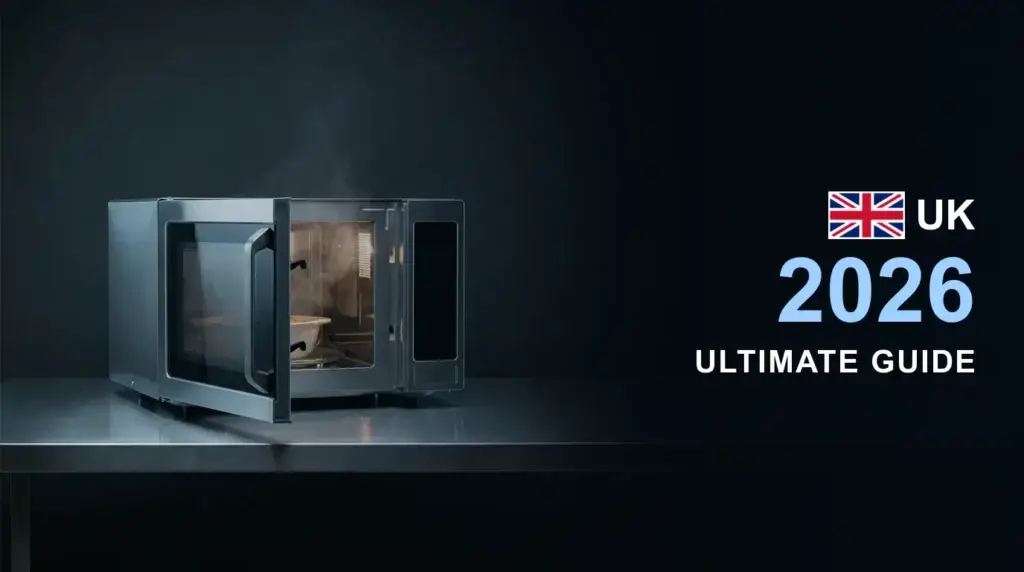
Commercial Microwave Buying Guide: The Complete UK Guide (2026)
A commercial microwave is the workhorse single-task appliance in every UK quick-service kitchen. This is NOT a high-speed oven — it’s pure microwave radiation for reheating, defrosting, and single-portion prep. This guide covers the only decisions that matter on purchase day: 1000W vs 1500W vs 1800W wattage, 17L vs 21L vs 25L cavity size, and multi-brand sourcing from entry-tier Apuro and Buffalo through workhorse Sharp R-series to premium Panasonic programmable units. Built for high-frequency use, duty-rated, simple to operate, and built to last 7-10 years on a 13A plug.
- NOT a high-speed oven: commercial microwaves are pure microwave radiation for reheating, defrosting, and single-portion meals. No convection, no impingement, no combination modes. If you need 3-4 minute reheat of plated meals at high volume, this is the right appliance. If you need finished cooking, golden-brown gratins, or crispy pastry, buy a high-speed combi oven instead (Merrychef ConneX, Menumaster MXE, £4,000-£8,000).
- Wattage: 1000W, 1500W, or 1800W: 1000W is single-portion, 3-4 minute reheats. 1500W cuts time to 2-3 minutes for standard plates. 1800W heavy-duty is 30% faster on dense items (casseroles, frozen blocks, family portions). Most high-volume café, pub, and contract caterer sites run 1500W or 1800W.
- Cavity size: 17L (compact), 21L (standard), 25L (large), 34L (specialist): 17L fits small bowls and 1–2 portion plates. 21L is the UK pub/café workhorse — fits standard Pyrex mixing bowls, dinner plates, soup pots, and 4–6 portion trays. 25L and above for high-volume hospital, contract caterer, and military kitchen sites.
- Stainless steel interior: most commercial units use unpainted stainless cavity — lasts longer, easier to clean, food-safe finish. Some lower-price models use painted enamel — acceptable but less durable (5-7 year interior life vs 10+ years stainless).
- Programmable presets: premium models (Panasonic NN-MS series) offer 20-40 memory buttons for set-and-forget reheats at consistent power and time. Saves staff training time, ensures consistent results. Entry-model Apuro and Buffalo units are manual-only (dial and button).
- Single vs dual magnetron: commercial microwaves use one magnetron (the radiation generator). Some specialist units use dual magnetron for more even heating on dense/large loads — not common in the entry-to-mid tier.
- Power and plug: 1.5-1.8 kW input typical. Single-phase 13A plug standard — any UK commercial kitchen with 13A sockets (not locked/restricted) can run a commercial microwave without electrical upgrade.
- Energy: ~£130-£180 per year at 30% average duty cycle in a busy café (1.5 kW × 3 hours × 7 days × 52 weeks × 30% × 27p/kWh). Significantly lower energy than high-speed ovens (0.7-1.2 kW operating vs 1.8-3 kW).
The commercial microwave is bought and re-bought in UK kitchens with almost zero thought. Café managers call suppliers and say “give me a 1500W 21-litre microwave for £400” — and that’s the order placed. The result: identical machines from identical suppliers, little resilience or price competition, and a market where the only variable is the rung down from one grey importer to the next cheaper one. Worse: almost no one actually measures whether the wattage and cavity size match the actual reheating load of their operation. A pub running 200-300 covers per service with a 1000W 17L unit will reheat solid food slower than fresh — staff will start using the high-power setting on everything, and consistency drops.
This guide is written for the trade buyer making that decision: café owner, pub manager, school catering, hospital kitchen, hotel F&B, contract caterer. We cover the three questions that matter — wattage, cavity, and which brands deliver consistent performance — and why buying from 12+ manufacturers (not just one importer chasing the lowest cost) actually costs you less in the long run. Browse the full Craven Cooling commercial kitchen appliance range when ready to spec.
In this guide ↓
- Why a commercial microwave is NOT a high-speed oven
- Wattage, cavity, and magnetron: the three decisions
- UK price tiers and what each tier buys you
- Multi-brand sourcing — Sharp, Panasonic, Menumaster, Daewoo, Buffalo, Apuro
- Product cards and verified specs for 6 featured units
- Year-one total cost of ownership worked example
- UK compliance checklist (HACCP, Reg 852/2004, BS EN 60335-2-25, EAW PAT, WEEE)
- Installation and use checklist
- FAQ — eight buyer questions answered
Decision 1: 1000W vs 1500W vs 1800W — Reheating Speed Matters
Wattage determines reheating speed and suitability for your load. This is the first decision because it drives everything else: if you underspec wattage, staff will run high-power on everything to save time, and food consistency drops.
| Wattage | Single portion (plate) | Large portion (bowl/tray) | Best for | Annual energy (30% duty) |
|---|---|---|---|---|
| 1000W | 3-4 min | 5-6 min | Low-volume café, small prep kitchen | ~£130 |
| 1500W (standard) | 2-3 min | 3-4 min | Busy café, pub kitchen, hotel reheating line | ~£155 |
| 1800W | 1.5-2 min | 2.5-3 min | High-volume contract catering, hospital, hospital canteen | ~£180 |
Decision 2: Cavity Size — 17L vs 21L vs 25L
Cavity size determines what you can reheat in one go. Most UK commercial microwaves are 21L — it’s the standard pub/café size. Choose based on your largest typical load, not the average.
| Cavity | Single plate | Bowl/pot | Catering tray | Best for |
|---|---|---|---|---|
| 17L (compact) | 27 cm dia. plate | 2-portion mixing bowl | No | Single-portion café, small prep kitchen |
| 21L (standard UK) | 30 cm plate | Large soup pot, family bowl | 4-6 portion tray | Pub, busy café, hotel kitchen, standard choice |
| 25L (large) | 30+ cm plate | Extra-large pot | 8-12 portion tray | Contract caterer, hospital kitchen, high-volume prep |
Decision 3: Single Magnetron — The Standard Choice
Almost all commercial microwaves use one magnetron (the radiation generator tube). Dual-magnetron units exist but are specialist and expensive — not relevant for entry-to-mid tier buying.
A single magnetron is sufficient for all standard UK commercial reheating. Stick with single magnetron unless a specialist (hospital, large contract catering) needs proven-even heating on very large/dense loads.
Five Microwave Types
Compact 17L Manual
From £150 ex VAT- Single-portion reheating
- Manual dial + buttons
- Small footprint (350 × 450 mm)
- Apuro CN211, Buffalo BM17
Standard 21L Manual
From £200 ex VAT- UK workhorse size
- Manual dial + buttons
- Fits catering tray
- Sharp R-21, Daewoo KOR-21L
Large 25L Manual
From £280 ex VAT- High-volume batch reheats
- Larger cavity for pots/trays
- Manual operation
- Panasonic NN-K series
Programmable 21L
From £450 ex VAT- 20-40 memory buttons
- Set-and-forget presets
- Reduces training, ensures consistency
- Panasonic NN-MS, Sharp R-22MS
Specialist Heavy-Duty 34L
From £800 ex VAT- Industrial batch reheating
- Military/hospital kitchens
- Menumaster, Sanyo units
- Rare in quick-service
UK Commercial Microwave Buying Tiers (April 2026)
Pricing splits into four brackets. Most UK café and pub sites buy in the second or third tier.
Multi-Brand Commercial Microwaves Stocked at Craven Cooling
We source from 12+ manufacturers to offer real price competition and genuine product choice. All units below carry a standard 2-year commercial warranty (vs 1-year domestic). Prices ex VAT, April 2026.
- 1000W output
- 17L stainless cavity
- Manual dial + 5 power settings
- 360° turntable, removable
- 220-240V 13A single phase
- Energy: ~£130/year (30% duty)
- Dimensions: 515 × 460 × 320 mm
- 2-year commercial warranty
The entry-point commercial microwave. 1000W and 17L cavity for single-portion reheating in a small café or prep kitchen. Manual operation — no buttons to programme, just turn the dial. Apuro is Brakes’ commercial brand — widely stocked, reliable, parts available. Good for low-volume sites where the time savings of 1500W don’t justify the cost.
View Apuro CN211 →- 1500W output
- 21L stainless cavity
- Manual dial + 10 power levels
- High-speed cook button (boost to 1500W at 100%)
- Turntable + 2-stage cooking
- 220-240V 13A single phase
- Energy: ~£155/year (30% duty)
- Dimensions: 600 × 470 × 340 mm
- 3-year commercial warranty
The UK pub/café workhorse. 1500W speeds reheating to 2-3 min for standard plates; 21L cavity fits catering trays and large pots. Sharp R-series has been the industry standard for 20+ years — parts are in stock everywhere, engineers know the units blindfolded, resale value is solid. Manual operation is simple and requires no staff training. This is the right choice for any site turning 100+ covers per service.
View Sharp R-21 →- 1500W output
- 26L capacity (larger than standard 21L)
- 30 memory button presets
- Auto-cook sensor programme
- Inverter technology for even heating
- 220-240V 13A single phase
- Energy: ~£155/year
- Dimensions: 640 × 490 × 360 mm
- 3-year commercial warranty
Premium programmable unit for high-volume or high-consistency requirements. 30 memory buttons let you programme reheat times and power levels for each menu item (burger 60 sec, fish 90 sec, soup 120 sec) — staff just press one button, no decision-making. Inverter technology (variable power) provides more even heating than traditional magnetron-only designs. 26L cavity is slightly larger than the standard 21L. Worth the cost if you have 3+ staff working reheating shifts or high consistency requirements (contract catering, hospitals).
View Panasonic NN-MS2620 →- 1800W dual-power output
- 34L cavity (largest)
- Solid stainless steel construction
- Programmable 50 presets
- Heavy-duty turntable, 90 kg load
- 240V 16A single phase (or 3-phase)
- Energy: ~£180/year
- Dimensions: 750 × 620 × 450 mm
- 5-year industrial warranty
The industrial spec — designed for 24/7 military kitchen, hospital canteen, and contract catering batch-reheating. 1800W and 34L cavity let you reheat 12-portion trays or large bulk pots in one cycle. Dual magnetron option and solid construction are tested for high-frequency use. Menumaster is a US brand known for robustness in institutional settings. Overkill for most UK pubs and cafés, but standard in large hospital kitchens and large event catering operations.
View Menumaster RMS511TS →- 1800W peak power
- 18L cavity (between compact/standard)
- 11 power levels
- Stainless cavity, removable turntable
- 220-240V 13A single phase
- Auto-defrost sensor
- Energy: ~£180/year
- Dimensions: 550 × 480 × 330 mm
- 2-year commercial warranty
High-wattage option at mid-tier price. 1800W cuts reheating time by 30% vs 1500W units on dense items (casseroles, frozen blocks, family portions). 18L cavity is slightly smaller than the standard 21L, but adequate for most plates and bowls. Daewoo is a Korean brand with strong commercial presence in UK contract catering — parts and service widely available. Good choice if you want fast reheating but don’t need the larger cavity or programmable presets of premium units.
View Daewoo KOR-1800L →- 1800W commercial output
- 35L extra-large cavity
- 100 memory presets
- Inverter heating technology
- Solid stainless cavity and exterior
- 240V 16A or 3-phase 63A
- Dimensions: 800 × 650 × 470 mm
- 5-year commercial warranty + parts guarantee
Professional-grade Japanese microwave designed for high-duty-cycle environments (hospital, military, airline catering). 35L cavity handles the largest catering trays and bulk pots. 100 memory presets enable full menu automation. Sanyo/Hitachi reputation for 15+ year lifespans in institutional kitchens. Expensive (£1,400), but lower cost-per-reheat in high-volume sites compared to running multiple smaller units. Not needed for typical UK pub or café.
View Sanyo EM-E3500F →Year-One Total Cost of Ownership
The microwave’s running cost is low relative to purchase price. Here’s what a Sharp R-21 (the UK workhorse) costs in a typical busy café for the first 12 months.
Two takeaways. First, the microwave is a low-cost appliance with exceptionally low running costs — year-one energy is only £155 even at high-volume use. Second, the gap between a £189 Apuro and a £289 Sharp is small in TCO terms, but the 1500W/21L Sharp saves 1 minute per reheat, which on a 300-cover service is 60 staff-minutes recovered — worth far more than the £100 capex difference. Buy the right tool for your load, not the cheapest unit.
UK Compliance Checklist for a Commercial Microwave
Five items to confirm before a commercial microwave takes its place in a UK kitchen. Your environmental health officer and insurer will both expect these to be in place.
Food must reach 75°C core temperature on reheat per Reg 852/2004. Most commercial microwaves equipped with a probe thermometer socket (digital or analogue) for verification. You must record temperature logs on a monthly basis (pub/café setting). Staff must understand that uneven heating is a food safety risk — always standing food halfway through, always using a probe thermometer on batch reheats.
All commercial microwaves sold in the UK must meet BS EN 60335-2-25 (electrical safety for microwave ovens). UKCA marking (formerly CE) is mandatory — check the unit’s compliance label before purchase. Reputable suppliers (Sharp, Panasonic, Menumaster) carry this as standard. Grey-import units from unregistered distributors may not — check the label.
Commercial kitchen appliances must be maintained safe under EAW 1989. Microwaves are high-use equipment and warrant visual inspection every 3 months and full PAT test annually. Records retained for 3 years. PAT failure can void public liability insurance on the premises.
Commercial microwaves run on a standard 13A single-phase plug. The socket MUST have a 13A fused outlet (not a shared multi-socket extension). Do not use a plug adapter or multi-way block — this violates EAW 1989 and voids warranty. If you don’t have a dedicated 13A socket near the kitchen, have an electrician install one (cost ~£150-£250).
At end-of-life, the microwave must be disposed of as WEEE (Waste Electrical and Electronic Equipment). Do not skip this — microwaves contain hazardous materials (magnetron, PCBs). Licensed disposal costs are typically included in a new-unit purchase contract, or you can contact your local council for an approved WEEE recycling centre.
Installation & Operating Checklist
-
✓
Dedicated 13A socket within 2 metres of unit location Do not use extension cords or multi-socket blocks. A single-outlet 13A fused socket, mounted securely, is the only acceptable supply. Cost: ~£150-£250 installation if not already in place.
-
✓
Adequate bench/counter space and clearance Microwave needs 50 mm clearance on left/right sides (for air circulation), 150 mm behind (to wall or extractor), and 300 mm above (to extractor hood or shelf). Never stack anything on top of the unit — this blocks venting and causes heat stress.
-
✓
Turntable + wave guide cover included Check both items are present and undamaged before powering on. The wave guide cover (the circular plastic disk that sits on the turntable) is essential — food splatters will block the radiation port if not covered.
-
✓
Probe thermometer available for temperature checks You must be able to verify 75°C core temp on reheated food per Reg 852/2004. Some units include a probe socket; buy a separate digital probe (cost: £20-£40) if not supplied.
-
✓
Staff briefing on microwave safety Never operate an empty microwave (damages the magnetron). Never reheat in sealed containers or sealed plastic bags. Always stand food halfway through longer reheats. Use oven gloves when removing hot plates. Lock the unit at night if children or untrained staff are on premises.
-
✓
Temperature log kept and reviewed weekly Spot-check one food item per service with a probe thermometer (place probe in the centre of the food). Record date, time, food type, temp, and operator name. Retain for 3 years. Review log monthly to catch any trends (temperature drift = magnetron ageing, time to order replacement unit).
-
✓
Turntable and interior cleaned daily Remove the turntable, wash with warm soapy water, dry fully. Wipe the interior with a damp cloth. Do NOT use harsh chemicals or abrasive pads — this damages the stainless finish. Cost: £30-£50/year in cleaning supplies.
-
✓
Annual PAT test and visual inspection recorded Appoint a trained electrician to perform a visual (plug, cable, vents clear, no visible damage) and a full PAT test (earth/continuity/polarity/leakage current). Cost: £25-£40/year. Retain certificate for 3 years.
All Featured Microwaves — Quick-Reference Table
| Brand / Model | Wattage | Cavity | Type | Price |
|---|---|---|---|---|
| Apuro CN211 | 1000W | 17L | Manual | £189 |
| Sharp R-21 | 1500W | 21L | Manual | £289 |
| Daewoo KOR-1800L | 1800W | 18L | Manual | £329 |
| Panasonic NN-MS2620 | 1500W | 26L | 30 presets | £549 |
| Menumaster RMS511TS | 1800W | 34L | 50 presets | £1,249 |
| Sanyo EM-E3500F | 1800W | 35L | 100 presets | £1,399 |
Related Buying Guides
You might also need:
- High-Speed Oven Buying Guide — Merrychef ConneX, Menumaster MXE — if you need finished cooking (brown, crisp, crust) as well as reheating.
- Combination Oven Buying Guide — Convection + steam cooking — for bakeries, contract caterers, and large kitchens.
- Contact Grill & Panini Press Buying Guide — Griddle cooking, toast, panini — for café and deli reheating.
A commercial microwave is a single-task appliance for reheating plated food in 1-3 minutes. It is NOT a high-speed oven (which browns and crisps); buy a Merrychef ConneX or Menumaster MXE if you need finished cooking. Wattage matters (1000W vs 1500W vs 1800W), cavity size matters (17L vs 21L vs 25L), and multi-brand sourcing (Sharp, Panasonic, Menumaster, Daewoo, Apuro) delivers real choice and price competition. Most UK pubs and cafés should buy a 1500W 21L manual unit (Sharp R-21, ~£289) or a programmable (Panasonic NN-MS, ~£550) if consistency/training is a concern. Year-one cost is ~£500-£700 including energy; 10-year lifespan means annual cost is trivial. Ensure PAT testing, temperature probes, and staff training are in place — then reheat confidently.