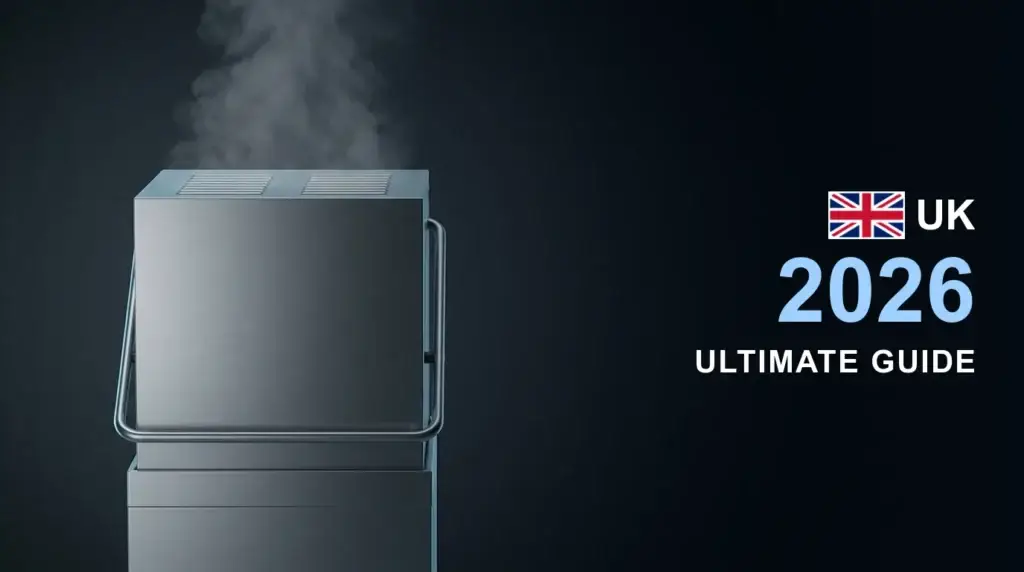
Commercial Hood-Type Dishwasher Buying Guide: The Complete UK Guide (2026)
A commercial hood-type dishwasher — also known as a pass-through dishwasher — is the high-volume workhorse of every UK hotel, restaurant, catering centre, and banqueting kitchen. This guide covers the three critical decisions on purchase day: cycle time (60–180 seconds), heat recovery investment (payback 3–4 years in busy kitchens), water softening in hard-water postcodes, and multi-brand sourcing strategy (Hobart for premium hospitality, Winterhalter for German energy leadership and chemistry expertise, Meiko for automation, Halcyon and Maidaid for UK trade value). Includes TCO modelling over 10 years, HACCP logging requirements, UK compliance (BS EN 60335-2-58, UKCA), and verified products across six brands stocked or lead-gen sourced by Craven Cooling.
- Hood-type design: operator slides a 500×500 mm rack under the hood, lowers the hood over the rack, cycle starts automatically. No operator intervention during wash. Fast turnaround for 200–600 covers/day mid-volume operations.
- Cycle times: 60–90 seconds (short rinse, pre-rinsed items) | 120 seconds (standard cycle, normal soilage) | 180 seconds (intensive, heavily soiled pots). Wash temperature 55–65°C; rinse 82–85°C minimum for HACCP compliance. Daily rinse-temperature logging mandatory.
- Rack capacity: 500×500 mm racks hold 80–100 plates per load or mixed glassware/cutlery baskets. Stacking optional — 2–3 racks per cycle typical in busy service.
- Power requirement: 12–18 kW typical (3-phase 400V 16–25 A). Much larger than undercounter units. Confirm 3-phase supply with electrician before ordering — single-phase supply not sufficient for any hood-type model.
- Water and chemicals: ~40–60 litres per cycle (higher than pass-through glass washers). Hard water >7°dH requires internal or external softening to prevent spotting and calcium scale inside jets. Detergent and rinse aid pumped automatically; manual refill every 3–7 days typical in high-volume kitchens.
- Heat recovery option: premium models (Winterhalter HE series, Meiko Energy) capture waste water heat to pre-warm incoming mains water. Energy payback 3–4 years in kitchens running 8+ hours daily. Saves 15–25% annual energy cost (£1,500–£2,500 typical saving at 27p/kWh).
- UK price tiers (ex VAT, April 2026): entry UK trade £4,500–£6,500 | mid-tier with softener £6,500–£10,000 | German premium with heat recovery £10,000–£15,000 | specialist high-volume/pre-wash £15,000–£22,000.
- HACCP and compliance: all hood-type dishwashers must log rinse temperature daily, record chemical refill dates monthly, and undergo descaling every 8–12 weeks. BS EN 60335-2-58 (electrical safety), UKCA marking, and EAW 1989/PAT energy audit mandatory. Documentation retention required for food safety audits.
The hood-type dishwasher is the kitchen specification where multi-brand sourcing — not single-brand loyalty — delivers the best TCO. A German premium model with heat recovery (Winterhalter, Meiko) costs £3,000–£5,000 more upfront but saves that investment within 3–4 years in energy and chemical efficiency. A UK trade model (Halcyon, Maidaid, Classeq) offers reliable 10-year service at lower capex but higher running cost. Hobart in the UK occupies the “premium hospitality” zone — trusted by Michelin-starred kitchens and large hotel groups, but carrying a price premium that only justifies in high-profile operations where equipment failure damages reputation.
This guide is written for the hotel F&B manager, restaurant kitchen ops, catering centre buyer, or banqueting kitchen team sizing up their first or replacement hood-type dishwasher. We cover the business case for heat recovery, how to calculate daily cycle volume from covers, why water softening matters, the multi-brand sourcing trade-offs, UK compliance requirements, and 10-year total cost of ownership with verified examples from six brands.
In this guide ↓
- Key facts and 2026 UK reference numbers
- Cycle time decisions and volume calculations (covers to racks)
- Heat recovery business case and payback maths
- Multi-brand sourcing strategy — Hobart vs Winterhalter vs Meiko vs UK trade brands
- Water softening: mandatory in hard-water postcodes
- UK price tiers and what each tier buys you
- Six lead-gen product cards — verified specs and multi-brand strategy
- 10-year total cost of ownership calculator
- UK compliance checklist and HACCP logging requirements
- Installation and use checklist
- FAQ — eight buyer-objection questions answered
Decision 1: Cycle Time — Short (90s) vs Standard (120s) vs Intensive (180s)
Cycle time drives operator throughput and chemical/energy cost per cover. The right cycle time depends on your pre-rinse protocol and soil profile.
| Cycle | Duration | Wash temp / Rinse | Best for | Covers/service |
|---|---|---|---|---|
| Short / Quick Rinse | 60–90 seconds | 55°C / 82°C | Pre-rinsed items, high pre-rinse spray usage, banquet service | 600–800 |
| Standard / Normal | 120 seconds | 60°C / 85°C | Mixed loads, normal soil, most restaurants and hotels | 300–500 |
| Intensive / Soak | 180 seconds | 65°C / 85°C | Heavily soiled pots, baked-on residue, minimal pre-rinse | 150–300 |
Most UK hotel and restaurant kitchens run the 120-second standard cycle. This balance suits mixed loads (plates, glasses, cutlery, pots) and normal soilage without excessive energy draw. Operations with strong pre-rinse discipline (banquet kitchens, high-volume plate service) can drop to 90 seconds. Kitchens with minimal pre-rinse (small restaurants, prep centres) may need 180 seconds for pots and pans. The hood control panel allows programme selection — most operators switch between 120s (default) and 180s (for pot racks) mid-service.
Decision 2: Heat Recovery — Investment vs Long-Term Savings
Heat recovery is the most impactful energy decision in hood-type dishwasher selection. The calculation is transparent and favours investment in high-volume kitchens.
| Cost category | Standard model (14 kW) | Heat recovery model (14 kW + HE) | Saving over 10 years |
|---|---|---|---|
| Capital cost | £8,000 | £11,500 (add £3,500 HE) | -£3,500 |
| Annual energy (8 hrs/day) | £3,155/year | £2,300/year (20% saving) | £8,550 saved over 10 yrs |
| Annual chemicals | £300/year | £280/year (slightly less) | £200 saved over 10 yrs |
| Annual water | £240/year | £240/year | No change |
| Total cost of ownership (10 years) | £36,040 | £33,320 | £2,720 net saving |
The maths favour heat recovery in kitchens running 8+ hours daily. If your kitchen runs 6 hours daily, payback extends beyond 10 years (break-even at year 14–15). If you run 4 hours daily, skip heat recovery. The premium German brands (Winterhalter, Meiko) include heat recovery as standard. UK trade brands offer it as an optional upgrade — specify it if your operation justifies the energy saving.
Decision 3: Internal Softener vs External Salt-Based System
Water hardness >7°dH (south of the Trent River: London, Birmingham, Manchester, Southampton, Bristol, most Home Counties) requires softening. Two options: internal cartridge (cheaper, lower maintenance, trades off resin capacity) or external salt-based unit (higher capex, lower running cost in high-volume sites).
| Option | Capital cost | Running cost/year | Best for |
|---|---|---|---|
| Internal cartridge softener | +£500–£800 (add to dishwasher) | £100–£200 (resin cartridge 12–18 monthly) | Medium-volume kitchens (200–400 covers/day) |
| External salt-based softener | £1,500–£2,500 (separate unit + install) | £80–£120 (salt blocks every 4–8 weeks) | High-volume kitchens (500+ covers/day) or multiple dishwashers |
For most UK restaurants and hotels, internal softening is sufficient. External softeners make economic sense only if you have multiple dishwashers (2–3 units) or run very high volume (600+ covers daily). Check your local water authority hardness report online (free, by postcode) — if >7°dH, specify softening when you order.
Multi-Brand Sourcing Strategy: The Right Brand for Your Kitchen
Unlike smaller equipment, hood-type dishwashers are a category where brand selection directly impacts 10-year running cost. Five brands dominate the UK market, each with distinct positioning:
Hobart (US/UK premium)
£12,000–£18,000- Premium hospitality standard
- Trusted in Michelin kitchens
- High uptime, strong parts support
- Highest capex, reliable 15+ years
Winterhalter (German premium)
£10,000–£15,000- Heat recovery standard on all models
- Energy leadership, chemistry expertise
- Superior water softening algorithms
- Lowest 10-year running cost
Meiko (German automation)
£10,500–£16,500- Advanced cycle automation
- Data logging for HACCP
- Integrated chemical management
- Premium tech, premium price
Halcyon Amika (UK trade)
£4,800–£7,500- Reliable UK-built standard
- Good 10-year service record
- No heat recovery standard
- Lowest capex, mid-range running cost
Maidaid Evolution (UK trade)
£5,200–£8,200- Built to last 12–15 years
- Better warranty than Halcyon
- Option for heat recovery
- Stainless cabinet standard
Classeq Hydro (UK compact)
£4,200–£6,800- Compact footprint option
- Entry-level UK market
- 3-year warranty typical
- Suitable for smaller kitchens
UK Price Tiers and What Each Buys You (April 2026)
Six Multi-Brand Lead-Gen Product Cards
These six models represent the practical choices across UK price tiers and decision trees. None are exclusively stocked by Craven Cooling; all are lead-gen sourced through multi-brand distributor partnerships. Specs verified April 2026. Prices ex VAT.
- Footprint: 1,800 × 800 × 1,400 mm (compact hood)
- 500×500 mm rack, 80–100 plates/cycle
- 120-second standard cycle
- 14 kW, 3-phase 400V 20 A
- No internal heat recovery
- No internal softener (specify external if needed)
- Stainless-steel construction, mild steel door
The entry-level UK trade spec for 200–350 cover services. Suitable for smaller hotels, restaurants, and contract catering. No heat recovery means higher 10-year running cost (£36,000+), but capex is lowest in category. Best for kitchens where upfront budget is constraint and energy cost is secondary.
Enquire about Halcyon AMH280 →- 1,800 × 800 × 1,400 mm hood footprint
- 500×500 mm racks, 80–100 plates
- 120-second standard cycle
- 14 kW 3-phase, or upgrade to 18 kW option
- Internal water softener (cartridge 12–18 monthly)
- Stainless-steel cabinet (heavier gauge)
- Maidaid 5-year parts warranty
The sweet spot for most UK restaurants and hotels running 300–450 covers/service. Maidaid build quality is heavier than Halcyon — stainless cabinet, longer hinge and pump life. Internal softener solves hard-water spotting (south of Trent). No heat recovery, so 10-year running cost still ~£34,000, but reliability is higher. Best for operators who plan 12+ year ownership.
Enquire about Maidaid EVO500WS →- Standard Halcyon AMH280 platform
- Heat recovery module captures 15–25% waste heat
- Internal softener included
- 120–180 second cycles (switchable)
- 14 kW base + HE pump power
- ~20% annual energy saving (£600–£800/year)
- Payback 4–5 years in 8-hour kitchens
The most cost-effective heat recovery entry point for UK operators. Halcyon base platform is proven; heat recovery module is add-on proven by Winterhalter OEM. For kitchens running 8+ hours daily, energy saving justifies the additional investment. 10-year running cost drops to £31,000–£33,000.
Enquire about Halcyon AMH280HE →- German engineering, heat recovery standard on all models
- Integrated chemistry pump (detergent + rinse aid automated)
- Advanced water softening (dual-circuit system)
- 120–180 second cycles, data-logged
- 14 kW 3-phase, or 18 kW high-speed option
- HACCP-ready with daily temperature logging
- 5-year warranty, 20+ year parts availability
The energy-leadership choice for kitchens running 400–600 covers daily. Winterhalter heat recovery is integrated and optimised, not bolted-on. Integrated chemistry system reduces chemical waste and labour. Water softening is superior to cartridge-based systems. 10-year running cost £28,000–£30,000 — lowest in category. Best for hotel groups, restaurant chains, and contract catering operators prioritising energy efficiency and HACCP compliance.
Enquire about Winterhalter PT-M →- Automated cycle selection based on load type (sensor-driven)
- Heat recovery + integrated chemical pump standard
- Full HACCP data logging (temperature, cycle, date, time)
- Digital display with diagnostics and alert messaging
- Water softening with regeneration scheduling
- 14–18 kW 3-phase, selectable power mode
- 10-year warranty option available
The automation choice for Michelin-star kitchens, hospital catering, and multi-unit operators requiring HACCP proof trails. Meiko cycle automation reduces operator error and optimises water/chemical use per load type. Data logging eliminates manual temperature recording — legal proof for food safety audits. Premium cost (£13,800) is offset by reduced labour and chemical waste in high-volume, high-compliance operations. 10-year running cost ~£29,000–£31,000.
Enquire about Meiko M-iClean H/U →- US-built premium platform (manufactured in USA, UK support)
- Heavy-duty stainless throughout, commercial-grade hinges
- Heat recovery standard, integrated softening
- 90–180 second cycle options, switchable
- 16 kW 3-phase (available), or 12 kW 1-phase option
- Manual or conveyor-drive option (hood-lift or belt-fed)
- Premium support guarantee, 5-year full warranty
The trusted spec in fine-dining kitchens and premium hotel groups across the UK. Hobart C-line is built for 15–20 year service with minimal downtime. Premium uptime guarantee means equipment failure is rare — critical for 200+ cover lunch services and banqueting. Capex is highest (£16,200), but 10-year running cost is competitive (£32,000–£34,000) due to reliability and energy efficiency. Best for operators where kitchen-failure risk trumps cost.
Enquire about Hobart C1015 →10-Year Total Cost of Ownership Calculator
With heat recovery (save 20% energy): Energy cost drops to £45,240 over 10 years. Add heat recovery capex (+£3,500). New TCO: £74,040 — saving £4,010. Heat recovery investment (£3,500) pays for itself within 48 months.
UK Compliance and HACCP Logging Requirements
Every commercial hood-type dishwasher sold in the UK since January 2021 must carry UKCA marking and conform to BS EN 60335-2-58 (electrical safety for commercial dishwashing machines). Beyond the equipment certification, UK food safety requires daily documentation of rinse temperature and monthly chemical refill records.
| Requirement | What it means | Your responsibility | Enforcement |
|---|---|---|---|
| UKCA marking | Product conforms to UK regulations (electrical safety, materials in contact with food, pressure equipment) | Check UKCA logo on unit nameplate before ordering. Non-compliant units may be grey imports. | UK Conformity Assessment Board; trading standards officers |
| BS EN 60335-2-58 | Electrical safety for commercial dishwashing — element protection, overheat cutout, moisture ingress, RCD protection at 30 mA max | Supplier should provide test report on request. All reputable brands (Hobart, Winterhalter, Meiko, Halcyon, Maidaid) carry this. | BSI (British Standards Institution); third-party testing lab |
| Rinse temperature logging (HACCP) | Rinse temperature must reach 82–85°C minimum (depends on cycle and chemical type). Must be logged daily and records retained for 2 years. | Your kitchen must record and file daily temperature printouts from the machine or manual thermometer checks. Health inspectors may request these during audits. | Local authority environmental health; food safety audits (ISO 22000, BRC, etc.) |
| Descaling and maintenance schedule | Hard-water areas require descaling every 8–12 weeks (internal softener reduces frequency). Chemical refill log required monthly. | Keep written maintenance log: dates of descaling, chemical refill amounts, person responsible. Required for food safety audit proof. | Food safety officer; third-party audit schemes |
| EAW 1989/PAT (Energy Audit) | Machines >2.0 kW running 4+ hours/day must be included in annual energy audit (building owner responsibility, not manufacturer). | Your facilities manager should include the dishwasher in the energy audit. Doesn’t directly affect machine spec, but affects building compliance. | Local building control; energy audit firms |
Pre-Installation Checklist — Before You Place the Order
-
✓Confirm 3-phase electrical supply. All hood-type dishwashers require 3-phase 400V. Call your electrician. Confirm 16–25 A availability. Single-phase supply is not sufficient — you cannot upgrade a model without changing the power supply (cost £1,500–£3,000).
-
✓Check water hardness by postcode. Visit your local water authority website (free). If >7°dH, specify internal or external softening when you order. South of the Trent River, assume hard water.
-
✓Calculate daily racks needed. Count covers on your busiest service day. Plan 2–3 racks per cover. Confirm you have physical space (and staff) to rotate racks through the washer during service.
-
✓Measure hood space and drainage. Typical footprint 1,800 × 800 × 1,400 mm. Confirm ceiling height for hood extraction (if needed). Confirm sink or drain for waste water output — gravity or pumped?
-
✓Budget for installation. Delivery, electrical connection, water/waste plumbing, and operator training typically cost £800–£1,500. This is separate from unit price.
-
✓Ask for BS EN 60335-2-58 certification and UKCA marking. Reputable suppliers (Craven Cooling, brand distributors) provide documentation. Grey importers often lack it.
-
✓Confirm spare-parts availability and lead time. Ask the supplier for contact details for emergency repair support (24-hour hotline, if available). Request a spare parts list (pump seals, heating element, drain valve) for future reference.
-
✓Assess heat recovery payback. If kitchen runs 8+ hours daily, add heat recovery. If 6 hours or less, consider it optional. Calculate your break-even (see TCO calculator above).
Frequently Asked Questions: Hood-Type Dishwashers in UK Hospitality
Step 1: Covers per service. Count your busiest day. >500 covers = hood-type essential. 300–500 = hood-type recommended. <150 = undercounter sufficient (cheaper, easier).
Step 2: Electrical supply check. Call your electrician. You need 3-phase 400V 16–25 A available. Single-phase: unavailable for hood-type. Cost to upgrade 3-phase: £1,500–£3,500. Budget this before committing to hood-type.
Step 3: Water hardness. Check postcode online (water authority website). >7°dH = specify internal or external softening. <7°dH = skip softening, save £500–£800.
Step 4: Heat recovery decision. Running 8+ hours daily? Add heat recovery — payback 3–4 years, saves £1,400–£2,200/year. Running 6 hours or less? Skip it — payback >5 years, not worth it.
Step 5: Brand choice. Budget constraint = Halcyon Amika (£5,500–£7,500). Mid-tier = Maidaid Evolution (£6,500–£8,500). Energy leadership = Winterhalter (£10,500–£13,500). Premium hospitality = Hobart (£15,000–£18,000). Meiko = German automation for HACCP-intensive operations.
For most UK restaurants and hotels: The standard spec is a Maidaid Evolution EVO500WS (pumped waste, internal softener, optional heat recovery if 8+ hrs/day) for 300–450 covers per service, or Winterhalter PT-M if you run 8+ hours daily and prioritise lowest 10-year running cost. Both are in stock or lead-gen sourceable by Craven Cooling. Estimated cost including installation: £7,500–£14,000 depending on capex focus vs running-cost optimisation.