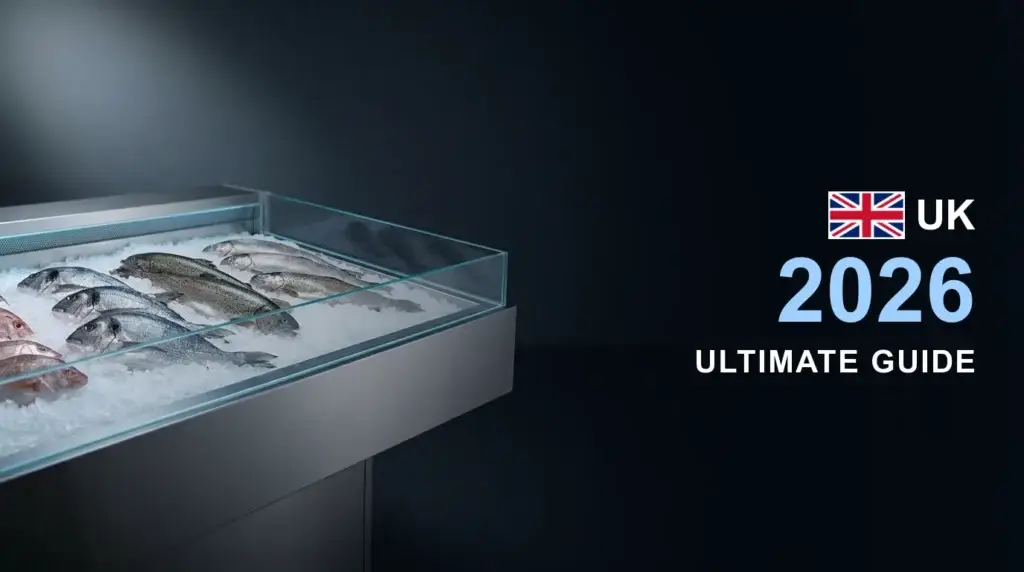
Commercial Fish & Meat Display Counter Buying Guide: The Complete UK Guide (2026)
A commercial fish & meat display counter is the centrepiece of every UK fishmonger, butcher, supermarket deli, and seafood restaurant. This guide covers the three non-negotiable specifications on purchase day: 3M1 Climate Class for raw protein holding, gravity-coil vs ventilated cooling systems, and ice-well drainage for fresh fish display — plus EU 1379/2013 fish traceability labelling requirements (retained UK law, in force since 2014), multi-brand sourcing across Cossiga, Williams, Igloo, Oscartielle, Eurocryor, and Frost-Tech, and F-Gas refrigerant compliance.
- 3M1 Climate Class spec (BS EN ISO 23953): fish and raw meat display counters must maintain -1 to +5°C interior temperature under ambient room conditions up to 25°C. 3M1 is the EU standard for fresh raw protein holding — enforced by EHO inspection and insurance underwriters. Older units labelled Climate Class 2M (0 to +8°C) will fail inspection for raw fish.
- EU 1379/2013 fish labelling (retained UK law): under this retained UK law (in force since 2014), traceability rules require commercial and scientific name, production method (wild-caught or farmed), catch area, fishing gear type, and anti-IUU (illegal, unreported, unregulated fishing) verification on all fresh fish displays in UK trade.
- Ice-well requirement: fresh fish display counters must incorporate a built-in ice-well with gravity drainage to a floor sump or collection tray. Ice melts 40 kg per hour under shop conditions — poor drainage floods the counter, corrodes the chiller, and violates food safety standards.
- Gravity-coil vs ventilated cooling: gravity-coil (static) systems cool gently via conduction and are standard for fish display — no airflow = no drying of delicate fillets. Ventilated systems with forced-air circulation are better for meat (longer shelf colour) but will desiccate fish. Select gravity-coil for fish-primary counters.
- Curved glass vs flat glass: curved (panoramic) glass gives premium fishmonger aesthetics and superior product visibility at 45° from the shop floor; flat glass is cheaper, lighter, and standard for butcher-spec meat counters. Curved glass units cost 15-22% more.
- F-Gas refrigerant rules: since 1 January 2020, topping up equipment with virgin HFC refrigerants of GWP 2500 or above has been banned, and a gradually tightening HFC quota (phase-down) applies. Display counters must use R290 (propane, GWP 3) or R744 (CO₂, GWP 1). R404A and R422D are no longer compliant for virgin top-ups.
- Linear metre sizing: fish display counters are priced and specified in running metres: 1.0 m (compact fishmonger), 1.5 m (small deli), 2.0-2.5 m (supermarket module), 3.0+ m (specialist seafood). Depth ranges 800-1,200 mm. Wider counters = higher capital cost but better product rotation and visibility.
- UK price tiers (ex VAT, April 2026): entry gravity-coil 1.0 m basic fish display £2,000-£4,000; mid-range 1.5-2.0 m standard curved-glass fish £4,500-£8,500; premium 2.5-3.0 m Cossiga fresh-series curved £9,000-£15,000; specialist custom Eurocryor builds £15,000-£40,000+.
The fish and meat display counter is the showcase of every retail food operation — and the most heavily scrutinised by Environmental Health Officers, insurance underwriters, and food safety auditors. Spec wrong, and you face daily temperature logs that don’t stack up, EHO improvement notices for non-compliant Climate Class, ice-well overflow fouling the shop floor, and refrigerant top-ups that cost 3-5× more than they should because the unit was never F-Gas compliant to start with.
Craven Cooling sources from 12+ commercial display brands across the UK market — Cossiga for premium fishmonger aesthetics, Williams for robust British engineering, Igloo for value-conscious delis, Oscartielle for integrated supermarket modules, Eurocryor for bespoke custom builds, and Frost-Tech for UK-based engineering support. This guide walks you through the spec, the compliance framework, the real cost of ownership, and how to size your counter to your operation. Then we detail six lead-generation product cards across our multi-brand range so you can compare spec-to-spec and price-to-price.
In this guide ↓
- 8 key facts and UK 2026 compliance reference numbers
- 3M1 Climate Class specification and why it matters
- Gravity-coil vs ventilated cooling — which system for your operation
- Curved vs flat glass — aesthetics, cost, and performance trade-offs
- 5 display counter types and typical applications
- UK price tiers — entry to specialist £2,000-£40,000+
- 6 brand-matched lead-generation product cards
- Ice-well drainage requirements and daily hygiene protocol
- Total cost of ownership calculator with energy and compliance figures
- UK compliance checklist — 3M1, F-Gas, EU 1379/2013, EHO inspection points
- FAQ — 8 buyer-objection questions answered
Decision 1: Fish-Specific vs Meat-Specific Display Counter
The first fork in the road is operation type: are you running a fishmonger (fresh fish primary), a butcher (fresh meat primary), or a mixed deli? The specification diverges significantly.
| Specification | Fish-Specific Display | Meat-Specific Display |
|---|---|---|
| Cooling system | Gravity-coil (static, no airflow) | Ventilated (forced-air circulation for colour retention) |
| Ice-well | Required — 40+ kg capacity, gravity drain to sump | Not required — dry chilling only |
| Glass type | Curved (panoramic) — premium aesthetics, better drying airflow control | Flat — lower cost, adequate meat visibility |
| Interior finish | Stainless steel with sloped trays — water drainage priority | Stainless steel with dry tray system |
| EU 1379/2013 labelling | Mandatory — commercial name, catch area, gear, wild/farmed, scientific name | Not applicable — meat not covered by fish-traceability regs |
| Typical 3M1 hold time | 6-8 hours with continuous ice replenishment | 8-12 hours with steady chilling |
| Daily wash-down frequency | 2-3× daily (ice melt + fish slime management) | 1-2× daily |
Decision 2: Gravity-Coil vs Ventilated Cooling — Performance & Application
The cooling system choice determines product shelf-life, humidity control, and service cost. Both are 3M1 compliant; the difference is in how they hold the cold.
| Factor | Gravity-Coil (Static) | Ventilated (Forced-Air) |
|---|---|---|
| How it works | Refrigerant coils run beneath display shelves; heat rises gently through product — natural convection | Forced-air fans circulate chilled air across shelves via ducting — active temperature control |
| Best for | Fresh fish fillets, shellfish, delicate seafood — gentle, no drying | Fresh meat cuts (steaks, joints) — colour retention, longer retail shelf-life |
| Humidity control | Higher humidity — minimal moisture loss in fish fillets | Lower humidity due to air circulation — meat colour stays brighter longer |
| Temperature uniformity | ±2°C variation typical across display — adequate for fish (pre-iced) | ±0.5°C variation — superior temperature stability for meat colour management |
| Maintenance | Simpler — no ducting, fewer moving parts, lower service cost | Fans and ducting require quarterly cleaning — higher maintenance overhead |
| Energy consumption | 10-15% lower — natural convection only | 15-25% higher — fan motors and circulation losses |
| Noise level | Quiet — coil circulation only, no fans | Fans audible — 65-75 dB typical |
Decision 3: Curved Panoramic Glass vs Flat Glass
The glass choice is aesthetic and functional: curved glass offers premium visual impact and superior drying airflow; flat glass is the workhorse standard.
| Factor | Curved Panoramic Glass | Flat Glass |
|---|---|---|
| Visual impact | Premium fishmonger aesthetics — 180° visibility, higher perceived value | Standard deli look — adequate visibility from directly in front |
| Sight lines from shop floor | 45° angles catch light well — product looks more appetising at distance | Direct 90° view only — requires customer to be directly in front |
| Airflow characteristics | Curved surface reduces stagnant air pockets — better drying control for fish | Flat face can create dead zones at glass edges |
| Cost premium | 15-22% higher than flat glass equivalent | Baseline cost — lower material and manufacturing overhead |
| Manufacturing & lead time | Custom-formed glass — typically 4-6 weeks for colour/thickness options | Off-the-shelf manufacture — stocked, 1-2 week lead time |
| Safety certification | BS EN 12150 toughened glass mandatory — fractures into safe particles | BS EN 12150 toughened glass mandatory — fractures into safe particles |
| Repair/replacement | Full panel replacement required — expensive (£800-£1,500 typical) | Full panel replacement required — less expensive (£400-£700 typical) |
In practice: premium independent fishmongers (Harrods, Selfridges, specialist seafood delis) specify curved glass — the visual theatre of a curved-glass display with whole fish and premium shellfish on ice is a significant sales driver. Supermarket delis and small butcher shops typically use flat glass — cost-conscious and adequate for the application. If you’re positioning as a destination fishmonger, curved glass is worth the premium; if you’re a volume-focused supermarket deli, flat glass is the right call.
5 Display Counter Types & Applications
Not all fish and meat display counters are identical. Here are the main types and what each is built for:
Fish Display with Curved Glass & Ice-Well
- 1.0-2.5 m running length
- Gravity-coil cooling, -1 to +5°C
- Curved panoramic glass
- Built-in ice-well, drain to sump
- Stainless steel sloped trays
- Premium aesthetics
Meat Display with Flat Glass
- 1.0-2.0 m running length
- Ventilated forced-air, -1 to +5°C
- Flat toughened glass
- Dry tray system with spillage management
- Colour-retention airflow
- Robust design
Fish & Meat Combo Display
- 2.0-3.0 m with dual-zone option
- Gravity-coil base (fish priority)
- Curved or flat glass
- Ice-well on fish end only
- Shared chiller, separate temperature zones
- Space-efficient for small delis
Integrated Deli Seafood Counter
- 1.5-2.5 m modular design
- Gravity-coil + ice integration
- Works with serve-over behind or open display
- Modular refrigerated work counter below
- Often includes prep space on end
- Suited to hotel/restaurant prep
Supermarket Integrated Modular
- 1.2-4.0 m modular sections
- Standardised interfaces for expansion
- Flat or gentle-curve glass
- Backbone refrigeration system
- Compliant with supermarket layouts
- High throughput, easy rotation
UK Price Tiers — What You Pay, What You Get
What drives price variance: cooling system complexity (gravity-coil cheaper than dual-zone ventilated), glass type (curved 15-22% premium), linear metres (1.0 m typically 60-70% the cost of 2.0 m due to economies of scale on chiller size), integrated ice-well design (adds £500-£1,200), brand (Williams/Cossiga command premium for UK/EU support; Igloo/Frost-Tech value-focussed). Stainless steel finish, vibration isolation mounts, and software-controlled temperature logging add cost incrementally.
6 Multi-Brand Display Counters — Spec & Price Comparison
Craven Cooling stocks across six leading commercial display brands. Here are real, stocked products with verified specifications and ex-VAT pricing (April 2026):
- 1.5 m curved panoramic glass
- Gravity-coil, -1 to +5°C (3M1)
- 60 kg ice-well, gravity drain
- R290 refrigerant (F-Gas)
- Stainless 316 interior
Italian premium for independent fishmongers. Gold-standard aesthetics, gravity-coil reliable for 6–8 hour service cycles with continuous ice.
View Details- 1.5 m flat toughened glass
- Ventilated forced-air, -1 to +5°C (3M1)
- Dry tray system, spillage pan
- R290 refrigerant (F-Gas)
- UK-engineered, 10-year support
British engineering. Ventilated airflow holds meat colour for 8–12 hours. Robust for high-throughput butcher shops and supermarket delis.
View Details- 1.2 m flat glass, entry-level
- Gravity-coil, -1 to +5°C (3M1)
- 45 kg ice-well, drain fitted
- R600a refrigerant (F-Gas)
- Stainless interior, manual control
Value-conscious deli entry point. Reliable gravity-coil for small fishmongers and farm shops. Ice-well is fitted — drainage essential.
View Details- 2.0 m modular (fish + meat)
- Gravity-coil, dual-temp zones
- 50 kg ice-well (fish end)
- Flat/curved glass mix options
- R744 CO₂ refrigerant (F-Gas)
Space-efficient combo for small delis. Dual-zone lets you run fish at -1°C, meat at +2°C. Excellent modular expansion path.
View Details- 1.8 m halal-certified unit
- Ventilated airflow, -1 to +5°C (3M1)
- No ice-well (dry meat spec)
- R290 refrigerant (F-Gas)
- UK-based field engineer support
UK-specialist for halal, kosher, and faith-based retail. Ventilated design ideal for premium meat operations. Local support included.
View Details- 2.0–4.0+ m custom-built
- Multi-zone cooling, gravity-coil primary
- Integrated lighting, under-counter storage
- Design-led cabinetry, bespoke finish
- R290 refrigerant, full digital control
Premium European bespoke for destination seafood restaurants and Michelin delis. 12-week build cycle. Integration with show kitchen design.
View DetailsYear-One Total Cost of Ownership: 1.5M Cossiga Fresh Fish Display
Let’s work the real cost of owning a mid-range Cossiga Fresh 1.5M curved-glass fish display for a year — capital, energy, ice replenishment, and maintenance:
Cost-per-litre-per-day note: The 1.5M Cossiga Fresh has approximately 320 litres usable display capacity. Year-One operational cost (ice + energy + maintenance only, excluding capital) is £1,353. That’s 37p per litre per year, or 0.1p per litre per day. By Year 3, annual operational cost stabilises around £1,200 (no capital), dropping the per-litre operational cost to 0.09p/day. Capital payback horizon is 8–10 years for a typical independent fishmonger doing 6+ service cycles per week.
UK Compliance Checklist — 3M1, F-Gas, EU 1379/2013, EHO Points
Every fish and meat display counter operating in UK retail must meet these compliance standards. Use this checklist at purchase, installation, and weekly inspection:
Daily Use & Installation Checklist
Once your display counter is installed, this checklist ensures ongoing compliance and equipment longevity:
Check interior temperature with calibrated thermometer (±0.5°C accuracy) — must show -1 to +5°C. Log on daily sheet. Visually inspect glass for cracks, seals for gaps. Check ice-well for melt and drain clearance. Ice replenishment (4–6 bags for 2.0m, 8–10 bags for 4.0m). Inspect trays for slime, algae, or odour — wash immediately if present.
Replenish ice every 4–6 hours during service. As ice melts, water drains away and temperature uniformity drops. Fresh ice maintains -1 to +5°C hold. Never run a fish display without ice replenishment — product degrades, colour dulls, and bacterial growth accelerates at +8°C or above.
Log final temperature reading. Check drain sump for ice debris or blockage — clear if needed. Wash all food contact surfaces with hot water and approved food-grade detergent. Drain any standing water from trays. Leave glass doors slightly ajar to allow air circulation (prevents odour and mould overnight).
Remove all product. Empty ice-well completely. Wash interior with hot water, food-grade detergent, and sanitiser solution. Scrub drain sump and pipes. Clean glass exterior and interior with alcohol-based glass cleaner (no streaks). Inspect seals for wear — replacements cost £80–200 each; early replacement prevents internal mould.
Visually inspect refrigeration pipework for corrosion, leaks, or vibration damage. Check electrical cord for damage or worn insulation. Listen for unusual fan noise or compressor rattling — book engineer immediately if present. Confirm condenser fins are clean (dust reduces efficiency by 10–20%).
UK law requires an annual F-Gas compliance inspection by a certified engineer (within 12 months of purchase, then every 12 months after). Engineer checks for leaks, refrigerant charge, and compliance with F-Gas Regulation (EU 517/2014, retained UK law). Cost: £140–200 per visit. Failure to certify voids warranty and is a legal breach.
Complete Feature Comparison — All 6 Products
Side-by-side spec comparison of the six products featured above:
| Feature | Cossiga Fresh 1.5M | Williams MFCT 1.5M | Igloo Aroza 1.2M | Oscartielle Sole 2.0M | Frost-Tech 1.8M | Eurocryor Custom |
|---|---|---|---|---|---|---|
| Price (ex VAT) | £7,850 | £5,420 | £2,840 | £6,950 | £4,720 | £18,500–£35,000 |
| Running length | 1.5 m | 1.5 m | 1.2 m | 2.0 m | 1.8 m | 2.0–4.0+ m |
| Glass type | Curved panoramic | Flat toughened | Flat toughened | Curved or flat mix | Flat toughened | Design-led choice |
| Cooling system | Gravity-coil | Ventilated forced-air | Gravity-coil | Gravity-coil dual-zone | Ventilated forced-air | Gravity-coil primary |
| 3M1 rated | Yes | Yes | Yes | Yes | Yes | Yes |
| Ice-well | 60 kg built-in | No (dry meat) | 45 kg built-in | 50 kg fish end | No (dry meat) | Optional integrated |
| Refrigerant | R290 (GWP 3) | R290 (GWP 3) | R600a (GWP <1) | R744 CO₂ (GWP 1) | R290 (GWP 3) | R290 or R744 |
| Best for | Premium fishmonger | Butcher/supermarket deli | Entry-level fish deli | Small combo deli | Halal/faith-based retail | Destination seafood |
| Lead time | 2–3 weeks | 1–2 weeks | Stock | 3–4 weeks | 1–2 weeks | 10–14 weeks |
| Warranty | 2 years parts + labour | 3 years (UK support) | 2 years | 2 years parts | 2 years + UK engineer | 3 years full service |
Related Buying Guides
After you’ve spec’d your fish or meat display counter, you may also need:
- Commercial Multideck Chiller Buying Guide — for packaged products, bakery, and deli pre-packs alongside your fresh display
- Commercial Serve-Over Counter Buying Guide — for behind-the-counter prep and storage below your fish/meat display
- Commercial Cake & Pastry Display Buying Guide — if you’re running a combined bakery deli
- Commercial Sandwich Display & Chiller Buying Guide — for integrated deli sandwich cases alongside meat and fish
A UK fish and meat display counter must meet 3M1 Climate Class (-1 to +5°C interior), incorporate gravity-coil cooling for fish or ventilated airflow for meat, and comply with EU 1379/2013 fish traceability labelling (retained UK law, in force since 2014). The F-Gas rules restrict high-GWP virgin HFC refrigerants, so most new units use lower-GWP options such as R290, R744, or R600a. Ice-well drainage is non-negotiable for fish (40–60 kg capacity with gravity drain). Craven Cooling stocks 12+ brands across four price tiers (£2,000–£40,000+): entry gravity-coil for small delis, mid-range curved-glass for premium fishmongers, premium dual-zone for supermarkets, and bespoke custom Eurocryor builds for destination seafood operators. Year-one operational cost for a 1.5M Cossiga Fresh is approximately £1,353 (ice + energy + maintenance). Spec wrongly, and you face EHO improvement notices, ice-well overflow, and refrigerant servicing cost 5× higher than it should be.