
Commercial Convection Oven Buying Guide: The Complete UK Guide (2026)
A commercial convection oven blows hot air around the cavity using a fan. No steam, no pressure system, no auto-clean cycle. But simple means affordable, reliable, and perfect for cafés, bakeries, schools, and pubs cooking the same menu day after day. This guide covers capacity sizing, energy maths, UK regulations, convection vs combi trade-offs, and exactly which models will plug into your circuit right now.
- Capacity rule of thumb: a 4-tray (4× GN1/1) convection handles 30–60 covers per service; a 6-tray handles 50–90; a 10-tray handles 90–150+. Mini countertop units (Roller Grill FC380 at 38L) suit café reheats and pastry, not full kitchen service.
- Convection advantage: fan-forced air cooks ~25% faster than static oven and saves ~25% energy on long bakes. Reduce your static recipe temperature by 20°C and adjust time by 25%.
- Power draw: a 4-tray compact (Blue Seal E31D4) pulls just 3.1 kW and runs on a standard 13A single-phase plug. A 4-tray larger unit (Lincat ECO9) pulls 7.5 kW and needs 16A hardwired or 3-phase.
- Three-phase: convection units above 7.4 kW need 3-phase. DNO upgrade typically £2,500–£7,000 plus internal rewiring.
- No steam = no PSSR. Convection ovens do not fall under PSSR 2000 unless they have water injection. Simpler compliance, faster commissioning.
- Extraction requirement: full commercial kitchens need Type II canopy per CIBSE DW/172. Mini countertop units under £1,000 often run under a wall vent in low-volume settings.
- UK price tiers (ex VAT, April 2026): entry mini £600–£1,100; standard 4-tray £1,600–£3,500; pro 6-tray+ £3,500–£6,500.
- Annual energy cost: a 3.1 kW convection (E31D4) running 8 hr/day, 6 days/week at 60% duty cycle costs around £1,250/year at 27p/kWh. A static oven of equivalent capacity drawing higher power longer costs £1,370+/year.
Convection ovens are the choice for bakeries, cafés, schools, and pubs running consistent menus. No steam plumbing, no pressure certification, simple maintenance. They pay for themselves in 18–24 months on energy alone.
This guide covers capacity sizing, power requirements, energy costs, UK regulations, and the two Craven Cooling models that deliver at the price point.
In this guide ↓
- Key facts and 2026 UK reference numbers
- The decisions that matter on purchase day
- UK price tiers and what each tier buys you
- Stocked products at Craven Cooling — verified specs and prices
- Year-one total cost of ownership worked example
- UK compliance checklist
- Installation and use checklist
- FAQ — eight buyer-objection questions answered
Convection vs Combi Oven: Where Convection Wins
A combi is a steam oven disguised as an upgrade. A convection is a fan oven. The difference matters for your wallet and your compliance.
| Factor | Convection (Dry Air) | Combi (Steam + Air) |
|---|---|---|
| Entry price | £1,608 (4-tray, E31D4) | £4,375 (10-grid BLIZZARD) |
| Power draw | 3.1–7.5 kW (13A plug to 3-phase) | 7.1–22 kW (always 3-phase for 6+ grids) |
| Water plumbing | None | Inlet + drain + safety valve |
| Pressure certification | Not required | PSSR 2000 scheme needed |
| Reheating frozen food | Fast, dry (no sweating) | Slower, keeps crust soft |
| Protein cookery (meat, fish) | Dries faster (reduce time 15%) | Moist, even cooking (longer hold time) |
| Bread crust | Crisp (if manual steam injection) | Very crisp (full steam control) |
| Auto-clean cycle | No | Yes (steam clears residue) |
| Probe cooking / remetered temp | Manual check only | Programmable + lockout |
| Annual running cost (4 hr/day) | £940–£1,320 | £2,870–£3,900 |
| Best use case | Cafés, bakeries, schools, pubs, pizza | Hotels, restaurants, catering, hospitals |
The decision: If your menu doesn’t need steam (pastries, roasts, reheats, cakes), convection is faster to sign off, cheaper to run, and simpler to repair. If you’re running bread, meat for hold, or need remetering, a combi or a steam-injection convection is the investment.
How to Size Capacity: Tray Count Maths
Kitchen buyers usually ask “what size?” as if they’re buying a car. The right answer is “how many trays in flight at peak service?”
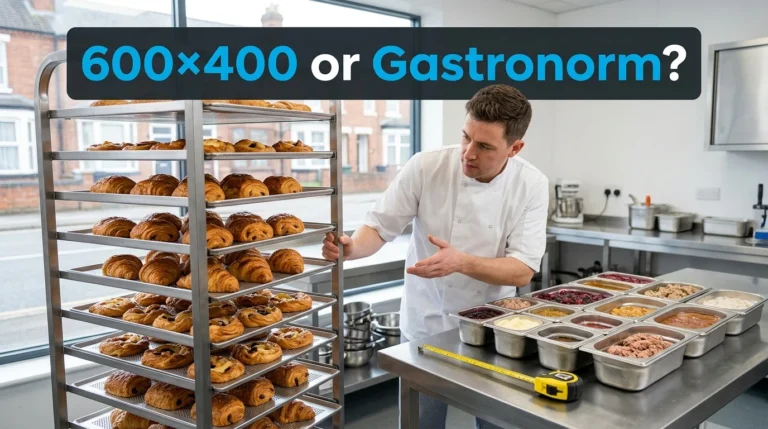
A 4× GN1/1 tray convection oven (like the Blue Seal E31D4) holds four GN1/1 containers (530× 325mm) stacked vertically. At 60mm pitch (standard), you fit 4 trays. At 75mm pitch (pastries that rise), you fit 4 but with more air space. Peak service rule:
4-Tray Convection
4× GN1/1, 95–100L- 30–60 covers/sitting
- £1,600–£3,500
- Single-phase available
- Cafés, small hotels
6-Tray Convection
6× GN1/1, 150L+- 50–90 covers/sitting
- £3,500–£5,500
- 3-phase required (9+ kW)
- Mid-size hotels, schools
10-Tray Convection
10× GN1/1, 200L+- 90–150+ covers/sitting
- £5,500–£8,000
- 3-phase, 16–22 A draw
- Full restaurants, catering
Mini Countertop
38–50L- 8–20 covers
- £600–£1,100
- 13A plug-in
- Pastry, reheats only
A common error: buyers order a 4-tray oven for a 120-cover restaurant. At peak service, all 4 trays are full, nothing can be finished cooking, and you’re waiting on food. The 4-tray is the floor for a 30–60-cover operation. If you’re north of 80 covers, step up or run two ovens.
Mini units (Roller Grill FC380 at 38L) are not restaurant ovens. They excel at:
- Reheating pre-cooked items (fries, chicken)
- Finishing pastries while fresh
- Café service (30 covers max, single sitter)
- Bench space is tight and 3-phase isn’t available
UK Power: Single-Phase, Three-Phase, and Upgrades
This is the biggest surprise for buyers moving from a static oven to a convection.
UK single-phase limit: A standard 32A circuit at 230V can deliver 7.36 kW maximum. The Blue Seal E31D4 at 3.1 kW fits with headroom. The Lincat ECO9 at 7.5 kW is over and needs either a 16A hardwired feed or 3-phase conversion.
| Model | Power Draw | Voltage / Phase | Installation |
|---|---|---|---|
| Roller Grill FC380 | 2.4 kW | 230V 1-ph 13A | Standard plug socket |
| Blue Seal E31D4 | 3.1 kW | 230V 1-ph 13A | Standard plug socket |
| Lincat ECO9 (4-grid) | 7.5 kW | 230V 1-ph 16A or 400V 3-ph | Hardwired 16A, or DNO upgrade for 3-phase |
| 3-Phase DNO Upgrade Cost | Typical £2,500–£7,000 for supply + £500–£2,000 internal rewiring. Allow 4–8 weeks for DNO. | ||
If your kitchen has no 3-phase and your landlord won’t fund an upgrade, the Blue Seal E31D4 at 3.1 kW solves the problem. It’s the only 4-tray unit in the UK market that runs on a standard socket. Price is £1,608 ex VAT — a premium of ~£200 vs a larger 7.5 kW unit, but worth it if you avoid a £3,000 three-phase upgrade.
How Convection Works: Temperature, Time, and Recipe Conversion
Convection circulates hot air. Static ovens radiate heat from elements. The fan speeds up cook time and distributes heat more evenly, allowing you to run at a lower temperature with the same or better result.
Standard rule of thumb:
- Reduce dial by 20°C from your static recipe
- Reduce time by 25%
- Check earlier — convection finishes faster than expected
Why 20°C? The fan spreads temperature evenly, so you need less thermal energy. A cake that needed 180°C for 40 min in static will finish in 30 min at 160°C in convection — often with better browning because the moisture stays in the cake longer.
Protein cookery is trickier. A roast that shrinks slowly in a static oven at high heat will shrink faster in convection because the surface dries quicker. If your roasting time was 20 min/kg at 200°C static, expect 15 min/kg at 180°C convection — but beef core temp at the probe is your real timer, not the clock. This is where a combi with remetering and programmable hold starts to earn its price.
Real Energy Costs: The Maths Nobody Shows You
Convection oven retailers quote kW as if it’s a spec, but what matters is how much you’ll actually spend to run it.
For comparison, an equivalent static oven pulling 5 kW would cost:
Annual saving: £768 per year on convection vs static. Over a 10-year lifespan, convection saves £7,680 in electricity alone — more than the oven cost. The payback is 18 months. After that, every day is profit.
A larger unit like the Lincat ECO9 at 7.5 kW costs:
Smaller is cheaper to run, but only if it handles your load. A 4-tray oven oversized for a café pays back. A 4-tray oven undersized for a 100-cover restaurant that then buys a second oven doesn’t.
Bakery & Pastry: The Natural Home for Convection
Convection ovens were invented for bakeries. They remain the gold standard because:
- Repeatability: fan circulates heat evenly, so batch 1 matches batch 50. Static ovens have hot spots near elements.
- Speed: 25% faster cook time means more batches before afternoon service.
- Color: even heat produces even browning — no pale tops, dark bases.
- Crust crispness: the air circulation dries the exterior slightly, crisping the crust without over-drying the crumb.
- Proofing control: running convection at lower temperature (160–180°C vs 200°C) gives you more time before the crumb sets, so proofing fermentation finishes before crust colour locks.
A small bakery typically runs a 4-tray convection oven 6–8 hours per day: morning proof and bake (2–3 hr), cooldown and replenish (1–2 hr), afternoon bake (2–3 hr). The Blue Seal E31D4 or similar 4-tray unit is the standard. Upgrade to a 6-tray only if you’re supplying restaurants or a supermarket in-store bakery.
A café running pastry reheats (croissants, Danish in the morning) plus quiche / savoury goods at lunch can run a mini Roller Grill FC380 (38L, £618) and never fill it past 70%. Low power draw, no 3-phase, low running cost, and the footprint fits beside an espresso bar.
Extraction, Venting & UK Compliance: CIBSE DW/172 and Beyond
Convection ovens produce less steam and odour than combination ovens or grills, but they still need proper extraction to meet building regs and environmental health.
CIBSE DW/172 requirement: A commercial kitchen needs a minimum of 30 air changes per hour of extract. For ovens, this is calculated as thermal convection method (m³/s per m² of cooking surface exposed to the kitchen).
In practice:
- Type II canopy (no hood): Required above any oven in a full commercial kitchen. Typical sizing: 1200mm wide× 800mm deep canopy above a 600mm oven, ducted to outside or a grease filter and then outside.
- Mini units (Roller Grill FC380): Often run under a wall-mounted extractor (250–400 m³/h extract) if the setup is low-volume (café with <30 covers). Not compliant for a full kitchen, but acceptable for light-use support cooking in a mixed use space (hotel lounge, staff canteen).
- Make-up air: Extract air must be replaced. Typical make-up is 75–95% of extract volume, via louvres or ductwork. In winter, this air is often heated to avoid kitchen chilling.
Convection ovens produce less humidity than combis, so extraction loads are lighter. A 4-tray convection in a proper Type II canopy will extract cleaner air and require less energy than a 6-grid combi under the same canopy.
Manual Analogue vs Digital Programmable Controls
This is not a price tier — both exist at every price point. It’s a workflow choice.
| Feature | Manual Analogue | Digital Programmable |
|---|---|---|
| Learning curve | None. Set dial, push start. | 2–3 days to train staff |
| Repeatability | Operator dependent (±5°C) | Locked recipe (±2°C) |
| Failure modes | Thermostat, element, fan | Plus: logic board, display, probe sensor |
| Service cost | £150–£300 for element/thermostat | £300–£800 (electronics + parts) |
| Batch repeatability (pastry, bread) | Good if staff trained | Excellent; recipes can be locked by manager |
| HACCP record-keeping | Manual logbook only | Automatic data logging (if equipped) |
| Price premium | Base price | +£300–£600 |
For a bakery: digital is worth the premium. Once a recipe is dialled in and saved, every batch of croissants bakes identically. Staff don’t guess; the oven remembers.
For a café or pub: manual analogue is simpler. One person sets the dial at 180°C, hits start, and checks the timer. Less to break, faster to repair.
Door Types: Drop-Down vs Side-Hinged
Most commercial ovens have a drop-down door that swings down like a hatch. Some high-end units have a side-hinged door that swings out to the side.
Drop-down door pros: The door becomes a tray rest when open — staff can rest baking trays on the lip while they load or unload. Standard in every kitchen.
Drop-down door cons: Takes floor space when open. If your oven is against a wall, the door can hit the wall and won’t open fully.
Side-hinged door pros: Doesn’t intrude into floor space; useful if the oven is tight against a wall or a fridge.
Side-hinged door cons: More expensive (£300–£500 upcharge). No tray rest; you need a separate landing table.
Most kitchens use drop-down. It’s standard, parts are cheaper, and the tray-rest functionality is hard to replicate. If you’re buying a Blue Seal E31D4, it’s drop-down. If you ever need to relocate the oven to a tighter space, drop-down can be limiting.
Craven Cooling Convection Ovens: Your Two Best Options
- 3.1 kW (13A plug)
- 4× GN1/1 (95L capacity)
- Thermostat 30–300°C
- 60 / 75mm tray pitch
- Drop-down door
4-tray standard unit. 3.1 kW, runs on 13A socket with no upgrade needed. Manual thermostat, simple to repair. Ideal for cafés, small hotels, bakeries, pubs. Handles 30–60 covers.
View on Craven- 2.4 kW (13A plug)
- 38L capacity (4 shelves)
- Temperature 30–300°C
- Depth 420mm
- No 3-phase needed
Compact countertop unit for cafés and pastry shops. Perfect for reheating, finishing pastries, small-batch baking. Fits on a bench. 8–20 covers max, zero infrastructure cost.
View on CravenAlternative Models & Price Tiers (Reference)
The market offers depth if you need more capacity or different specs:
| Model | Capacity | Power | Price (ex VAT) | Use Case |
|---|---|---|---|---|
| Roller Grill FC380 | 38L | 2.4 kW | £618 | Café pastry / reheats |
| Buffalo CW863 | 50L | ~2.5 kW | £649.99 | Mini oven, denser packing |
| Blue Seal E31D4 | 95L (4× GN1/1) | 3.1 kW | £1,608 | Standard café / bakery |
| Lincat ECO9 (4-grid) | 99L (4× GN1/1) | 7.5 kW | £3,068.70 | Larger bakery, 3-phase available |
| Lincat ECO9 (6-grid) | 150L+ (6× GN1/1) | 11 kW | est. £4,200 | Mid-size hotel / restaurant |
| Lincat ECO9 with steam injection | 4 or 6 grid | 7.5–11 kW | est. £3,500–£5,000 | Hybrid: dry + light steam for bread |
Note on steam injection: Lincat ECO9 units with water inlet allow manual steam injection (no auto-cycle, no PSSR). This gives bread crust control without a £8,000 combi. Typically £400–£800 upcharge — useful for bakery-café hybrid.
UK Compliance Checklist: Before You Buy
Convection ovens avoid the PSSR pressure vessel requirement, but they still have to meet building regs and food safety standards.
-
✓
Extraction capacity signed off?
Building control and environmental health must approve extraction before commissioning. Type II canopy is standard; mini units may use wall vents.
-
✓
Power supply confirmed?
Is your oven 13A plug-capable or hardwired 16A/3-phase? Get an electrician quote before ordering.
-
✓
Thermal calibration certificate?
Request from supplier — shows oven reaches stated temperature. Not legally required but proof for hygiene inspections.
-
✓
HACCP documentation?
Manual logbook (staff record core temps) or digital logging. Keep records 3 years minimum.
-
✓
Maintenance plan in place?
Annual element check, fan grease, door seal inspection. Budget £150–£300/year for service.
-
✓
Insurance inspection?
Some insurers require one-off inspection after install. Confirm with broker beforehand.
Convection Oven Price Tiers & Entry Costs
Add 20% VAT to all ex-VAT prices. Postage is typically included for units under 6-tray; larger units may have specialist delivery charges (£200–£600).
Head-to-Head: Convection vs Static vs Combi (Full Scorecard)
| Metric | Convection (E31D4) | Static Equivalent | Combi (Rational 6-grid) |
|---|---|---|---|
| Entry price (ex VAT) | £1,608 | £800–£1,200 | £5,058–£10,000 |
| Annual running cost (4 hr/day) | £1,254 | £2,022 | £3,100–£4,200 |
| 3-year cost (purchase + running) | £1,608 + £3,762 = £5,370 | £1,000 + £6,066 = £7,066 | £7,000 + £9,300 = £16,300 |
| Power (3-phase needed?) | 3.1 kW, NO | 4–5 kW, NO | 10.8 kW, YES |
| 3-phase upgrade cost | £0 | £0 | £2,500–£7,000 |
| Capacity (covers/sitting) | 30–60 | 30–60 | 80–150 |
| Cook speed (vs convection) | Baseline (100%) | 20–30% slower | Comparable (combi mode) |
| Even heat distribution | Excellent (fan) | Fair (hot spots) | Excellent |
| Bread crust crispness | Good (manual steam only) | Fair | Excellent |
| Protein cooking (roasts) | Good (watch shrinkage) | Good | Excellent (remetering) |
| PSSR pressure cert needed? | No | No | Yes |
| Water plumbing? | No | No | Yes (inlet + drain) |
| Maintenance complexity | Low (thermostat, element) | Low | High (steam valve, pump, probe) |
| Best for… | Bakeries, cafés, pubs, pastry, pizza | Budget kitchens only | Full-service restaurants, catering, hospitals |
Bottom line: If you’re running a menu that doesn’t need steam, convection is the sweet spot. It’s faster and cheaper than static, simpler and more affordable than combi. If you need steam badly (bread, artisan roasts), a combi or steam-injection convection is the upgrade.
Commercial convection ovens are the unsung backbone of small kitchens — bakeries, cafés, pubs, schools. A 4-tray convection is 25% faster than static, uses 25% less energy, and avoids the pressure certification and 3-phase upgrade cost of a combi. The Blue Seal E31D4 at £1,608 runs on a 13A socket and handles 30–60 covers per sitting. The Roller Grill FC380 mini unit at £618 is perfect for pastry and reheats in tight spaces. Total cost of ownership over 10 years (purchase + running cost + maintenance) is £8,500–£12,000. For any kitchen that doesn't need steam, convection wins on simplicity, energy, and long-term cost.
Frequently Asked Questions
Yes, if your menu doesn't need steam. Convection is dry air only. If you bake bread, steam veg, or hold roasts, you'll miss steam. If you just need speed and even heat, convection is enough.
A 4-tray holds four GN1/1 (capacity ~100L). A 6-tray holds six (~150L). The 6-tray costs ~30% more, may need 3-phase, and handles 50–90 covers vs 30–60 on 4-tray. Choose 4-tray if under 60 covers; 6-tray if 60–90.
The fan circulates hot air faster and more evenly. Standard adjustment: reduce temperature 20°C and time 25%. So 200°C for 40 min static becomes 180°C for 30 min convection. Check earlier than expected and record the new timing.
Yes, if under 3 kW. The E31D4 (3.1 kW) runs on 13A. The FC380 (2.4 kW) is safe on 13A. A Lincat ECO9 at 7.5 kW needs 16A hardwired or 3-phase. Always check kW before buying.
Yes, for full commercial kitchens. CIBSE DW/172 requires 30 air changes/hour. A Type II canopy must be ducted outside. Mini units can use wall vents in low-volume settings; check with building control first.
The E31D4 (3.1 kW) at 8 hr/day 6 days/week costs approximately £1,254/year. A Lincat ECO9 (7.5 kW) costs ~£3,034/year. Over 10 years, convection saves ~£7,680 vs an equivalent static oven.
No. A mini unit (38L) is for pastry and reheats. A 60-cover restaurant needs at least a 4-tray convection. Mini units suit cafés (under 30 covers), hotel lounges, or pastry-only bakeries.
Steam-injection convection (e.g., Lincat ECO9 with water inlet) lets you manually spray steam with no PSSR requirement. A full combi has automatic steam — costlier and more complex. Steam-injection is the middle ground for bread crust without full combi cost.
10–15 years with proper maintenance (annual element checks, fan bearing grease, door seal). Heating elements typically last 8 years of heavy daily use. Most ovens retire during kitchen refits, not failure.
Complete Convection Oven Models Comparison (2026)
| Model | Manufacturer | Capacity | Power | Price (ex VAT) | Best For |
|---|---|---|---|---|---|
| Roller Grill FC380 | Roller Grill | 38L (4-shelf) | 2.4 kW / 13A | £618 | Café pastry, reheats, tight space |
| Buffalo CW863 | Buffalo | 50L (2/3 GN) | ~2.5 kW / 13A | £649.99 | Mini oven, small café |
| Blue Seal E31D4 Turbofan | Blue Seal | 95L (4× GN1/1) | 3.1 kW / 13A | £1,608 | Bakery, café, pub, standard 4-tray |
| Lincat ECO9 (4-grid) | Lincat | 99L (4× GN1/1) | 7.5 kW / 16A or 3-ph | £3,068.70 | Larger bakery, digital control |
| Lincat ECO9 (6-grid) | Lincat | 150L+ (6× GN1/1) | 11 kW / 3-phase | ~£4,200–£5,000 | Mid-size hotel, restaurant prep |
| Lincat ECO9 + Steam Injection (4-grid) | Lincat | 99L (4× GN1/1) | 7.5 kW / 16A or 3-ph | ~£3,500–£3,900 | Bread bakery, artisan finishing |
| Blue Seal E33D5 (6-grid) | Blue Seal | 130L (6× GN1/1) | ~9 kW / 3-phase | ~£4,500–£5,500 | Professional bakery, larger capacity |
Prices ex VAT are subject to change. Contact Craven Cooling for current stock, availability, and bespoke quotes. Equipment leasing available from Kennet Finance from £1,000 + VAT per quarter.
Get a Quote or Arrange a Viewing
Craven Cooling has 30+ years' experience supplying kitchens across the UK. Our team can help you size the right oven, arrange installation, confirm extraction requirements with your local building control, and handle leasing or finance options.
Call or email:
- Phone: 01792 732702
- Email: sales@cravencooling.co.uk
- Web: cravencooling.co.uk (relaunching as cravencooling.co.uk)
Our sales team will send you a detailed spec sheet, arrange site measurements if needed, and confirm any compliance questions with your building control officer. Lead times: Craven stock units (E31D4, FC380) ship 3–5 days; specialist orders 2–4 weeks.
This buying guide reflects current UK commercial cooking equipment specs, regulations (CIBSE DW/172, HACCP 852/2004, PSSR 2000), and energy assumptions (27p/kWh non-domestic, April 2026) as of publication. Prices, availability, and product specs are subject to change. Always confirm with suppliers and building control before final purchase. For permission queries or technical clarifications, contact sales@cravencooling.co.uk.